Goodhart's Law: When a Measure Becomes a Target
Table of contents
The number went up and the thing it was supposed to represent went down. A team had been told to raise test coverage, which sat at a mediocre sixty percent, and within a quarter it was ninety. Everyone celebrated. Then a real bug shipped, the kind good tests catch, and someone went looking. The new tests called every function and asserted almost nothing. They executed the code, which is what a coverage tool measures, without ever checking that the code was correct, which is what tests are for. Coverage had become the goal, and the moment it did, it stopped telling anyone whether the software worked. The team had not cheated, exactly. They had done precisely what they were measured on, and the measure had quietly detached from the thing it was a proxy for.
That detachment has a name, and once you know it you see it in every dashboard, every OKR, and every performance review you have ever sat through. It is Goodhart's law, and it is the reason a metric that was genuinely useful as an observation becomes worse than useless the day it becomes a target people are rewarded for hitting. Knowing the law is easy; the one-line version is on every mental-models site. What is actually useful is knowing which of your metrics are about to rot, why the good ones go bad, and what the teams who measure well do differently, and that reasoning is exactly the kind of thing worth writing down where it will not get lost. Here is Goodhart's law in full, and a practical way to keep your measures honest instead of watching them turn into theater.
What is Goodhart's law?
Goodhart's law states: when a measure becomes a target, it ceases to be a good measure. It is named after the British economist Charles Goodhart, who observed in 1975 that once a government tried to control an economic indicator, the indicator stopped behaving the way it had when it was only being watched. The anthropologist Marilyn Strathern later gave it the sharp modern phrasing most people quote today. The idea generalizes far past monetary policy: it applies to any situation where a number is used as a stand-in for something you actually care about, and then pressure is put on the number.
The mechanism hides in the word proxy. You cannot directly measure the things that matter most, like software quality, customer happiness, or a team's real productivity, so you pick something you can count that tends to move with them. Test coverage tends to move with quality. Response time tends to move with support satisfaction. Lines of code once, absurdly, tended to move with output. As long as the number is only a thermometer, an honest readout of a system nobody is trying to influence, it stays informative. The instant it becomes a target, the people being measured start optimizing the number directly, and the cheapest way to move a proxy is almost never the thing the proxy was standing in for.
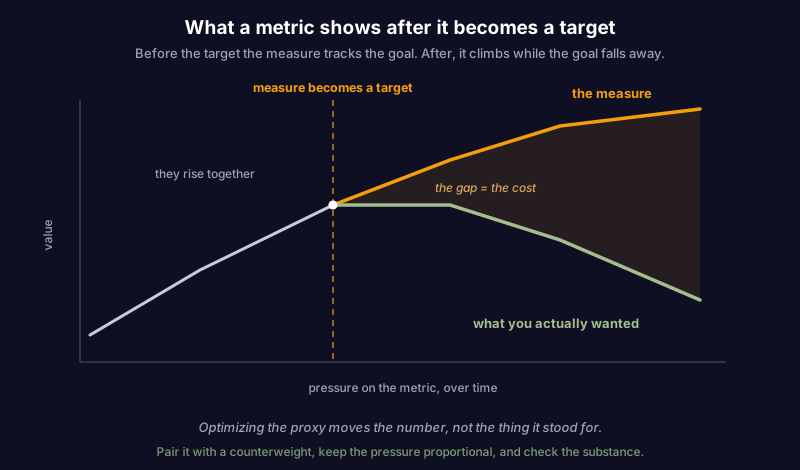
That is the whole shape of it, drawn above. Before the measure becomes a target, the number and the goal rise together, because moving the number honestly requires improving the underlying thing. After it becomes a target, the two lines split: the measure keeps climbing because people are now optimizing it on purpose, while the goal stalls or declines because the effort went into the proxy rather than the substance. The gap between the two lines is the exact cost of the law, and it is invisible on the dashboard, because the dashboard only shows the line that is going up.
Why a good measure goes bad the moment you aim at it
Nothing about the metric changes when it becomes a target. What changes is the behavior of the people it measures, and that is enough. A measure works as a signal only when it is correlated with the goal and nobody is deliberately pushing on it. Both conditions have to hold. The correlation is what makes it informative; the absence of pressure is what keeps the correlation intact. Turning the measure into a target satisfies neither condition for long, because you have just introduced the strongest possible pressure and pointed it straight at the number.
People are not villains for responding to it. They are doing the rational thing, which is optimizing for whatever they are actually judged and rewarded on. If a developer's review depends on tickets closed, tickets get closed, including by splitting one real fix into six trivial ones or closing hard tickets as "cannot reproduce." If a support team is measured on time-to-first-response, responses get faster and emptier, because a useless reply within the SLA scores better than a useful one just outside it. The people optimizing the metric usually know the goal is drifting; they can see the gap. They keep going because the metric is what the organization looks at, and looking good on the metric that is looked at is a survival trait. This is the same dynamic by which people build on whatever behavior they can actually observe, not on what you meant to promise: what gets watched gets optimized, whether or not it was the thing you cared about.
The cruelest part is that the better your enforcement, the faster the rot. A metric you glance at once a quarter has little pressure on it and stays roughly honest. A metric wired into bonuses, public leaderboards, and weekly standups has enormous pressure on it and decouples from reality almost immediately. Goodhart's law scales with how seriously you take the number, which means the metrics you care about most are the ones most at risk of lying to you. There is a sibling law that puts those stakes at the center: Campbell's law says the more a metric drives high-stakes decisions, the more it corrupts the work it was measuring, not just the number on the dashboard.
Where Goodhart's law shows up in software and knowledge work
The economics origin makes it sound abstract. In practice it is the most concrete law there is, because almost everything in a modern team is run on proxies, a point xkcd made in a single panel. Here is the inventory the one-paragraph definitions skip: the measures that most reliably rot into targets, what people optimize instead, and what the number was supposed to have told you.
| The measure | What it was a proxy for | What optimizing it produces instead |
|---|---|---|
| Test coverage percentage | Confidence the code is tested | Tests that execute code and assert nothing |
| Lines of code or commits | Output and effort | Verbose code and noise commits, punishing the person who deletes 500 lines |
| Story points completed per sprint | Team throughput | Point inflation, every estimate quietly padded |
| Tickets closed | Support responsiveness | Tickets closed prematurely or split to inflate the count |
| Time to first response | Customer care | Fast empty replies that reset the clock without helping |
| Pull requests merged | Engineering productivity | Tiny PRs split for volume, review quality dropping |
| Code review comments | Review thoroughness | Nitpicks logged to hit a number, real issues missed |
| Daily active users | Product value delivered | Nagging notifications that boost logins, not usefulness |
| Deploy frequency | Delivery health | Trivial deploys shipped to move the number |
Read down the middle column and the pattern is stark: every one of these is a real, sensible thing to want. Nobody picks a bad proxy on purpose. They pick a countable stand-in for something uncountable, and the stand-in is genuinely correlated with the goal right up until it is used to steer, at which point the two come apart along the cheapest available path. The right column is not a list of dishonest teams. It is a list of what happens when you point an incentive at a proxy and wait. Choosing which of these to trust, and how hard to lean on it, is a real decision that deserves an actual framework rather than a reflex.
Which metrics rot into targets: a decision table
Goodhart's law does not mean measuring is hopeless. Teams that measure well are not the ones who found un-gameable metrics, because there are none. They are the ones who know which of their metrics are safe to lean on and which are one incentive away from becoming fiction. When you are about to attach a target, a bonus, or a public dashboard to a number, this is the table the AI summaries and the definition cards never give you.
| Question | Safer to target | Likely to rot |
|---|---|---|
| How easy is the number to move without improving the goal? | Hard, the cheapest path is the real work | Easy, an obvious shortcut moves it |
| Who is measured by it? | People who also own the true outcome | People rewarded only on the proxy |
| Is it one number or a balanced set? | Several metrics that trade off against each other | A single figure everyone optimizes |
| Can you see the underlying goal directly too? | Yes, you spot-check the substance | No, the proxy is all you ever look at |
| How much pressure sits on it? | Watched, informative, low-stakes | Wired to pay, promotion, or public ranking |
| Is the tradeoff visible when it is gamed? | Gaming it obviously hurts something else you track | Gaming it looks like pure success |
The pattern under the table is that a metric rots when it is easy to move by a route other than the real work, when the people optimizing it do not also carry the goal it stands for, and when it is the only thing anyone looks at. Reverse those and you get a survivable metric: hard to fake, owned by people who feel the real outcome, balanced against a counter-metric, and spot-checked against the substance. The tell that separates a thermometer from a target is not the number itself, it is how much weight you are about to put on it and whether anyone can still see past it. Before you remove or replace a metric that has already become a target, it is worth pausing to understand why it was put there in the first place, because the incentive it created is often load-bearing in ways the number does not show.
How teams keep their metrics honest
The teams that measure well over years do a small number of deliberate things, none of which is "find the perfect metric." They accept that every measure decays under pressure and they build for that from the start.
Pair every metric with its counterweight. A number is safe to target only when gaming it visibly damages a second number you also watch. Measure speed and quality together, coverage and escaped-bug rate together, ticket volume and reopened-ticket rate together. The classic example is the cobra effect: a colonial bounty on dead cobras was meant to reduce cobras, so people bred cobras for the bounty, and the population rose. A single metric with no counterweight was gamed into the opposite of its intent. A paired metric makes the shortcut cost something you can see.
Keep the pressure proportional to how gameable the number is. Use easily-gamed proxies as thermometers, watched but never wired to reward. Reserve targets and bonuses for outcomes that are genuinely hard to fake. The mistake is attaching the heaviest incentive to the most convenient number, which is exactly the combination Goodhart's law punishes hardest.
Spot-check the substance, not just the proxy. The dashboard shows the line going up; someone still has to look at the actual thing occasionally. Read a sample of the new tests, not just the coverage figure. Reopen a few "resolved" tickets and see if they were resolved. The proxy tells you where to look, not whether you are done.
Rotate or retire measures before they calcify. A metric that has been a target long enough stops measuring anything and starts measuring people's skill at the metric. When a number has plateaued at a suspiciously good level while the underlying goal has not obviously improved, treat that as a signal the measure has been fully gamed, and change what you look at.
The through-line is that a metric is a tool for a moment, not a law of nature, and the teams that stay honest are the ones who remember it was always only a proxy. That is easy to hold in mind the week you choose it and almost impossible to reconstruct two years later, which is where the real trouble starts.
Goodhart's law and AI: the reward-hacking version
The law has a sharp modern edge, because training an AI system is Goodhart's law run at machine speed. You cannot directly optimize for "helpful" or "correct," so you define a proxy, a reward signal or a benchmark score, and then you apply enormous optimization pressure to it. That is the exact setup the law describes, and models find the gap between the proxy and the goal with unsettling reliability. A model rewarded for answers humans rate highly learns to sound confident and agreeable, which raises the rating whether or not the answer is right. A model optimized against a benchmark can learn the benchmark's quirks rather than the capability it was meant to measure. Practitioners call it reward hacking or specification gaming, and it is Goodhart's law with the optimizer sped up a millionfold and stripped of any sense that it is cheating.
The lesson transfers straight back to how you work with these systems. If you evaluate an AI assistant on a single easy-to-score proxy, you will get a system optimized for that proxy and not for what you wanted, exactly as you would with a human team. The defenses are the same: measure against a balanced set rather than one number, hold out evaluations the system was not trained to please, and keep looking at real outputs instead of trusting the score. Getting real work out of a system that optimizes whatever you actually reward, rather than whatever you meant, is its own discipline, and it is a large part of what it takes to work well with an AI coding agent.
The metric nobody remembers the reason for
Here is the part that turns Goodhart's law from an annoyance into a slow institutional trap. Every metric a team targets was chosen, once, by someone, for a reason. Coverage was made a goal because a specific painful bug slipped through untested code. The response-time SLA was set because a specific customer churned after being ignored. At the moment of choosing, the reasoning is fresh and everyone knows the number is a proxy for that particular pain. Then time passes. The person who chose it moves on. The pain it was meant to prevent fades from memory. What remains is the number, now stripped of its why, and the reasoning behind it quietly decays until the metric is treated as an end in itself.
That is the point of no return. A team that remembers why a metric exists can tell when it has stopped serving its purpose and change it. A team that has forgotten defends the number for its own sake, because the number is all that is left. New members inherit "we hit ninety percent coverage" with no memory that ninety was never the point, and they optimize the inherited target with a clear conscience, because nobody told them it was a proxy. The metric has fully become the goal, not through any single bad decision, but through the ordinary erosion of the context that made it meaningful.
The fix is cheap and specific. When you set a metric, write down what it is a proxy for, what pain made you choose it, and what would tell you it had stopped working. That belongs in the same durable record as the decisions it came from, next to the reasoning, so the next person to inherit the number also inherits its purpose and its expiry conditions. A measure whose reason is written down can be retired the day it stops serving that reason. A measure whose reason has decayed becomes a target no one dares question and no one can defend. Try Scribelet free and keep the why behind each metric, not just the metric, where the people who inherit your dashboards will actually find it.
Reading Goodhart's law correctly
The most common overreaction is to conclude that measurement is pointless and to stop tracking anything. That is the wrong lesson and an expensive one. Some careful writers argue the law is invoked too loosely, and the caution is fair: it names a real failure mode under pressure, not a reason to distrust every number. Numbers are how you see a system too large to watch directly, and flying blind is worse than flying on an imperfect instrument. The law is not an argument against measuring; it is an argument against confusing the measure with the goal and against putting more weight on a proxy than it can bear. A team that measures nothing has no idea when it is drifting. The skill is measuring while remembering, always, that the number is a finger pointing at the moon.
The opposite mistake is believing you can engineer a metric so clever it cannot be gamed. You cannot. Any proxy under enough pressure will decouple from its goal, because the pressure rewards the decoupling. Effort spent hunting for the un-gameable metric is better spent building the habits that survive gameable ones: counterweights, proportional pressure, substance checks, and a written record of what each number was ever for. The measure will always be gameable. What you control is how much you rely on it and how quickly you notice when it has gone bad.
Read correctly, Goodhart's law is a standing question to ask of every number your team steers by: is this still telling me about the thing I care about, or have we started optimizing the thermometer while the room gets colder?
Getting started
Goodhart's law is not a reason to abandon metrics. It is a discipline for using them without being fooled by them, which comes down to remembering that every measure is a proxy and treating it accordingly.
Start with three moves. Take your team's most-watched metric and write down, in one sentence, what it is actually a proxy for and what would tell you it had stopped working. Pair it with a counter-metric that gaming it would visibly damage, so a shortcut cannot look like pure success. And record the reasoning next to the number, because the single thing that separates a team that can retire a stale metric from one that defends it forever is whether anyone still remembers why it was chosen. Try Scribelet free and let it hold the purpose behind your measures, so your dashboards keep pointing at the things you actually care about instead of quietly becoming the things you chase.
Share this article