Knowledge decay: why your notes are silently going stale
Table of contents
You probably have a note somewhere about that API you integrated last year. Maybe it covers the authentication flow, rate limits, the endpoints you used. You wrote it carefully. It was accurate at the time.
But APIs change. Rate limits get updated. Auth flows get deprecated. That note has been quietly becoming a liability instead of an asset, and you'd never know until you tried to use it and hit a wall.
This is knowledge decay. It's the gradual loss of accuracy in your stored information as the world around it changes. And it's happening to your notes right now.
Most note-taking tools treat this as a you problem. You should review your notes more often. You should be more organized. You should tag things better. But the problem isn't your habits. It's that information has a half-life, and your tools don't account for it.
This article explains what knowledge decay is, why it affects personal notes more than most people realize, and what you can do about it. Including letting AI handle the maintenance for you.
What is knowledge decay?
Knowledge decay is the gradual loss of accuracy in stored information as the world around it changes. A fact that was true when you wrote it down becomes partially true, misleading, or outright wrong as its underlying source updates. The same happens to decisions: a choice made with a sound decision-making framework still rests on assumptions that quietly expire, and the record of it reads exactly as confident as the day you wrote it. The second- and third-order effects you predicted when you decided are the same kind of expiring assumption: a bet on how the world would react, quietly going stale until someone checks it against what actually happened. The reasoning behind a metric decays the same way, and once nobody remembers why a high-stakes number was chosen it hardens into a target no one can defend.
The term comes from organizational knowledge management, where companies lose institutional knowledge through employee turnover, outdated processes, and unmaintained documentation. But knowledge decay isn't just an enterprise problem. It affects personal knowledge management just as deeply. It's a physics-of-information problem that touches every note you've ever written.
Samuel Arbesman, a complexity scientist, explored this concept in his book "The Half-Life of Facts." As Farnam Street's overview of his research explains, knowledge across every domain has a measurable rate of decay. Medical knowledge has a half-life of roughly 45 years and shrinking. The half-life of an engineering best practice is shorter. The half-life of an API reference? Months.
The half-life of different types of information
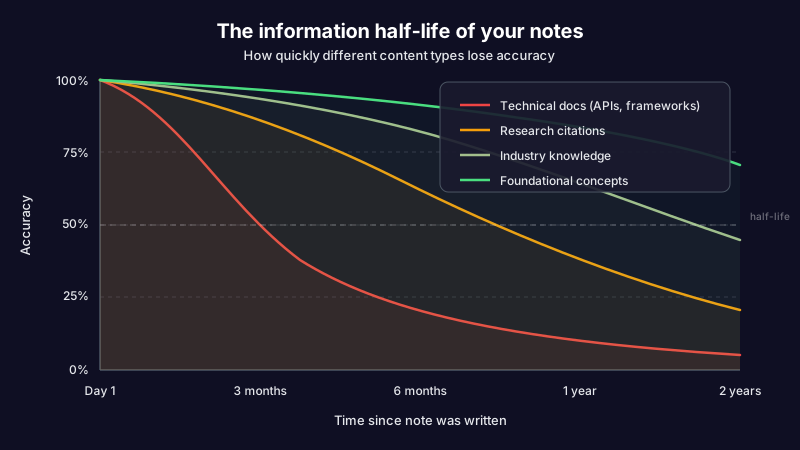
Not all notes decay at the same rate. The type of information determines how quickly it goes stale.
Technical documentation decays fastest. Framework APIs change quarterly. Libraries ship breaking changes. A React guide written in early 2025 might reference patterns that were deprecated by early 2026. Express.js v4 middleware patterns are anti-patterns in v5. The Python package you documented might have been forked, renamed, or abandoned.
Research citations decay at a medium rate. Papers get retracted, updated, or superseded. According to Retraction Watch, the rate of paper retractions has grown roughly tenfold since 2000. That literature review you built is accumulating risk with every month it sits untouched.
Industry knowledge shifts more slowly but still shifts. Market size figures go stale. Competitive landscapes change. Regulatory requirements update. The client research brief you wrote six months ago probably contains at least one number that no longer holds.
Even foundational concepts aren't immune, though they decay slowest. Paradigms shift. Design patterns fall out of favor. The "right" way to structure a React application in 2024 isn't the same as in 2026.
The more specific and external-facing your notes are, the faster they decay.
The same clock runs on the configuration files nobody thinks of as writing. A system prompt is a document a machine reads on every request, tuned to a model that gets replaced twice a year, which is why a system prompt is an artifact, not a setting. The same clock runs on the examples you paste into a prompt to steer it: they freeze a format the world keeps moving away from, and the output stays fluent while it drifts. It even runs on the prompt a model writes for you when you ask it to: a generated prompt captures the day you asked and keeps steering there long after. And it runs on a chain of prompts you save and reuse, which bakes in the task, the format, and the model it was tuned for, then keeps running after any of them changes.
What knowledge decay looks like in your notes
Knowledge decay is invisible until it isn't. You don't get a notification when an API you documented ships a breaking change. Nobody emails you when a paper you cited gets retracted. Nobody flags the estimate whose assumptions quietly stopped being true. The note just sits there, looking authoritative, waiting to mislead.
Here's what it looks like in practice.
Say you're a developer who's written technical guides, architecture decision records, integration notes. Six months pass. The framework ships a major version. Three of the APIs you documented now have different signatures. The auth library you recommended switched to a new token format. Your onboarding doc for new engineers is now teaching patterns your codebase has moved away from. Someone follows your guide, hits errors they don't understand, and spends two hours debugging before realizing the guide is wrong. That is Brandolini's law running inside your own notes: the wrong line was cheap to write and expensive to catch. The same rot reaches the reasoning inside the code itself: good names tell you what a function does, never why it does it that way, and the why is the first thing to go.
Research notes rot differently. You build a literature review across dozens of notes, citing a study that supports a key finding, and the paper you cited can change under you after you file it. A year later, that study gets retracted due to methodological concerns. Your literature review still cites it. Your analysis still builds on it. You don't find out until a peer reviewer flags it, and by then you've built three months of work on a foundation that cracked.
Consultants and knowledge workers face a subtler version. You assemble research for a client engagement: market sizing, competitive analysis, regulatory landscape. The engagement wraps. Three months later, a similar engagement starts. You pull up the old research because it was thorough. But the market has shifted, a competitor pivoted, and a regulation changed. You present the old data with minor updates, confident it's mostly right. "Mostly right" is a dangerous baseline when your credibility is on the line.
Every one of these is an ordinary consequence of stale notes, of information with a shelf life stored in tools that don't track expiration.
Encryption changes none of this. A note sealed behind zero-knowledge encryption goes stale on exactly the same schedule as a plaintext one, because security protects the bytes, not the accuracy. A locked note you can no longer trust is still a liability, just a private one.
Decay compounds quietly enough that most people only meet it in bulk, years later, when they export everything to move to another app and finally see the whole pile at once. That is its own kind of reckoning, and it is why migrating off Evernote after a decade tends to be less about the destination app than about how much of the archive was still true. Most of that pile is the ninety percent Sturgeon's law predicts; the trouble is that the ten percent worth keeping is buried in it, and decay is steadily thinning even that.
Why your note-taking app doesn't help
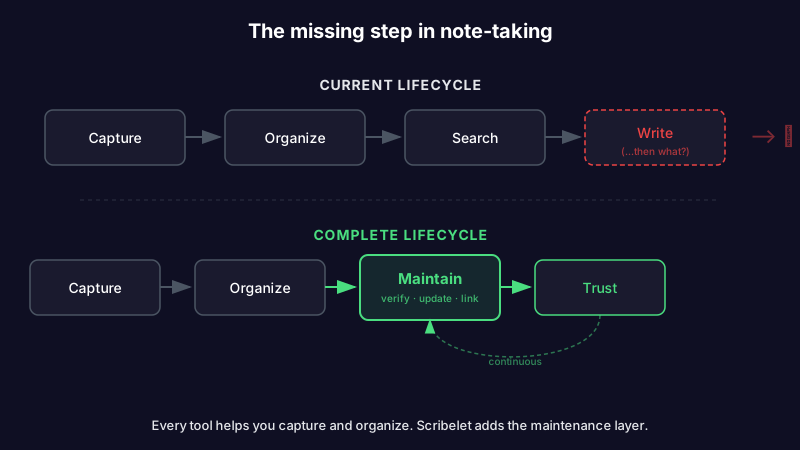
Every major note-taking tool is built around the same lifecycle: capture, organize, search, retrieve. They help you create notes. They help you find notes. They do nothing to address knowledge decay or tell you whether the notes you find are still accurate.
Look at the tools:
Notion is excellent at databases, project management, and team wikis. Its AI helps you write and summarize. But once you write a note, Notion treats it as finished. If the information in that note becomes outdated, Notion doesn't know and doesn't care.
Obsidian gives you complete control over your files. Local-first, plugin-rich, deeply configurable. But the maintenance burden falls entirely on you. Obsidian's philosophy is "file over app," which is admirable for data ownership. It's less helpful when you need to know which of your 500 notes contains a deprecated API reference. Nor does bolting AI on top close the gap: all four ways to add AI to a vault read your notes on demand, and not one of them revisits a note you are not currently looking at.
Apple Notes captures thoughts with zero friction. It's on every Apple device, syncs seamlessly, and stays out of your way. But it's also the tool equivalent of a filing cabinet. It stores what you put in and never looks at it again.
Even AI-native tools like Mem and Reflect focus their intelligence on search, organization, and writing assistance. The AI helps you find related notes and generate new content. It doesn't check whether the notes it found are still true. So a surfaced note gets the same trust as a fresh one, and trusting a source you already caught being wrong is exactly how a stale note keeps its authority.
Source-grounded research tools like Google's NotebookLM ground every answer in material you upload, which genuinely helps when you're working through a dense reading pile. But the notebook is built around those sources, so a summary generated in March is still a March summary in November. The distinction is source library vs living notes, and it decides whether the tool is still useful after the first read.
Digital gardens are the honorable exception, because they promise upkeep out loud: notes that get revised and deepened as your understanding grows. The tooling underneath still only publishes them, so the promise depends entirely on you remembering to return. That's why digital gardens stall at seedling.
LLM wikis, the newest arrival, automate the synthesis itself: you curate the sources and a model compiles them into an interlinked markdown wiki. It's a genuine improvement on re-reading a folder of PDFs forever. It also inherits this exact problem, because a compiled wiki freezes on the day you build it and nothing in the pattern watches the sources for changes afterward.
The note-taking industry has a blind spot. Every tool in the market helps you move from blank page to organized knowledge base. None of them help you move from organized knowledge base to trustworthy knowledge base.
The lifecycle should be: capture, organize, maintain, trust. That third step is where every current tool stops and where the real problem begins.
If you're interested in a tool that fills this gap, Scribelet is built around the idea that your notes should stay accurate after you write them, not just well-organized.
How to fight knowledge decay
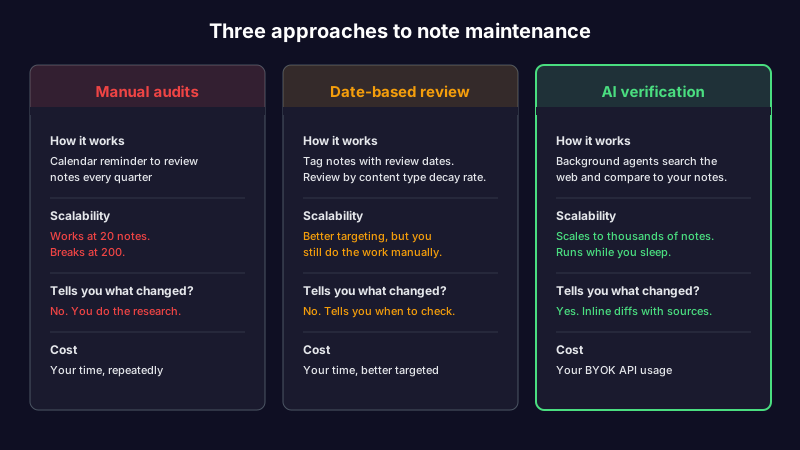
There's no way to stop information from changing. But if you've wondered how to keep notes up to date without manually auditing everything, there are three approaches, each with different tradeoffs.
Manual audits: thorough but unscalable
Set a calendar reminder. Once a quarter, open your most important notes and check them against current sources. Verify the APIs still work the way you described. Check that the citations haven't been updated. Confirm the market data is still current.
This works if you have 20 notes. It breaks down at 200. And at 2,000, it's not a maintenance strategy. It's a fantasy.
The manual approach also requires you to know what changed. If you're reviewing a technical note, you need to know that the framework shipped a new version. If you're reviewing a research note, you need to know that a citation was retracted. You're doing the verification work that should be automated.
Date-based review: better targeting, still passive
A more structured version: tag every note with a review date. Use a system (a tag, a property, a reminder) to surface notes that are due for review based on how quickly their content type decays. Technical notes every three months. Research notes every six. General knowledge annually.
This improves targeting. You're reviewing notes when they're most likely to have decayed, not on an arbitrary schedule. But you're still doing the work manually. And the system tells you when to check, not what changed.
If you want the version of this that runs on a schedule rather than on your willpower, we set out a maintenance layer you can actually run, split by what a machine should handle and what still needs your judgement.
AI-powered verification: the maintenance layer
The third approach is to let an AI agent do the checking.
Background agents search the web on a schedule you configure. They compare what they find against what you wrote. When something doesn't match, they surface the discrepancy as an inline diff: green highlights for new information, red for what's outdated. Each change includes a source link so you can verify the finding yourself.
You review, accept or dismiss, and move on. The note stays current. You didn't have to remember to check it, know what changed, or do the research yourself.
This is what Scribelet's background verification does. You set the schedule per note (or let the system prioritize based on content age and type). Agents run in the background. When they find something, you see a clear, traceable diff. Not a vague "this might be outdated" warning, but a specific "this API endpoint was deprecated in v5.2; here's the replacement, here's the migration guide."
The key difference from the first two approaches: note maintenance is no longer your job. The tool handles it.
The same decay reaches anything an AI has stored about you, which is why it is worth knowing what belongs in an AI's memory and what expires before you let one accumulate facts unchecked. It also shows up live inside a single long session, where a model's answers get worse as its working context fills with clutter.
And because Scribelet is privacy-first, the default AI runs in a fully isolated environment where your data is never used for training. If you want even more control, BYOK (Bring Your Own Key) lets you route through OpenAI, Anthropic, or Google directly. Your API key, encrypted at rest. Your provider, your choice.
Ready to stop maintaining your notes manually? Try Scribelet and see how AI-powered note maintenance works.
A new category: notes that maintain themselves
The note-taking conversation has been stuck for years. Every product announcement is about the same things: better organization, prettier editors, smarter search, AI writing assistance. These matter. But they all address the same phase of the lifecycle: getting information in.
Nobody talks about knowledge decay or what happens after. The closest the conversation gets is the recurring idea of self-maintaining knowledge bases, which splits into two very different bets depending on whether the AI curates external sources or maintains what you already wrote.
The industry lifecycle looks like this:
Capture → Organize → Search → Write
What's missing:
Capture → Organize → Maintain → Trust
That "maintain" step is where knowledge decay either gets caught or doesn't. It's where a note stays an asset or becomes a liability. It's the difference between a knowledge base you can rely on and one you have to second-guess.
We built Scribelet around this missing step. Not because organization and search don't matter (they do, and Scribelet handles both). But because we kept finding outdated information in our own engineering docs and realized no tool we used cared about that problem.
Background verification is one piece of this maintenance layer. But the concept is broader:
- Daily digests surface themes, action items, and connections across your recent notes, so patterns don't slip through the cracks
- Auto-linker discovers semantic relationships between notes you didn't explicitly connect, building your knowledge graph without manual effort
- Stale checker flags stale notes you haven't touched in 60 or more days that relate to topics you're actively working on
All of this comes from designing a note-taking tool around the premise that notes need ongoing care, not just a good filing system.
Your notes deserve maintenance, not just organization
Knowledge decay is real, measurable, and already happening in your notes. The API guide you wrote last quarter has probably drifted from reality. The research you compiled for a project is accumulating risk every month it goes unreviewed. The technical documentation your team relies on is one framework update away from being actively misleading, which is the maintenance layer a team wiki is missing.
That's not a failure of discipline. It's a property of information. Facts change. Sources update. Best practices evolve. The only question is whether your tools help you keep up or leave you to figure it out alone.
Information has a half-life, and right now every note-taking app ignores that. They help you create and organize. None of them help you maintain and verify. But maintenance can be automated: AI-powered verification catches what manual audits miss, at a fraction of the effort.
Your notes aren't failing because you're disorganized. They're failing because your tools don't account for the half-life of what you wrote.
Start writing with background verification. Try Scribelet free.
Share this article