Personal Knowledge Management Is Missing a Step
Table of contents
You did everything the guides told you. You set up a personal knowledge management system. You picked a method, you captured diligently, you linked your notes and tagged them and gave them a home. For a while it felt like building a second mind. Most people build it only for work, though the rest of your life needs the same system just as badly.
Then you went to use it. You opened the note you were sure you had, the one about the deployment process or the tax rule or the API you integrated last year, and you read it, and you hesitated. Was this still true? You couldn't tell. The note looked exactly as confident as the day you wrote it. That confidence was the problem.
This is the failure mode nobody in the personal knowledge management conversation talks about. Every system teaches you to capture, organize, and retrieve. Not one of them keeps what you captured accurate. So this post is about the missing step, where each of the popular systems stops, and what a knowledge system would have to do to actually earn your trust.
What is personal knowledge management?
Personal knowledge management (PKM) is the practice of capturing, organizing, and retrieving the information you encounter so you can use it later. It covers your notes, references, ideas, and the connections between them. The goal is to turn scattered input into a body of knowledge you can actually think with.
The term goes back to work by Jason Frand and Carol Hixon at UCLA around the turn of the millennium, and the Wikipedia entry on personal knowledge management still frames it the way most guides do: a process to gather, classify, store, search, retrieve, and share knowledge. Read a dozen modern PKM articles and you'll see the same pipeline under different names.
- Capture: get the idea, quote, or fact out of your head or off the web and into your system.
- Organize: file it, link it, tag it, so it can be found again.
- Distill: pull out what matters, summarize, connect it to what you already know.
- Retrieve: find it when you need it, ideally by meaning and not just keyword.
That pipeline is genuinely good. It is also where every system stops. Notice what it quietly assumes: that a note, once captured and filed, stays true. It doesn't, and that assumption is the crack the whole practice falls through.
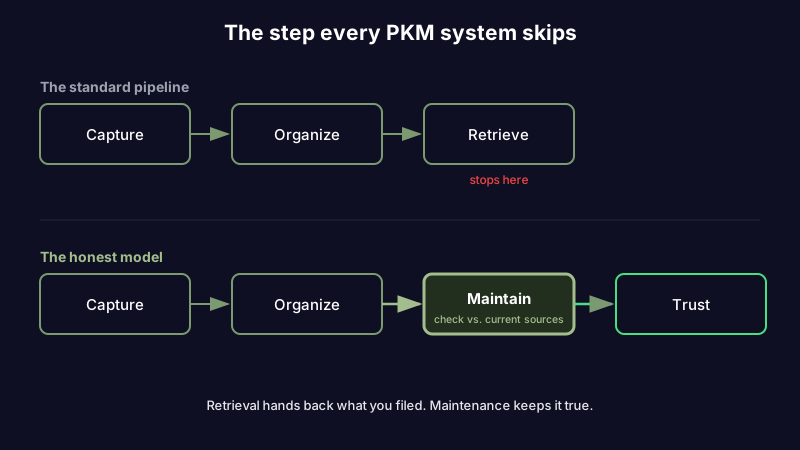
Most of what breaks in a PKM system is not a filing problem. It is a decay problem, which is why we spend so much time here on knowledge decay: the slow, silent drift of your notes away from reality while they sit there looking finished. Scribelet exists because that step was missing everywhere we looked, including our own notes.
The four PKM systems everyone actually uses
Before we get to the missing step, it helps to see how the popular systems handle the four they do cover. There are really only a handful of frameworks under all the blog posts, and each is good at something specific.
Zettelkasten is the slip-box method, built from atomic notes that link to each other so ideas connect sideways instead of stacking by folder. Sönke Ahrens made it famous in How to Take Smart Notes, the book that split notes into fleeting, literature, and permanent notes. Follow the smart notes method to the letter and you still hit the same wall, because the method ends the moment a note is filed. It is unmatched for developing thinking over years. Its weak point is upkeep: the linking is manual, and most people abandon the slip-box when the maintenance outpaces the payoff. That is exactly the gap a zettelkasten that links itself is meant to close.
PARA and Building a Second Brain organize by actionability instead of topic. Tiago Forte's Building a Second Brain overview sorts everything into Projects, Areas, Resources, and Archives, which is a superb filing system. The catch is that filing is not maintaining, which is why PARA has no maintenance step: a note filed under Resources in 2024 is just as findable and just as wrong in 2026.
Digital gardens treat notes as plants that grow and get revised in public, moving from seedling to evergreen. The ethos is the most honest about upkeep of any system, since gardening is mostly weeding. The tooling almost never delivers it, which is the whole argument in tending a digital garden: everyone plants, nobody weeds. The closely related evergreen notes method shares the blind spot exactly: notes meant to evolve almost never get revisited.
The commonplace book is the oldest of the four, a curated collection of quotes and passages worth keeping, running from Marcus Aurelius to Ryan Holiday's notecard system. It is wonderful for collecting wisdom that ages slowly. It was never designed for facts that change, which is most of what a working professional actually needs to keep current.
| System | Organizes by | Great for | Where it stops |
|---|---|---|---|
| Zettelkasten | Idea links | Developing thinking over time | Manual upkeep, then abandonment |
| PARA / Second Brain | Actionability | Fast capture and retrieval | Filing is not maintaining |
| Digital garden | Growth stage | Public, evolving notes | Weeding rarely happens |
| Commonplace book | Curation | Slow-aging wisdom | Not built for changing facts |
Every one of these is a real answer to capture, organize, and retrieve. Every one of them ends there. The reason isn't that their creators were careless. It's that maintenance was never something a notebook could do for you, so nobody built the practice around it. That was a reasonable limit for paper. It stopped being reasonable the moment software could search the web on your behalf.
Where every PKM system quietly breaks
Here is the uncomfortable fact under all of this. Knowledge has a half-life. The complexity scientist Samuel Arbesman spent a whole book, The Half-Life of Facts, showing that established knowledge decays at a measurable rate across fields, from medicine to engineering. What was true when you wrote it down has an expiration date, and you almost never see it expire.
Your notes inherit that half-life and then hide it. A blog post that goes stale at least looks old; the date is right there at the top. A note that goes stale looks exactly like a note that is still correct. It sits in your carefully organized system, findable and confident, and the first time you learn it is wrong is when you act on it in front of a client or ship it into production.
This is why the standard PKM pipeline fails in a specific, predictable way. Every step assumes the previous one produced something durable. Capture assumes the fact was true. Organize assumes it stays true long enough to be worth filing. Retrieve hands it back to you months later with no memory of how much the world moved in between. The system is optimized to preserve what you wrote, not to keep it correct, and those are very different jobs.
None of the frameworks are wrong about the first three steps. They are just incomplete. The honest version of the model has a fourth step, and it is the one that turns a pile of notes into knowledge you can rely on. This is the same argument we make about the missing phase in note-taking, applied to the whole category instead of a single method.
What a self-maintaining PKM system looks like
Add the missing step and the pipeline reads: capture, organize, maintain, trust. The fourth step is maintenance, and trust is what it buys you. A note you know is being checked is a note you can actually use without re-verifying it by hand every time.
For most of PKM's history this step was impossible to automate, so the practice pretended it wasn't needed. It is needed now, and it is possible now, because the same tools that read and search the web can do it while you sleep. The principle is simple: a knowledge system should check its own accuracy instead of waiting for you to catch the error the hard way.
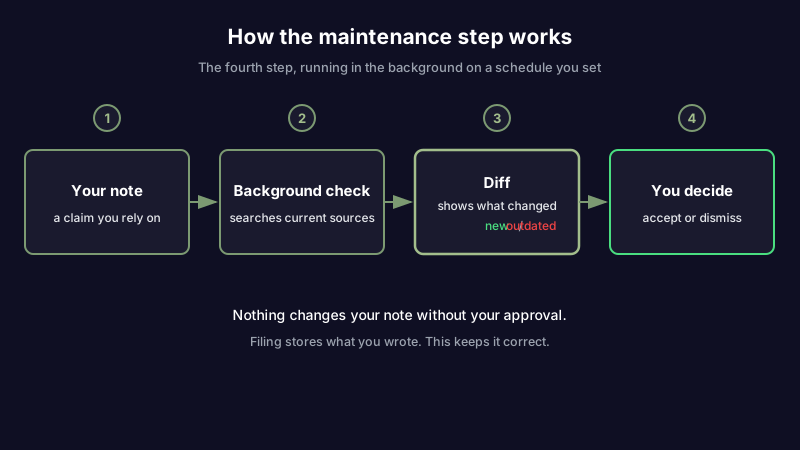
Concretely, maintenance means a few things running quietly in the background:
- Verification against current sources. The system periodically searches the web for the claims in a note and compares what it finds to what you wrote. When they disagree, it shows you a diff, green for new information and red for what's outdated, with a link to the source. You see how background verification works and decide what to accept. Nothing changes your note without your say-so.
- Connection, not just storage. Instead of you hand-linking every atomic note, the system surfaces related notes by meaning, so the slip-box grows its links on its own.
- Memory of your context. The system learns the people, projects, and terminology you actually work with, so its checks and suggestions are about your world, not a generic one.
That is the difference between a filing cabinet and a maintenance layer. A filing cabinet holds what you put in it, exactly as you left it, decay included. A maintenance layer holds it and keeps an eye on it. If you have read this far you can already feel which of your own notes you would not trust today. That list is the argument.
How to build a PKM system that maintains itself
You do not need to throw out your method. Zettelkasten, PARA, a garden, a commonplace book: keep whatever fits your brain. Maintenance is a step you add, not a system you switch to. Here is the shortest path.
- Keep your existing capture and organize habits. Whatever gets notes into your system reliably is already working, whether that's a nightly brain-dump, a running AI work log, or logging a line between tasks through the workday. Don't reform it.
- Mark the notes that make checkable claims. Anything with an external fact under it (an API reference, a pricing comparison, a process, a summary of a paper) is a candidate for maintenance. Pure reflection and half-formed ideas are not, and that's fine.
- Put those notes on a verification schedule. Let the system re-check them against the web on a cadence you set, rather than auditing everything by hand.
- Review diffs, don't rewrite from scratch. When something changed, you want to see exactly what changed and why, then accept or dismiss. This is far cheaper than re-reading your whole archive looking for rot.
- Do a light weekly pass on the rest. Ten minutes on the notes that surfaced this week keeps the backlog from ever forming. The mechanics of that habit are in our 30-minute weekly review system.
If you want the fuller walkthrough of standing this up from nothing, including capture and organization, our guide to building an AI second brain covers the whole flow with maintenance built in from the start.
A note on trust and control, because it matters for a system that reads your notes. Maintenance means sending note content to an AI provider to run the checks. You should get to choose which provider, and you do. Scribelet's AI works out of the box, and if you want provider control you can bring your own OpenAI, Anthropic, or Gemini key; it's encrypted at rest and your notes go to the provider you picked. Your keys, your models, your call.
Which PKM system should you use?
If you are choosing a personal knowledge management app or method from scratch, match it to how you think. Pick Zettelkasten if you write to develop ideas over years. Pick PARA or a second brain if you capture fast and want everything findable by project. Pick a digital garden if you like revising notes in public. Pick a commonplace book if you mostly collect wisdom that ages slowly.
Then, whichever you pick, add the fourth step. The method decides how your knowledge is shaped. Maintenance decides whether you can still trust it in a year. Those are separate choices, and almost everyone makes only the first one.
The reframe
Personal knowledge management was never really about capture. Capturing is the easy part; your phone does it in a second. It was never mostly about organizing either, or the perfect folder structure would have solved this a decade ago. The hard part, the part that decides whether the whole practice pays off, is keeping what you captured true long enough to matter.
That is the step the frameworks skip, not out of negligence but out of history. A notebook could not check itself, so the practice grew up around the three things a notebook could do. Software can do the fourth thing now. A system that captures and organizes and retrieves but never verifies is a very tidy way to store things that are slowly becoming wrong.
You already know which notes those are. Set up your first desk and point maintenance at them first.
Share this article