Literature notes: the layer everyone abandons
Table of contents
You finished a good book last year and did the responsible thing. You kept literature notes as you read: the argument in chapter three you did not want to lose, two quotes worth stealing, the page where the author finally said the thing the whole book was building toward. It felt like real work, because it was.
Open that file now. It is a slab of half-context: page numbers pointing at an edition you no longer own, a quote with no memory of why you flagged it, a link to the author's blog post that now returns a 404. You have not looked at it since the week you wrote it, and you never will again. The literature note did its job for exactly one afternoon.
This is the strange fate of literature notes. They are the single most-taught step in every serious note-taking method and the single most-abandoned one in practice. The bridge between what you read and what you actually keep gets built by everyone and crossed by almost no one. This guide covers what a literature note is, how to take one, a template and three worked examples you can copy, and the one step that decides whether any of it was worth the effort.
What is a literature note?
A literature note is a note you write in your own words while reading a source, capturing the ideas worth keeping and where they came from. It sits between a raw highlight and a finished idea: more considered than a margin scribble, less permanent than a concept you have made your own. Its job is to move an idea out of someone else's text and one step closer to your thinking.
The term comes from the zettelkasten tradition and was popularized for a modern audience by Sönke Ahrens in How to Take Smart Notes, his study of how the sociologist Niklas Luhmann worked. Ahrens splits note-taking into three types, and the literature note is the middle one.
The literature note is where reading turns into raw material. Get it right and your permanent notes have something to draw from, though taking smart notes that stay true asks one more thing of you after the permanent note is filed. Skip it and you are back to highlighting, which is to say back to nothing.
The three types of notes: fleeting, literature, permanent
Fleeting notes are throwaway capture: a thought on a walk, a line you jotted so you would not forget it. Literature notes are what you write when you engage with a source, in your own words, with a reference back to it. Permanent notes are the ones you write for your future self, atomic and self-contained, that live in your slip-box and connect to everything else. Andy Matuschak describes literature notes as secondary and separate: a lightweight synthesis of observations collected while reading, deliberately kept apart from your own developed ideas.
The three types are easiest to hold side by side:
| Note type | What it is | When you write it | Lifespan | Where it goes next |
|---|---|---|---|---|
| Fleeting | A raw thought or reminder to yourself | The moment it occurs to you | Hours to a day, then discarded | Processed into a literature or permanent note, or deleted |
| Literature | A source's idea, in your words, with a reference | While reading or right after | Until you distill it (in theory) | Promoted into a permanent note |
| Permanent | Your own idea, atomic, standing on its own | When an idea has become yours | Years, if maintained | Linked into the slip-box forever |
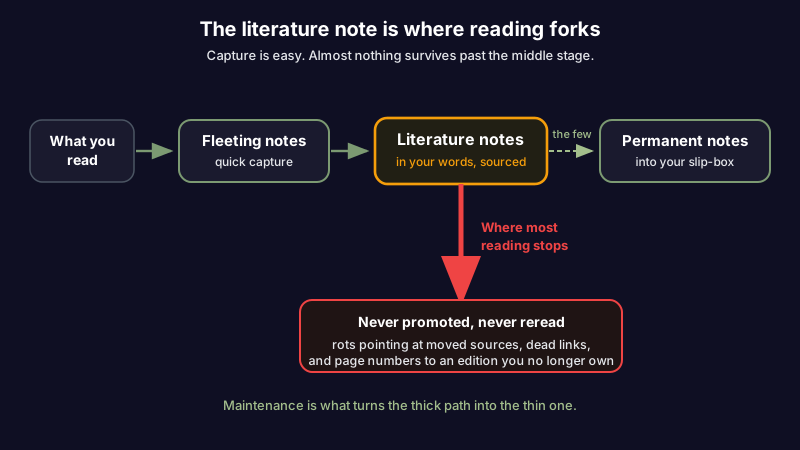
The middle row is the one that breaks. Fleeting notes are disposable by design and nobody mourns a lost one. Permanent notes, once written, tend to get used. Literature notes sit in between, written with care and then never promoted, and that accumulation is the problem this article is actually about. But first, the part every other guide covers.
How to take literature notes
The mechanics are not complicated, and you can learn them in a paragraph. Read with a way to mark passages. When something matters, stop and write a sentence or two in your own words about what it says and why it is worth keeping, and note the source and location. Do not transcribe. If you are copying the author's sentence verbatim, you are making a highlight, not a literature note. The act of rephrasing is the whole point, because it forces you to understand the idea well enough to say it differently.
A literature note has four parts, and they fit on a small skeleton you can reuse for every source:
Source: [author, title, and the edition or URL]
Location: [chapter, page, timestamp, or section]
Claim: [the idea, in your own words, one or two sentences]
Why it matters: [what you would use this for, or what it changes]
Keep the claim short and in your voice. The "why it matters" line is what separates a literature note from a fancy highlight: it records the thought you had while reading, which is the thing you will actually lose. Fill the skeleton in while the reading is fresh, because "process this later" is a promise made to a version of you who has already moved on to the next book.
Literature note examples
Theory is thin without a real one in front of you. Here are three worked literature note examples across the source types you read most: a book, a research paper, and a talk. Each shows the raw highlight first, then the literature note, so the difference is visible. For dense sources, reading a paper in passes is what gives you a claim worth writing down instead of a page of highlights.
From a book. You are reading on habit formation and hit a claim that habits run on a cue, routine, reward loop.
- Highlight (verbatim): "The cue and reward become intertwined until a powerful sense of anticipation and craving emerges."
- Literature note:
Source: Duhigg, The Power of Habit (2012 paperback)
Location: Ch. 2, p. 47
Claim: Habits run as a three-part loop (cue -> routine -> reward). The
  leverage point for change is the cue, not willpower.
Why it matters: Reframes habit change as environment design. Useful for
  the note on why streak apps work and to-do lists do not.
From a research paper. You are reading a study on spaced repetition and want the finding, not the whole abstract.
- Highlight (verbatim): "Retention was significantly higher in the expanding-interval condition than in the massed condition at the two-week retention test."
- Literature note:
Source: study on spacing effect, J. of Applied Cognitive Psych (2019)
Location: Results, Table 3
Claim: Reviews spaced at expanding intervals beat cramming at two-week
  recall. Effect held across ages; sample was students, not general public.
Why it matters: Evidence for scheduling review by interval, not by mood.
  Note the sample limit before citing it as universal.
From a talk or podcast. You are listening to a conference talk and something lands.
-
What you heard: the speaker argues that documentation rots because it is written once and never re-read.
-
Literature note:
Source: engineering talk on internal docs (conf 2025), speaker's name
Location: ~18:30
Claim: Docs decay because writing is a one-time event with no re-read
  trigger. The fix is a review cadence, not better writing.
Why it matters: Same failure mode as literature notes. Connects to the
  knowledge-decay thesis; possible permanent note on "capture without
  a re-read step is landfill."
Notice the shape. Each note is short, in your own words, tied to a specific location, and carries a line about what you would do with it. That last line is the seed of a permanent note. The research-paper example also does something a highlight cannot: it flags the study's limit ("sample was students") so the future you does not overclaim. A good literature note is already thinking, not just filing.
Literature notes vs. permanent notes
The question people keep asking, in every zettelkasten forum thread, is where the line falls between a literature note and a permanent note. The distinction is not about polish. It is about ownership.
A literature note still belongs to the source. It says "here is what this author argued, and here is where they argued it." It is tied to a book, a paper, a talk. A permanent note has cut that cord. It states an idea as yours, standing on its own, phrased so it makes sense years later without the book open next to you. You might read ten literature notes across four books and distill them into one permanent note that none of those authors would recognize as theirs anymore.
Fleeting notes are the easy case: they are disposable by design, meant to be processed within a day or two and then thrown away. The trouble is that most people's literature notes quietly behave like fleeting notes. They get written, they never get processed into anything permanent, and unlike fleeting notes they do not get thrown away. They just accumulate.
Why literature notes are the layer everyone abandons
Here is the honest sequence. You read the book. You take careful literature notes. You feel productive. And then the reading ends, life resumes, and the literature notes sit there waiting to be turned into permanent notes by a future self who never shows up. The distillation step has no deadline and no trigger, so it never happens.
What you are left with is a growing pile of source-bound notes that were never meant to be permanent and never got promoted, either. This is a commonplace book by accident: a collect-and-forget archive of other people's ideas, filed and never reread. It is also the reason so many people conclude that remembering what you read is hopeless. The notes existed. They just went nowhere.
And they do not age well. A literature note is unusually exposed to knowledge decay because it is defined by its links to the outside world. The page number points at a specific edition. The source URL rots. The statistic you noted was superseded by a newer study. The framework the author described shipped a breaking change. A permanent note about your own reasoning can stay true for years. A literature note is only ever as current as the source it is chained to, and sources move.
So the literature note fails twice. It fails forward, because you never distilled it into anything permanent. And it fails in place, because even the raw record it preserved is quietly going out of date while you assume it is safe.
What a literature note needs after you write it
Strip away the method-war arguments and a literature note needs three unglamorous things done to it, on repeat, if it is going to be worth more than the afternoon you spent making it.
It needs to be resurfaced. A note you never see again cannot become a permanent note, so something has to bring the right literature note back when you are working on a related idea, rather than waiting for you to go digging. The whole promotion step depends on the note showing up at the moment it is relevant.
It needs to be re-checked against its source. The claims in a literature note point outward, at a page, a link, a number. Keeping the note trustworthy means periodically comparing what it says to what the source says now, and seeing the difference when the source has changed. This is the part manual systems cannot do, because you would have to remember to reopen every book you have ever read.
It needs to be re-linked as your thinking grows. A literature note written when your slip-box held 80 notes is under-connected once it holds 400. New adjacent ideas have arrived that the old note was never wired to, and reading is only cumulative if those connections actually get made.
None of this is intellectually hard. It is just relentless, on no schedule, forever, which is precisely the kind of work humans quit and software does not.
Keeping literature notes alive without the busywork
This is the step Ahrens leaves to your discipline, and it is the step Scribelet is built to take off your hands. The principle is simple: if a literature note is only useful when it resurfaces, stays accurate, and stays connected, let those three things run in the background instead of depending on you remembering to do them.
Background verification checks a note's factual claims against the web on a schedule you set, then shows you a diff: green for what is new, red for what is now outdated, with the source. The literature note that summarized a since-corrected study surfaces the correction, instead of sitting there teaching you the old number. You review the change, accept or dismiss it, and the note updates. That is the "keep your sources current" chore turned into an event that arrives on its own.
An auto-linker watches your growing note graph and suggests connections a literature note did not have when you wrote it, which is how a source-bound note starts earning its way toward a permanent one. A stale checker flags notes that relate to your recent reading but have not been touched in months, giving you the resurfacing trigger the method never provided. Semantic search means you can find every literature note that touched an idea by meaning, not by remembering which book it was in.
Because this is AI reading your notes, control is the point. Scribelet's AI works out of the box, and bringing your own OpenAI, Anthropic, or Gemini key is an optional path if you would rather your notes be checked by the provider you choose than one we picked for you. Either way, every change lands as a diff you approve, not a silent edit. You can see your first diff on a note you already half-trust.
Approaches to literature notes, compared
Every method here gets you a decent literature note on the day you write it. The difference shows up a year later, in whether that note ever became knowledge or just became clutter.
| Approach | Captures source in your words | Resurfaces old notes | Keeps sources accurate | Promotes toward permanent notes |
|---|---|---|---|---|
| Highlights only (Kindle, Readwise export) | No, verbatim capture | Random resurfacing at best | No | No, highlights stay highlights |
| Plain markdown (Obsidian, Logseq) | Yes | Only if you search by hand | No, notes freeze at capture | Only when you remember |
| Classic zettelkasten discipline | Yes | No, by hand only | No, sources drift | Yes, if you keep the habit |
| A maintained system | Yes | Yes, by relevance and schedule | Yes, re-checked against sources | Yes, with linking and resurfacing done for you |
The middle two rows are where nearly every guide on the method stops. The last row is the difference between a literature note that became part of your thinking and one that became landfill.
A literature note is a loan, not a keepsake
The reason your literature notes went nowhere is not that you took them wrong. You probably took them well. The method simply handed you a note that only pays off if you come back to it, distill it, and keep its sources honest, and then left all three jobs to a future self on no deadline.
Treat a literature note as what it is: a loan from a source that you intend to turn into something of your own. That only works if the note resurfaces while the idea is still live, stays accurate while its sources move, and finds its way to the permanent notes and evergreen ideas it was meant to feed. Reading compounds when that maintenance happens and rots when it does not, which is the step every note-taking method skips. Let a system carry it, and start turning your reading into knowledge that lasts. Start free.
Share this article