False Equivalence: How to Spot and Dismantle It
Table of contents
Someone drops a line into a planning doc: "it's basically Postgres with a nicer UI." Both store your data, both speak something close to SQL, so the sentence slides past without a second look and the comparison quietly becomes the decision. A week later you are knee deep in the differences that line erased, the ones about durability guarantees and operational load and what happens at three in the morning, and you realize the whole choice turned on a single true but shallow trait that was never the point.
That move has a name. It is false equivalence, and it is one of the most effective ways a bad comparison gets through a room full of careful people. It works precisely because the shared trait is usually real. The two things genuinely do have something in common, and that grain of truth is what carries the much larger claim that they are therefore the same, or close enough to treat the same. For anyone who weighs options, reads to decide, or leans on an AI assistant to compare things, false equivalence is not a debate-club curiosity. It is a failure mode that lives inside tool choices, technical arguments, and the notes you keep. Here is what it is, why it is so persuasive, where it shows up, and how to take it apart.
What is false equivalence?
False equivalence is a logical fallacy in which two things are treated as equal because they share one superficial trait, while the differences that actually matter are ignored. The shared trait is real. The equivalence it is used to justify is not. The usual shorthand is "comparing apples and oranges," but that undersells it, because the fallacy is not that the two things differ. Everything differs from everything in some way. The fallacy is picking the one axis on which they match, holding it up as the whole comparison, and letting the axes that decide the question drop out of view.
The structure is always the same. A and B share property X. The argument treats X as the relevant dimension. But the real question depends on properties Y and Z, where A and B are not close at all. A small open side project and a bank's core ledger are both "just software that stores records." True, and useless, because the thing you are actually deciding runs entirely on the dimensions that sentence skipped. A knowledge base that stores the reasoning and the differences behind a conclusion, not just the conclusion itself, is what lets you reopen a comparison later and see which axis it was really standing on.
Why false equivalence is so persuasive
The persuasive power comes from the grain of truth. A pure non sequitur gets caught, because the listener can see the two halves do not connect. False equivalence connects them with something genuine, so the objection has to be more precise than "that's wrong." You have to say "that's true, and it is the wrong dimension," which is a harder and slower thing to say in the moment, especially out loud, especially when the comparison already sounds reasonable.
Three features make it stick.
The first is that it compresses. "They're basically the same" is short, confident, and memorable, while the correct response is a list of the ways they differ and why those ways decide the question. Brevity reads as clarity, and the longer, more accurate account sounds like hedging next to it. The second is that it exploits a real cognitive shortcut. Finding a shared feature is how we categorize the world, and most of the time the category is good enough, so the habit of "same category, treat the same" is usually rewarded and rarely examined. False equivalence rides that habit into cases where the category is doing no real work. The third is asymmetry of effort. Stating the equivalence costs one sentence. Refuting it costs a paragraph, because you have to reintroduce all the context the comparison stripped out, which is the same reason a confident wrong claim is so much cheaper to produce than to clean up. The person making the false equivalence spends a little; the person answering spends a lot.
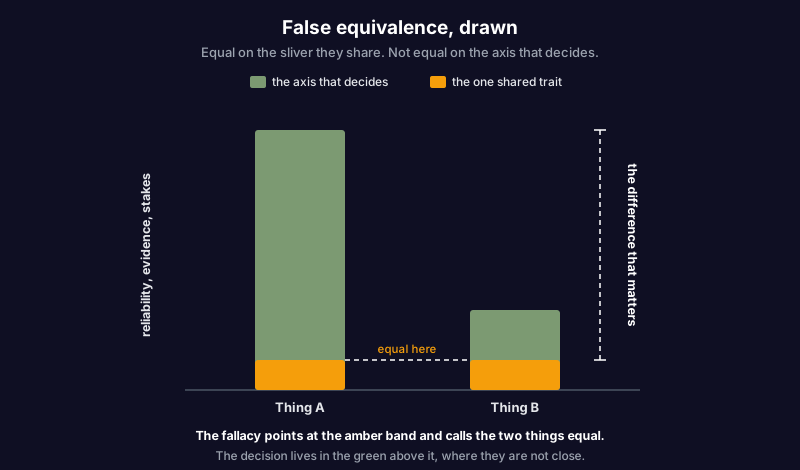
The picture above is the fallacy in one frame. The shared trait is real, and it is small. The differences that decide the question are large, and they are exactly what the equals sign is drawn over. False equivalence is not an error of inventing a similarity. It is an error of scale, treating a sliver of overlap as if it were the whole shape.
Where false equivalence shows up
Once you have the shape, you start catching it in places that have nothing to do with politics, which is where most examples are set. Naming the setting makes the move easier to see.
| Where it operates | The shared trait it leans on | What it ignores |
|---|---|---|
| Tool and vendor comparisons | "Both do X" (store data, send messages, run jobs) | Reliability, operational cost, failure modes, scale |
| An AI answer weighed against an expert | Both are "a confident, fluent explanation" | Evidence, track record, accountability for being wrong |
| "Both sides" framing in a review | Two objections were both "raised" | One is backed by a benchmark, the other by a hunch |
| Whataboutism in a thread | Both parties "did something wrong" | Severity, intent, scale, and whether it answers the point |
| Moral or risk equivalence | Two events "are both bad" | Magnitude, probability, and what is actually comparable |
The engine under every row is identical. A true, shared surface feature is promoted to the status of the whole comparison, and the dimensions that would separate the two things are left off the table. The tell is always the same too: the comparison feels tidy, and the moment you ask "same along which axis, and is that the axis the decision turns on," the tidiness falls apart. This is the close cousin of treating a simple model of a thing as if it were the thing itself. A false equivalence is a map with one feature drawn in and everything else left blank, handed to you as if it were the territory.
False equivalence in your notes and AI tools
For most people now the sharpest version does not arrive in an argument. It arrives in an answer. You ask an assistant to compare two libraries, two approaches, two tools, and it returns a clean, balanced paragraph that lists what they have in common and gives each a fair-sounding nod. The format itself leans toward equivalence, because an even, hedge-both-ways summary reads as fair and complete. What it often skips is the one dimension on which the two are not close, the dimension your actual decision depends on, because that dimension takes a stance and the smooth summary avoids taking one.
The risk is that the balanced-sounding comparison gets saved as a balanced-sounding fact. You capture the takeaway, "these two are roughly equivalent, with tradeoffs," and the specific axis where they diverge, the one worth the note, was never written down because the answer never surfaced it. Each time you reread the tidy summary it feels more settled, and the slow drift of a note from something you understood into something you only half recognize finishes the job. The fix is to make the capture do what the comparison would not: record the axis that actually differs, and the evidence for it. Checking a claim and its grounds at the moment you save it is the cheap moment to notice that an equivalence was asserted and never earned. A decision filed on a false equivalence is the kind you end up paying for later without ever seeing it coming, because the dimension that mattered was edited out before it reached your notes.
How to respond to a false equivalence
You cannot refute a false equivalence by denying the similarity, because the similarity is usually real. You refute it by moving the conversation to the dimension the comparison skipped, which is also how the research on countering it frames the fix: surface the differences the comparison hid rather than deny the likeness. A few moves do most of the work, in a meeting or in the margin of your own thinking.
- Grant the shared trait, out loud. Start with "yes, both of those are true." Conceding the real part immediately strips the argument of its defense and clears the way to the actual question. Fighting the similarity is how you lose, because you are now arguing against something true.
- Name the axis that decides it. Say plainly which dimension the decision actually turns on. "Both store data, agreed. The question is what happens when a write fails, and there they are not close." The move is to replace the comparison's axis with the relevant one.
- Quantify the gap. A false equivalence survives on vagueness, so put a number or a concrete consequence on the difference. "One loses a transaction once a decade, the other once a week" ends the comparison faster than any adjective.
- Ask for the comparison on the right dimension. Turn it into a question the other person has to answer on your axis, not theirs. "On durability specifically, how do they compare?" If the equivalence was false, it cannot be restated there.
- Watch for the retreat. A common follow-up is to quietly shrink the claim to something defensible ("well, I just meant they're similar"), then expand it again later. Pin the claim to a single meaning and hold it there. If "similar" is all that was meant, then it was never an argument for treating them the same.
None of this requires calling anyone dishonest. Most false equivalence is sincere, a real shortcut misfiring, not a trick. The response is the same either way: concede the overlap, name the dimension that matters, and make the comparison happen there.
False equivalence vs related ideas
The fallacy gets filed next to several neighbors, and the distinctions are worth pinning down, because each one fails on a different axis.
| Idea | What it gets wrong | How it differs from false equivalence |
|---|---|---|
| False equivalence | Treats two unlike things as equal over one shared trait | The baseline case: a real similarity is inflated into sameness |
| False balance | Gives two positions equal weight regardless of evidence | A media and framing version of false equivalence, about airtime rather than logic |
| Brandolini's law | Describes the cost of refuting nonsense, not a comparison | About effort asymmetry; it explains why false equivalence is annoying to answer, not what it is |
| Hitchens's razor | A claim asserted without evidence can be dismissed without evidence | About unsupported assertions; false equivalence smuggles in a supported one to carry an unsupported leap |
| The illusory truth effect | Repetition makes a claim feel true | About a claim feeling true through repetition, not two things feeling equal through overlap |
The one worth keeping straight is false balance, because it is the same error wearing a press badge. False equivalence is the logical move, two unlike things declared equal on a shared trait. False balance is that move applied to coverage and attention, where a fringe claim gets equal time with an established one because "both views exist," a trap newsrooms get warned about by name. Same inflation of a thin similarity, different venue.
The one move that matters
False equivalence is hard to catch in the moment because the similarity it rests on is genuine, and a true statement does not trip the alarm that a false one would. The reliable defense is a single question, asked before the comparison sets: same along which dimension, and is that the dimension the decision turns on? If the answer is a shrug, the equivalence was carrying more weight than it could hold. A knowledge base that keeps the axis a comparison actually turned on, and the evidence behind it, not just the clean verdict that two things were "basically the same," is how you keep your decisions honest about what they were really standing on. Try it free.
Share this article