Betteridge's Law of Headlines: Why the Answer Is No
Table of contents
The headline asks "Is this common household spice the secret to a longer life?" and for half a second you want the answer to be yes. You click. Four hundred words in, past the anecdote and the stock photo, you reach the hedge: one small study, in mice, suggesting maybe, pending more research. The headline asked a question the article never answers. If the spice really did extend your life, the headline would have said so, in a flat declarative sentence, with the study's name attached.
That gap between the question in the headline and the shrug in the body has a name. Betteridge's law of headlines states that any headline ending in a question mark can be answered by the word "no." It is half a joke and half a genuinely useful filter, and in an era when a model can generate a thousand speculative headlines an hour it is more useful than it has ever been. Here is what Betteridge's law actually claims, why it holds as often as it does, why AI has made it sharper, and how to use it when you read, when you write, and in the notes where a question you once left open quietly hardens into a fact.
What is Betteridge's law?
Betteridge's law of headlines is the observation that if a news headline ends in a question mark, the answer is almost always "no." It is named after the British technology journalist Ian Betteridge, who stated it in a 2009 blog post picking apart a TechCrunch story whose question-mark headline promised far more than its reporting could deliver. The same idea had circulated earlier, including a version from 1991 sometimes called "Davis's law," but Betteridge's phrasing is the one that stuck.
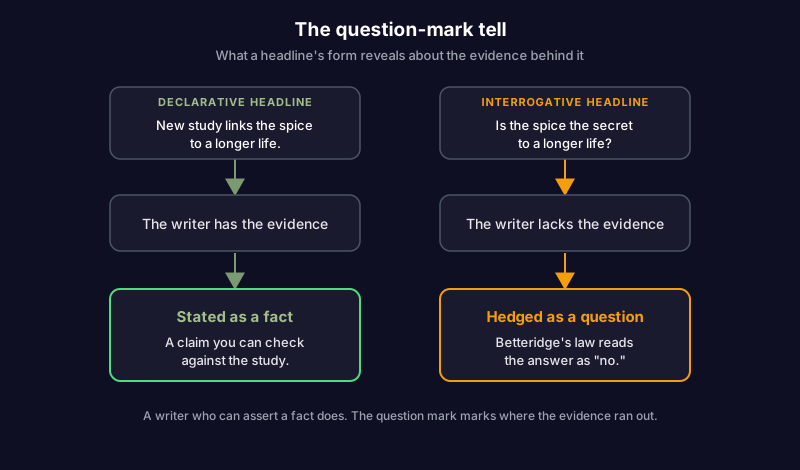
The law is not a claim about grammar. It is a claim about what a question mark in a headline reveals about the person who wrote it. A headline is the most valuable real estate a publisher owns, and a writer who has the facts uses it to make an assertion, because an assertion is stronger than a question. "New study links the spice to longer life" is a better headline than "Is the spice the secret to longer life?" in every way, unless the writer cannot actually support the first version. The question mark is a tell. It marks the place where the evidence ran out and the writer reached for intrigue instead.
That is why the law belongs next to the other principles about how trust and evidence get mismatched. It is a cousin of the Gell-Mann amnesia effect, where you trust a source on one topic right after catching it wrong on another, and of Brandolini's law, the bullshit asymmetry principle that refuting a bad claim costs far more than making one. All three describe the same underlying problem: the signal that should lower your confidence is right there, and you read past it anyway. The practical defense is not to distrust every headline but to keep the claims that matter somewhere you can actually check later, so a hedged question does not quietly settle into your notes as a fact.
Why the law holds so often
The mechanism is an economic one, not a grammatical rule, and it runs through the incentives of whoever wrote the headline.
A declarative headline is a promise the writer has to keep. "Interest rates will fall in March" commits the publication to a claim it can be held to, so an editor only runs it when the reporting backs it up. A question-mark headline promises nothing. "Will interest rates fall in March?" can run on pure speculation, because a question cannot be wrong. It extracts the click that the interesting-but-unprovable premise is worth, while quietly reserving the right to answer "probably not, nobody knows" in the body. The question mark is how a headline sells certainty it does not have.
There is a second force underneath the first. If the answer were actually yes, the question would not be interesting enough to pose. "Does the sun rise in the east?" is not a headline. The questions that get the treatment are the ones where the surprising, traffic-earning answer would be yes, and where the boring, true answer is no. So the form selects for exactly the cases the law predicts: a tantalizing yes the writer cannot support, dressed as a question so that the dull no can hide in the final paragraph.
Betteridge's law in the age of AI
Betteridge was writing about human journalists chasing traffic. The sharpest modern version is the headline a language model wrote, and there are now a great many of them. "Is this the end of search?" "Can AI replace your doctor?" "Will prompt engineering be obsolete by next year?" The question-mark headline is the native grammar of the AI content farm, because it is cheap to generate, it cannot be fact-checked into being wrong, and it harvests the click from a premise the underlying article never had the evidence to assert.
This is worse than the newspaper case in a specific way. A content operation can now produce speculative question headlines faster than any reader can evaluate them, which is Brandolini's law running at machine scale: the cost of generating a plausible, unanswerable question has fallen to near zero, while the cost of actually checking each one has not moved. The volume of headlines asking whether some tool will change everything has exploded, and almost none of them carry the evidence that would let them drop the question mark. The reader who internalizes Betteridge's law has a cheap, fast first-pass filter for exactly this flood: a question-mark headline is not news, it is a prompt, and the honest answer is usually no.
The same tell shows up when you ask an AI assistant itself. A model will happily generate a confident-sounding headline or summary that poses a question and then fail to resolve it, because it is optimizing for a plausible-looking output, not for a defensible claim. Treating its question-shaped outputs the way you would treat a clickbait headline, as a starting point to verify rather than a finding to keep, is the same discipline as checking an AI claim against the world before you save it.
Examples of Betteridge's law
The law is easiest to internalize as a set of patterns. Once you have seen the shapes a few times, you spot the tell before you click.
| The headline | What the question mark signals | The Betteridge reading |
|---|---|---|
| "Is [new technology] the end of [established thing]?" | The writer cannot show it is, or they would have | No. The established thing is fine for now. |
| "Could [small study] mean [big conclusion]?" | One preliminary result stretched toward a claim it cannot carry | No, not yet, and probably not at that scale. |
| "Has [company] finally solved [hard problem]?" | A press release the writer could not independently confirm | No. "Finally" is doing the work "proven" cannot. |
| "Are we about to see [dramatic event]?" | Speculation with a deadline nobody will check later | No, or at least not on the implied timeline. |
| "Will [job] be replaced by AI this year?" | A fear or a hope with no reporting behind it | No. If it were happening, the headline would name it. |
The pattern that matters most is the one you write yourself. The question-mark headline is not only a journalism habit. It is how an open question gets filed, in a feed, in a saved article, and in your own notes, where it is far more durable than any single headline.
How to read past a question-mark headline
The law is a filter, not a verdict. Its value is that it tells you where to spend your limited attention, not what to conclude. A few habits turn it into a reliable reading practice.
Start by answering the headline before you read. Say "no" out loud, then open the article to see whether it changes your mind. Most of the time the body confirms the no, and you have saved yourself the time; occasionally it genuinely supports a yes, and that surprise is worth noticing, because a question headline that actually delivers is rare enough to be informative.
When the premise matters to you, find the load-bearing claim and check it directly. A question headline almost always rests on one study, one source, or one quote. Name it, then ask whether it actually supports the headline's implied yes, or whether it has been stretched. This is Sturgeon's law used as a filter: most of what any feed produces is crud, so the skill is deciding fast what is worth a real look rather than reading everything at face value.
Treat the question as the start of an inquiry, not the end of one. If the headline asks whether a framework is dead or a technique is obsolete, the useful move is to ask the second-order version: if it were true, what would follow, and what would you expect to already be seeing? Asking "and then what?" usually resolves a speculative headline faster than the article does, because the dramatic yes tends to imply consequences that have obviously not happened.
The version hiding in your own notes
If you keep notes, Betteridge's law is not only a media filter. It describes a specific way your own knowledge base rots. You read a speculative article, you find the premise interesting, and you save a line about it. The line started life as a question, hedged and provisional. But a saved note strips the hedge. Six months later the entry reads as a flat fact, its original question mark long gone, and you build on it as if it had been confirmed. The note does not remember that the claim arrived as clickbait. Only you did, and you forgot.
This is the quiet half of the law, and it is the half a tool can actually help with. A claim you captured as "might this be true?" should not silently become "this is true" just because time passed and the question mark fell off in the copy. The defense is to keep the source and the uncertainty attached to the claim, so a note that began as speculation still reads as speculation when you return to it, and so a claim you never actually verified is flagged as unverified rather than inherited as fact. That is the same discipline that keeps a cited source from going stale under you and that fights the slow decay of a knowledge base generally: the question is cheapest to resolve when you first meet it, and most expensive once you have built on the assumed answer.
When Betteridge's law does not apply
The law is a heuristic, and treating it as an iron rule is its own mistake. The clearest exception is the honest question headline, the one written by someone who does have the answer and uses the question as a hook before delivering a well-supported yes. These exist. A headline asking whether a widely held belief is wrong, written by a reporter who did the work to show that it is, resolves to yes, and the law fails cleanly.
The academic case is the sharpest counterexample. A 2016 study by Cook and Plourde looked at whether scholarly article titles that pose questions get answered "no," and found that in the research literature the law does not hold: yes-or-no question titles are rare there, and the ones that do appear are answered "yes" more often than "no," because a paper's title usually introduces a genuine investigation rather than a traffic-seeking tease. The lesson is to read the law as a statement about incentives, not about punctuation. Where the writer is paid for clicks, the question mark is a tell and the answer is usually no. Where the writer is paid for being right, a question in the title can be an honest one. Knowing which regime you are in is the whole skill, and it is a judgment worth making deliberately rather than applying the rule by reflex.
Getting started
Betteridge's law is not a reason to sneer at every headline that ends in a question mark. It is a reason to stop spending attention and trust on claims that were never asserted in the first place, and to notice when one of those unasserted claims slips into your own notes wearing the clothes of a fact.
Read the question headline as a "no" until the body earns a "yes," check the one claim the premise rests on before you save it, and keep the uncertainty attached to anything you capture so a maybe does not quietly become a fact. Try Scribelet free and let it hold your notes with their sources, flag the claims you never verified, and check them against the world, so the question you left open does not come back months later looking like the answer.
Share this article