Brandolini's Law: Why Debunking Costs More Than Lying
Table of contents
Someone in a thread claimed the library you maintain leaks memory under load. It does not, and never has, but the claim was one sentence and it took ten seconds to type. Refuting it took your afternoon. You pulled the benchmarks, re-ran them on a clean machine, screenshotted the flat memory graph, dug up the closed issue where this exact worry was investigated two years ago, wrote it all up in careful, non-defensive prose, and posted it. By then the original claim had been quoted twice more, and one of the people who saw it walked away believing the leak was real, because the correction was longer and more boring than the accusation. You were right. It cost you a hundred times what it cost them, and you are not sure it worked.
That imbalance has a name. It is Brandolini's law, and once you have felt it you recognize it in every argument that goes nowhere, every rumor you cannot kill, every wrong sentence in a document that takes a meeting to unwind. Most write-ups give you the one-line definition and a rueful nod. What is more useful is understanding exactly why the asymmetry is so steep, why generative AI has made it steeper, and what it means for the notes and sources you rely on, because a false claim you save is just as cheap to write down and just as expensive to catch later. Here is Brandolini's law in full, and a practical way to spend your limited refutation budget where it actually counts. A companion bias makes the problem worse: even after you catch a source being wrong, you tend to forget it the moment you turn the page, so the same unreliable source keeps earning the trust it should have lost.
What is Brandolini's law?
Brandolini's law, also called the bullshit asymmetry principle, states that the amount of energy needed to refute nonsense is an order of magnitude larger than the energy needed to produce it. It was coined in 2013 by the Italian programmer Alberto Brandolini, who put it in a tweet after watching a televised debate, and it spread because it named something everyone had experienced and nobody had labelled. The phrasing is deliberately blunt. The point it makes is precise.
The word doing the work is asymmetry. A false claim and its correction are not two moves in a fair exchange. Producing a wrong statement is nearly free: you assert it, in a sentence, with no obligation to be right. Refuting it is expensive: you have to gather evidence, establish context, anticipate objections, and present the whole thing convincingly enough to overcome the head start the claim already has. The claim gets to be short and confident. The correction has to be long and careful. In the time it takes you to dismantle one bad argument thoroughly, three more can be made.
This is why the law lands harder than it first reads. It is not a complaint about liars. It is a statement about the structural cost of truth-telling: the defender always pays more than the attacker, whether or not the attacker meant any harm. A single confident error, made in passing, can obligate someone else to a research project. Most of the time nobody signs up for that project, so the error stands, not because it won on the merits but because refuting it was not worth anyone's afternoon. If you keep notes you rely on, that same economics is quietly at work inside them, where a wrong line is cheap to write and expensive to ever catch. Worth keeping a claim somewhere you can actually check it later.
Why refuting costs an order of magnitude more
The asymmetry is not an accident of psychology. It comes from three concrete mechanics that stack on top of each other.
You have to prove a negative. Making a claim requires asserting one thing. Refuting it often requires demonstrating the absence of something, which takes far more evidence. "The library leaks memory" is one sentence; "the library does not leak memory under any of these representative workloads" is a benchmark suite. The claimant points; the refuter has to survey.
You need specialized knowledge the claim does not. A wrong statement can be produced by anyone, on any topic, with no expertise at all. A correct rebuttal usually requires knowing the domain well enough to say precisely why the claim fails, and to defend that against follow-ups. The gap in required effort is exactly the gap between having an opinion and having the goods.
Volume beats depth. A stream of loosely-related wrong claims, delivered quickly, cannot be answered at the same speed, because each one takes real work to address and there is only one of you. This is why a firehose of small errors is so effective and so exhausting: by the time you have carefully handled the first, five more are waiting, and stopping to handle them all looks, to an onlooker, like you are losing.
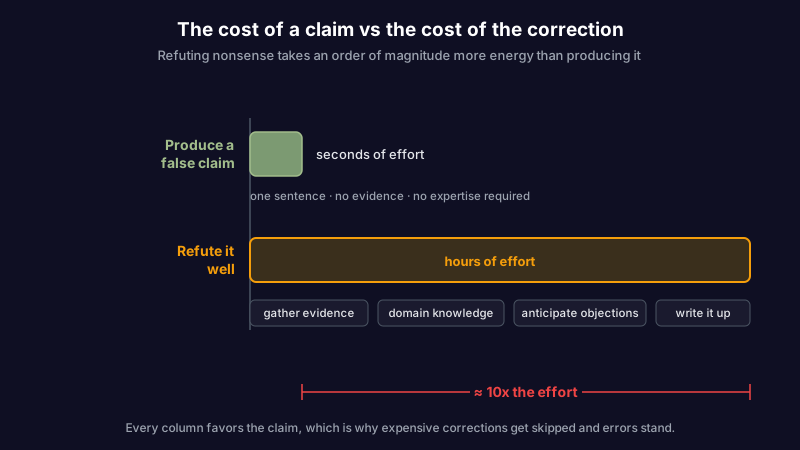
Put the two sides in a table and the imbalance stops being a feeling and becomes a budget:
| Producing a false claim | Refuting it well | |
|---|---|---|
| Evidence required | None | Gather, verify, cite |
| Expertise required | None | Domain-specific |
| Length | One sentence | Paragraphs, with context |
| Time to complete | Seconds | Hours |
| Attention it earns | High (confident, simple) | Low (long, qualified) |
| Who is obligated | No one | Whoever cares about the truth |
The through-line is that every column favors the claim. That is the whole law: not that truth loses, but that truth is expensive, and expensive things get skipped. The practical consequence is that you cannot refute everything, so the only winning move is to be deliberate about which claims are worth the cost, which is a second-order question about where a wrong belief actually leads if you leave it standing.
AI made the asymmetry worse
Brandolini's law was already steep. Generative AI tilted the floor further, because it collapsed the one cost the producing side still had: effort.
A wrong claim used to at least require a human to write it. Now a model can generate a paragraph of fluent, plausible, subtly-wrong text in a second, at no cost, in unlimited quantity. The production side of the asymmetry has gone from cheap to free and from slow to instant. The refutation side has not moved at all, because checking whether a confident-sounding paragraph is actually true still takes a person with the relevant knowledge the same afternoon it always did. The ratio that Brandolini estimated at ten to one is now, for machine-generated text, effectively unbounded: one prompt can produce more plausible falsehood than a room of experts could refute in a week. It is no accident that "Brandolini's law AI" is now something people search for; the law found its perfect engine. This is also Sturgeon's law with the production cost removed: ninety percent of everything was always crud, and now that ninety percent is free to generate at unlimited scale.
This is the part that matters even if you never argue with strangers online. The same fluent, confident, occasionally-wrong text is now flowing into your own notes, your research, and your documents, whenever you paste an AI answer in without checking it. A model will happily tell you a function was deprecated in a version where it was not, cite a paper that says the opposite of what it claims, or invent a statistic that reads perfectly. Each of those costs the model nothing to produce and costs you real work to catch, and if you do not catch it at the moment you save it, you have filed a landmine that will cost even more to find later. That is why verifying a claim before it goes into your notes is not paranoia; it is the cheapest point on the whole cost curve to pay the refutation tax.
What it means for your own knowledge
Most discussions of Brandolini's law are about public discourse. The more useful frame, if you keep a body of notes you trust, is that the asymmetry runs inside your own head and your own files.
Every claim you write down is cheap to produce and, if it is wrong, expensive to catch. You copy a configuration flag from a forum post, a rate limit from an API doc, a "best practice" from a talk, a figure from an article. Producing that note took a moment. If any of it was wrong, or was right then and has since changed, the cost of discovering that lands on future you, usually at the worst possible time, usually after you have already acted on it. This is the private version of Brandolini's law: an unverified note is a wrong claim you made to yourself for free, and the bill comes due when you least expect it. It compounds with the slow decay every note undergoes as the world moves past it, so that even a note that was true when you wrote it becomes a false claim you are trusting.
The instinct to save the source, not just the conclusion, is the same instinct behind reading a paper in passes and capturing what you can actually defend. A conclusion with no source is a claim you will have to re-refute from scratch every time you doubt it. A conclusion with its source attached is a claim you already paid the refutation cost on once, banked, so you never pay it again. The asymmetry does not go away, but you get to pay it a single time instead of repeatedly.
A practical defense against the asymmetry
You cannot refute everything, and trying to is how the law wins by exhaustion. What you can do is spend your refutation budget deliberately, and make sure the expensive work you do pay for is never wasted. Five moves, in rough order of leverage:
- Verify at the cheapest point: on the way in. Checking a claim when you first save it costs far less than discovering it was wrong after you have built on it. The refutation tax is lowest at the moment of capture, so pay it there.
- Save the source, not just the claim. A conclusion with its evidence attached is a refutation you only have to do once. A bare assertion is one you will redo every time you doubt it, which is Brandolini's law charging you interest.
- Keep the debunking once you produce it. When you do spend an afternoon dismantling a claim, that write-up is expensive and reusable. Store it where you will find it the next time the same claim resurfaces, because it will.
- Choose which claims are worth the cost. Not every wrong statement deserves your afternoon. Refute the ones whose consequences are large or irreversible, and let the trivial ones stand; spending equal effort on every error is how the firehose beats you.
- Do not tear down what you have not understood. The mirror image of the law is that some things you would dismiss as wrong are load-bearing for reasons you have not seen, so investigate before you refute or remove. A confident correction that turns out to be the wrong one is the most expensive move of all.
The reason this belongs in a tool and not just in your habits is that the expensive part, the verified claim with its source and reasoning attached, is precisely the part that decays out of a plain note first. Scribelet is built to hold the claim, the source, and the check together, and to re-verify a note against the current web on a schedule you set, so the refutation you paid for once keeps paying off instead of quietly going stale. Try it free and stop paying the same refutation tax twice.
Reading Brandolini's law correctly
The tempting misreading is despair: if refuting costs ten times what lying does, then truth is hopeless and there is no point correcting anything. That is not the lesson. The lesson is that refutation is a scarce, expensive resource and should be spent like one. You would not answer every email with a legal brief; do not answer every wrong claim with a research project. Triage.
The opposite misreading is that the law is only about arguing with strangers, so it does not concern you if you stay off the internet. But the asymmetry is a property of information itself, not of social media. It operates in a code review where a confident wrong comment costs an hour to disprove, in a document where one stale line misleads a team, and in your own notes where an unchecked claim waits to cost you later. Anywhere a claim is cheaper to make than to verify, Brandolini's law is running, which is nearly everywhere.
Read correctly, it is a lens for a single question you can ask at every claim that crosses your desk: is this cheap assertion worth the expensive check, and if it is, how do I make sure I only have to pay for that check once? Knowing which claims deserve the effort is itself a decision worth making deliberately rather than by reflex.
Getting started
Brandolini's law is not a reason to give up on being right. It is a budget constraint on it. The energy to refute nonsense is real and limited, and the way to win is to spend it where it counts and never spend it twice on the same thing.
Start with three moves. Verify claims at the moment you save them, when the refutation cost is lowest, not months later when you have already relied on them. Save the source alongside every claim, so a conclusion you paid to check stays checked. And when you do produce an expensive debunking, keep it somewhere it will resurface the next time the claim does. Try Scribelet free and let it hold your claims with their sources and re-check them against the world, so the asymmetry that makes truth expensive only charges you once.
Share this article