Poe's Law: Why You Can't Tell Satire From Sincerity Online
Table of contents
You stop on a comment three replies deep. It argues, with total conviction, something so far past reasonable that it has to be a joke. Then you are not sure. Maybe the person means every word. Maybe they are mocking the position by performing it. You scroll up for context and find none, check the profile and learn nothing, and hover over the reply box, unsure whether to laugh along or argue back. The one thing that would settle it is missing: a signal of what the writer actually intended.
That gap has a name. It is Poe's law, and it has quietly become one of the most useful ideas for anyone who reads, writes, or saves anything online. The short version is famous and the explanations mostly stop there, with a definition and a shrug. What is worth more is seeing why the ambiguity is structural rather than accidental, why generated content has made it sharper than its author could have imagined in 2005, and what it means for the notes and sources you rely on, because a claim you could not read the intent behind is exactly the kind you end up trusting by default. Here is Poe's law in full, with examples, a way to tell satire from sincerity, and the version running quietly inside your own notes.
What is Poe's law?
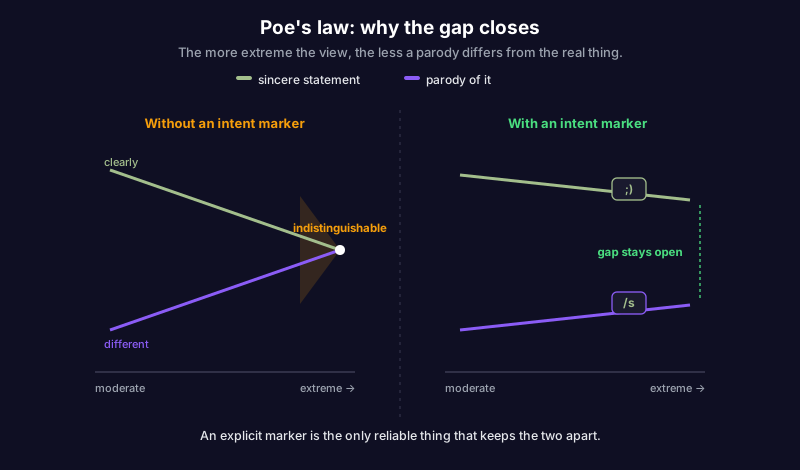
Poe's law is an adage of internet culture stating that, without a clear indicator of the author's intent, a parody of an extreme view is impossible to tell apart from a sincere expression of that view, and a sincere extreme view is just as easily mistaken for parody. The ambiguity runs both ways. A joke gets read as a real belief; a real belief gets dismissed as an obvious joke. The only reliable fix the law names is an explicit marker: a winking emoji, a "/s" tag, a line that says "I am kidding."
The term was coined by Nathan Poe in a 2005 post on an online forum, in the middle of a long argument about creationism and evolution. His observation was narrow at first: without a blatant display of humor, it is impossible to write a parody of a fundamentalist position that someone will not take as the genuine article. The name is a coincidence worth clearing up, since the search results are full of it: Nathan Poe has no relation to Edgar Allan Poe. The idea escaped its original religious context almost immediately, because the mechanism it describes is everywhere people communicate in text without tone. By 2017 WIRED was calling it troll culture's central rule. Politics, fringe subcultures, product reviews, code comments, a one-line message from a colleague: anywhere the words arrive stripped of voice and face, the intent has to be reconstructed, and often it cannot be.
It is worth separating Poe's law from a close cousin so the rest of this stays clean. Poe's law is about not being able to read intent. The Gell-Mann amnesia effect is about not being able to carry forward reliability you already measured. One is a failure to classify the register of a message; the other is a failure to remember a source's track record. They often appear together online, but they are different problems with different defenses.
Why parody and sincerity collapse into each other
The effect is not a lapse of attention. It is produced by how written communication works, and three things stack up to create it.
The first is that text carries no tone. In person, a raised eyebrow, a flat delivery, a half-smile tells you instantly that a statement is not meant straight. Online, all of that is gone. The reader is left with the literal words and whatever context happens to surround them, and context online is thin: a reply with no thread above it, a screenshot with the replies cropped off, a quote with the speaker removed. With the tonal channel closed, the only thing left to judge is the content, and the content alone is frequently not enough.
The second is the extremity paradox: the further out a view sits, the harder it is to parody. Mild positions are easy to exaggerate into obvious satire, because the gap between the real thing and the joke is wide. But a position that is already at the edge leaves nowhere to exaggerate to. Any parody of it has to be at least as extreme as the sincere version, which means it looks exactly like the sincere version. This is why Poe's law bites hardest precisely where the stakes feel highest. The sincere fanatic and the person mocking the fanatic end up writing the same sentence.
The third is that the marker is the whole game, and markers are fragile. The law does not say parody and sincerity are always indistinguishable. It says they are indistinguishable without a clear indicator of intent. A "/s" at the end, a winking face, an account everyone knows is a bit: those collapse the ambiguity in a single character. But markers get stripped when content is quoted, screenshotted, translated, or summarized. A satirical post that was obvious in its original home becomes a sincere-looking claim the moment it travels one hop without its marker. The intent does not survive the copy.
Poe's law in the age of AI
Nathan Poe was describing forum arguments between humans. The sharpest modern version involves no human author at all. Generated text and images have pulled the intent marker out of a whole new category of content, and they have done it at scale.
Start with the text. A language model will produce a flawless-sounding statement of any position, extreme or mild, sincere or satirical, with the same even confidence. It does not signal when it is improvising, parodying, or repeating something it absorbed without understanding. So a passage that reads as a committed argument may be a model completing a pattern, and a passage meant as a send-up may be taken as a genuine claim, and nothing in the prose tells you which. The tonal channel was already closed in text; AI removes even the weak human tells, the slightly-too-much, the tiny inconsistency, that sometimes gave a parody away.
Then the images and video. A synthetic photo of a public figure saying something outrageous sits in the same uncanny zone Poe's law describes, except now the "view" is fabricated whole. Is it a satirical edit, a sincere fake meant to persuade, or a genuine clip? Without a watermark or a disclosure, which is exactly the intent marker the law is about, the three are indistinguishable on their face. The related search "Poe's law AI" has become common for a reason. The point is not that everything online is fake. It is that the indicator of intent is now missing from a much larger share of what you see, and the law's conclusion follows directly: you cannot reliably tell the register of a message from the message alone.
This is why catching an AI assistant in a confident error is worth more than a sigh. A model that will state a parody and a fact in the same tone is a model whose output you have to classify yourself, every time, the same way you classify a stranger's extreme comment. The moment you use that assistant as a sounding board, it will hand you a confident answer with no marker for how sure it actually is, and a confident answer is precisely the thing to check rather than adopt. That checking is cheap to do now and expensive to skip; it is the same discipline as fact-checking a claim against the world before you save it.
Examples of Poe's law
The effect shows up anywhere a message arrives without the tone, context, or marker you would need to read its intent. A few of the common shapes, and what they have in common:
| Where it happens | What you see | Why the intent is unreadable |
|---|---|---|
| A cropped screenshot | A single extreme reply, no thread | The context that signaled a joke was cut off |
| A satirical account | A straight-faced post taken literally | The "everyone knows this is a bit" marker does not travel |
| An AI-written passage | A fluent, confident argument | The model uses one tone for sincerity, parody, and improvisation |
| A synthetic image or clip | A public figure saying something outrageous | No watermark or disclosure separates edit from fake from real |
| A terse work message | "Great. Just great." in a thread | Text drops the sarcasm the voice would have carried |
| Your own old note | A claim you saved without its register | You stripped the "I was skeptical of this" context when you captured it |
The last row is the one almost nobody counts, and it is the one that matters most if you keep a knowledge base. You save a line from somewhere, and whatever told you how to read it, the eye-roll you felt, the "this is clearly spin" reaction, does not get saved with it. The note is just as susceptible to Poe's law as any stranger's comment, and the stranger whose intent you are failing to read is your past self. This is close kin to the way most of what any source produces is low quality: the problem is not any single item, it is reading each one without a reliable way to judge it.
How to tell satire from sincerity
You cannot restore tone to text, and you cannot verify the intent behind everything you read. The goal is narrower and achievable: stop treating an unreadable message as if you had read it. A few habits do most of the work.
Mark your own intent, always. The cheapest contribution to the whole problem is to never add to it. When you write something that could be read as parody or as sincere, add the indicator: the "/s", the explicit "joking", the note of context. The same applies to what you save. A claim captured with "source was being sarcastic" or "I did not believe this" keeps its register attached, so future you does not have to reconstruct it.
Look for the marker before you assign an intent. Ask the concrete question: is there an indicator of what the author meant, or am I supplying one? If the only thing telling you a post is sincere (or a joke) is your own assumption, you have not read the intent, you have guessed it. Hold the reading as provisional rather than fact.
Rate the source, not just the message. A known satire site, a known-serious outlet, an account with a track record: the source often carries the intent the individual message cannot. When you catch yourself unable to classify a message, the source's history is the next-best signal, which is the same reason it pays to track a source's reliability over time rather than re-judging every piece from scratch.
Remember the asymmetry before you spread it. Repeating a parody as if it were real, or a sincere claim as if it were a joke, is a one-second action; correcting the misreading later is a long one. That is Brandolini's law applied to intent: the misread travels cheaply and the fix is expensive, so the discipline is to resolve the ambiguity before you pass the thing on, not after.
Treat a missing marker as missing data, not as permission to decide. If a message genuinely has no readable intent and no source signal, the honest state is "I do not know whether this is sincere", not a coin-flip dressed as a judgment. Leaving it explicitly undecided is more accurate than forcing it into one bin.
The version hiding in your own notes
If you keep notes, or run an AI assistant over them, Poe's law is not an abstraction about strangers on the internet. It is a property of your own knowledge base. Every claim you save arrives with a register, sincere, sarcastic, speculative, overstated-for-effect, and the register is the first thing lost in the capture. Six months later the saved line reads as flat fact. The note does not remember that the source was joking, or that you wrote it down precisely because you doubted it. Only you did, and the memory faded.
The defense is structural, not a matter of being more careful in the moment. Capture the intent with the claim: a word on whether the source was serious, a note on your own confidence, the context that told you how to read it. Verify claims when you save them, while the surrounding signal is still in front of you, because the register is far harder to reconstruct later than to record now. This is the same failure mode that lets notes quietly go stale and start misleading you: a line that was once clearly provisional hardens into something you treat as settled. And treat an AI assistant working over those notes the way you would treat any source whose intent you cannot read from its tone. Its fluent confidence is not a marker of sincerity or accuracy; it is the absence of a marker, and the absence is the whole point of the law.
When Poe's law is not the explanation
The idea gets stretched, so a guard is worth stating. Poe's law is specifically about the unreadability of intent in the absence of a marker. It is not a license to call anything you disagree with "probably satire", and it is not a reason to believe nothing. If a message has a clear indicator of intent and you still misread it, that is not Poe's law, that is a reading error. If a source has an established, obvious register and you ignore it, that is not the law either, that is choosing not to use the signal in front of you.
The other misreading is to swing to blanket cynicism and treat every message as a potential fake. That is paralysis, not skepticism, and it is its own kind of inaccuracy. Plenty of content online carries perfectly legible intent: the marker is there, the context is intact, the source is known. The law applies to the specific case where the indicator is missing, and the discipline it asks for is equally specific. Supply the marker when you write, look for it when you read, and when it genuinely is not there, hold the intent open instead of inventing one. Deciding which ambiguous messages are even worth resolving is itself a judgment worth making deliberately rather than by reflex.
Getting started
Poe's law is not a reason to distrust everything you read. It is a reason to stop pretending you have read an intent you only guessed at, in a world where generated text and images have stripped the marker from more content than ever. The fix is small and mostly mechanical: supply the indicator when you write, look for it before you assign a reading, and when it is missing, say so.
Start with your own knowledge base, where the ambiguity is quietly most expensive. Capture each claim with its register, a word on whether the source was serious and how far you believed it, so a line you once held at arm's length does not come back looking like settled fact. Verify claims at the moment you save them, while the context that signals intent is still there. And treat a confident AI answer as a message with no intent marker, to be checked rather than adopted. Try Scribelet free and let it keep your notes with their sources and their context, and re-check them against the world, so the register you could read today is still readable the day you rely on it.
Share this article