AI fact-checking for notes that stay accurate
Table of contents
You wrote the note because you needed to trust it later.
Maybe it was an API behavior, a market number, a study summary, or the pricing model of a competitor you track. It was true when you saved it. Six months later, you are searching your notes again, and the note still sounds confident. Even if you once caught its source getting something wrong, that discount rarely survives the reuse, which is the Gell-Mann amnesia effect running inside your own knowledge base.
That is the problem. AI fact-checking for notes is useful only if it treats your note as something durable: a claim you may reuse months after the source changed. A chatbot verdict is not enough. A good verification workflow extracts exact claims, checks current sources, shows evidence, and lets you decide what gets written back.
This article explains which notes deserve verification, where AI fact-checking fails, and what a trustworthy note-verification workflow should show before you let it touch your knowledge base.
Want to see the product version of this? Try Scribelet's AI verification on a note that cites an external source, then review the diff before accepting anything.
What AI fact-checking for notes should do
AI fact-checking for notes is a workflow where software identifies factual claims inside your notes, checks them against current sources, and shows evidence-backed corrections for you to review. That multi-step shape, identify then check then propose, is itself a prompt chain: each step does one job, and you can see its output before it feeds the next. Unlike a chatbot answer, note verification preserves your original note, cites sources, and lets you accept or reject proposed changes. Rejecting a correction out of hand because it contradicts what you already wrote is the Semmelweis reflex aimed at your own notes, which is exactly why a good workflow shows you the evidence instead of asking you to take a verdict on faith.
The distinction matters because notes are not one-off prompts. They accumulate. They connect to projects, clients, citations, decisions, and future work. Standing instructions accumulate the same way, and finding the lines that stopped earning their place takes the same kind of check: test the claim rather than trust that it is still true.
When a note goes stale, the mistake does not stay contained inside that note. It travels into the next decision you make with it, and by then refuting it later costs an order of magnitude more than checking it now.
A useful note checker should do four jobs.
First, it should separate claims from prose. "Stripe supports this billing flow" is a claim. "This felt like the cleanest path" is judgment.
The first one can be checked. The second one needs context, not a web search.
Second, it should retrieve evidence from the right place. The right source for a React API claim is the React documentation or release notes, not a generic blog post. The right source for a pricing claim is the vendor's current pricing page, not an old comparison article.
Third, it should compare evidence against your wording. The output should not be "true" or "false" in isolation. It should explain what changed, what still holds, and what source supports the correction.
Fourth, it should keep you in control. The safest workflow is not silent rewriting. It is a diff: here is what your note says, here is what the source says now, here is the proposed edit, and here is the evidence.
That is why Scribelet uses the term AI verification more than fact-checking. Verification is broader. It covers stale facts, source drift, missing caveats, changed APIs, and claims that are too ambiguous to update automatically.
Why ordinary AI fact checkers do not solve stale notes
Most AI fact-checking tools were built for a different job: review a draft, scan an article, or check an AI-generated answer before it is published. That is useful. It is not the same as keeping a personal knowledge base accurate over time.
The difference is lifecycle.
A draft has a deadline. You check it, publish it, and move on.
A note keeps coming back. You write it in March, cite it in June, link it from a project plan in September, and ask your AI assistant about it in December. If the original source changed in July, a one-time check from March does not protect you.
Microsoft's guidance on how to fact-check AI points out the everyday failure modes: AI may cite incorrectly, rely on outdated information, or omit context. Those problems get worse when the content being checked is not a disposable answer, but a note you expect to keep using.
Research points in the same direction. Stanford's Cyber Policy Center summarized a study where 15 large language models were tested on more than 6,000 PolitiFact claims. Models with only built-in knowledge performed poorly.
Reasoning and web search helped inconsistently. The strongest gains came from curated evidence supplied through retrieval-augmented generation, with the best setup reaching a macro F1 score of 0.90 compared with 0.27 without curated context.
The lesson for notes is blunt: model confidence is not verification. The quality of the evidence pool matters more than how fluent the answer sounds.
That is why "ask ChatGPT if this note is still accurate" is a weak maintenance system. It might work for a quick sanity check. It will not tell you which claims in 400 notes have drifted, which source changed, or what wording should be updated.
Source-grounded tools raise the floor here, and it is worth knowing exactly where they stop. Google's NotebookLM answers from material you uploaded rather than from model memory, which is a real improvement over a bare chatbot verdict. It still checks the sources you gave it at the moment you gave them, so a notebook assembled in March does not notice that a vendor rewrote a pricing page in July. That limit is why people start looking for NotebookLM alternatives once the research phase ends and the notes have to stay usable.
If your real problem is knowledge decay, you need a loop, not a verdict.
Which notes deserve verification
Not every note should be checked by AI. Some notes age badly. Others do not.
A journal entry from 2024 does not need source verification. It records what you thought, felt, or noticed at the time. Rewriting it because the world changed would be wrong.
A technical note about OAuth scopes is different. If the provider deprecates a scope, the note is no longer a record of your thinking. It is a trap waiting for the next person who follows it.
Use this triage before turning on automated note verification:
| Note type | Verification priority | Best source to check |
|---|---|---|
| API docs, framework notes, migration guides | High | Official docs, release notes, GitHub repositories |
| Research summaries and citations | High | Original papers, journal pages, retraction notices |
| Client and market intelligence | High | Vendor pages, filings, current reports |
| Architecture decision records | Medium | Current code, internal docs, dependency docs |
| Meeting notes and project plans | Medium | Follow-up decisions, tickets, calendar records |
| Personal reflections and journals | Skip | Not source-checked unless they cite external facts |
A developer note makes the risk easy to see. You documented a webhook integration in January with a note saying the provider retries failed events for 72 hours. In May, the provider changes the retry window to 24 hours and updates the docs.
Your note still looks polished. The next incident response plan built from that note now has the wrong recovery assumption.
That is a verification problem, not an organization problem. Better tags will not catch it. A prettier editor will not catch it. A weekly review helps only if you remember to check that exact claim against the current docs.
For a manual workflow, Scribelet's 30-minute note review system is a good baseline. For notes that carry source risk, AI can narrow the work to the claims most likely to matter.
One thing to watch when an assistant has already read that note: correcting the answer is not enough. Fix the source, not just the memory, or the next extraction pass writes the outdated claim straight back.
How a note-verification workflow should work
A serious AI fact-checking workflow starts with the same discipline traditional fact-checkers use: preserve the exact claim before changing it. The Knight Science Journalism project at MIT describes the editorial process as identifying and marking facts, cross-referencing them against source material, and documenting corrections. Notes need the same discipline, adapted for a system that runs after the note was written.
Here is the sequence that matters.
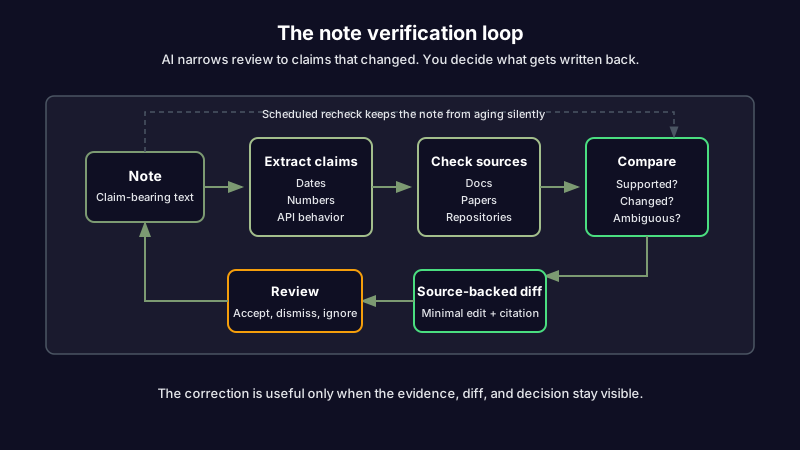
- Extract exact claims. The system should identify specific sentences that carry evidence burden: dates, numbers, API behavior, quotes, source summaries, policy details, and named-entity claims.
- Choose the source path. It should decide whether to check the open web, a configured connector, a cited URL, or a private source like a repository.
- Retrieve current evidence. It should fetch current material and keep source links attached to the finding.
- Compare claim and evidence. It should detect whether the claim is supported, contradicted, incomplete, or too ambiguous to judge.
- Show the diff. It should propose a minimal edit instead of rewriting the note from scratch.
- Ask for review. The user should accept, dismiss, or ignore. The tool should not assume that current search results understand the context better than the person who owns the note.
- Schedule the next check. A fast-moving API note may need monthly verification. A literature note may need a slower cadence.
Notice what is missing from that list: "generate a better note." That is a different task.
Verification is narrower and more valuable. It does not ask AI to become the author. It asks AI to do the tedious source work, then show receipts.
The output should look something like this:
Original claim:
The API retries failed webhook deliveries for 72 hours.

Current source:
Provider docs now state retries continue for 24 hours after the initial failed delivery.

Suggested diff:
Replace "72 hours" with "24 hours."

Source:
Provider webhook delivery documentation, last updated May 2026.
That is the moment where the note owner can make a decision. Maybe the source is right and the note should change. Maybe the note was describing an older API version and needs a caveat instead. Maybe the source page is wrong for your account tier.
The tool should make that judgment easier. It should not pretend the judgment disappeared.
If your notes reference technical sources, configure verification sources before you rely on generic web search. For developer notes, the GitHub connector can check claims against the code and docs you actually use.
Source quality matters more than model confidence
AI fact-checking breaks down when retrieval breaks down. A model can write a clear explanation from weak evidence. That is worse than an obvious failure because it feels finished. It also cannot always tell whether a source means what it appears to say, since a satirical or AI-generated page can read exactly like a sincere one.
This is the difference between source-backed verification and AI theater.
For note verification, sources should be ranked by how close they are to the original fact:
| Claim type | Strong source | Weak source |
|---|---|---|
| API behavior | Official docs, release notes, repository code | Tutorial posts, forum guesses |
| Research finding | Original paper, journal correction, retraction database | Blog summary, citation snippet |
| Pricing or packaging | Vendor pricing page, terms page | Old comparison article |
| Legal or policy detail | Government source, official policy document | News recap without links |
| Internal decision | Decision record, ticket, meeting note, code change | Memory, chat summary |
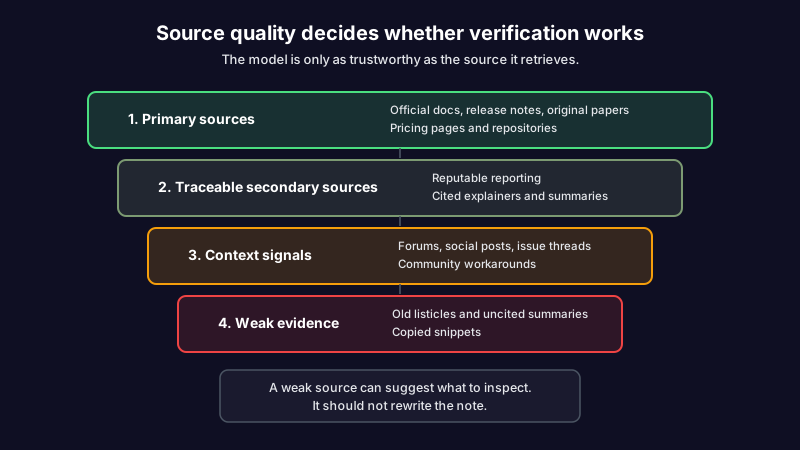
Forums and social posts are not useless. They can show that a problem exists, reveal a workaround, or surface a breaking change before docs catch up. But they are not the final source for claims that carry risk.
The Columbia Journalism Review covered X's AI-written Community Notes and found the same tension at platform scale. AI notes can contribute to fact-checking, but quality depends heavily on implementation. In one case, a draft AI-written note made a false claim about protest footage before human review prevented it from appearing publicly.
That is a useful warning for personal knowledge bases. Human review is not a ceremonial step. It catches the places where retrieval, context, or source interpretation failed.
For high-stakes notes, AI should act as triage. Medical, legal, financial, regulatory, and reputation-sensitive claims still need expert judgment. A verification agent can flag the claim, collect source material, and show where the note may be outdated. It should not become the authority of record.
Privacy and control are part of the workflow
Fact-checking a note means sending some part of that note into an AI and search workflow. For throwaway prompts, that may not feel like a big decision. For a knowledge base, it is. The same holds when you ask a model to write your prompts from your own notes: whatever you hand it to work from leaves your machine, and where it goes is worth knowing.
Your notes contain client names, project details, private research, half-formed thinking, and relationships that only make sense in context. A tool that verifies them needs to explain where the text goes, which provider processes it, how provider keys are stored, and whether the AI can write back without review.
Ask these questions before trusting an AI note checker:
- Can I choose which notes are verified?
- Can I restrict which sources it checks?
- Does it show a diff before editing?
- Can I reject a suggested change?
- Which AI provider receives the note text?
- Are provider keys encrypted at rest?
- Can I use the feature without giving the vendor my own API key?
That last question matters because Bring Your Own Key (BYOK) is useful, but it should not be a setup tax. Scribelet's AI works out of the box. BYOK is the optional control path for people who want provider choice, cost visibility, or stricter routing through OpenAI, Anthropic, or Gemini. The deeper argument is covered in BYOK AI explained.
The principle is simple: AI should not quietly become the owner of your notes. It should show its work, preserve your original text, and leave the final write-back decision to you.
That is especially true for teams. A shared desk can contain research from several people. A verification result that changes a team note should be traceable: who accepted it, what source supported it, and what changed in the note.
Without that trail, you have not solved trust. You have moved it from stale notes to invisible automation.
What this looks like in real work
The easiest way to understand AI note verification is to look at the places where ordinary notes fail.
Technical notes
A developer saves an internal note about a framework migration. It says a specific configuration flag is required in v4, links to the docs, and includes a code snippet. Two releases later, v5 removes the flag and changes the default behavior.
Search still finds the note. The snippet still looks plausible. The only visible problem is that it no longer matches reality.
A verification workflow should detect the version-sensitive claim, check the current release notes, and propose a focused edit: keep the v4 note for historical context, but add a v5 caveat and link to the migration guide. That is exactly the kind of outdated documentation problem that wastes engineering hours because the note looks trustworthy.
Research notes
A researcher summarizes a paper and records the key claim in a literature note. A year later, the paper receives a correction. The correction does not invalidate the entire note, but it narrows the conclusion.
An article checker would not help unless the researcher happened to resubmit the note for review. A note-verification system can periodically re-check cited sources, flag corrections or retractions, and ask whether the wording should change.
The right output is not "this note is wrong." It is more specific: "The cited paper now includes a correction affecting the sample-size claim. The conclusion may still hold, but this sentence should be qualified."
Client and market notes
A consultant keeps a competitive research note with pricing, plan limits, and feature positioning. The note gets reused across two proposals because it was thorough the first time. The competitor changes packaging in April.
The stale note does not announce itself. It sits in the knowledge base until the consultant quotes the old plan in front of a client.
Verification cannot replace judgment about the market. It can do the dull check: compare saved pricing claims against the current pricing page, flag mismatches, and show the new wording before the note enters another proposal.
That is the real value of AI fact-checking for notes. It does not make you smarter by writing new thoughts for you. It protects the thoughts you already did the work to capture.
Can AI fact-check notes automatically?
AI can automatically check some note claims, but it should not automatically rewrite your knowledge base. The safer pattern is automatic detection and human-approved correction. Let the system find source drift, gather evidence, and propose a diff. Keep the final decision with the note owner.
This distinction protects you from the two obvious failure modes. Fully manual review does not scale past a small set of notes. Fully automatic rewriting can erase context the AI did not understand.
The middle path is where AI helps most: it narrows the review surface.
Is AI fact-checking reliable enough for research notes?
AI fact-checking is reliable enough for research-note triage when it uses strong sources and shows uncertainty. It is not reliable enough to be the final authority on high-stakes claims.
The University of Kansas open textbook chapter on research notes makes the same underlying point from a journalism angle: detailed notes let writers and fact-checkers retrace how a claim was found and supported. AI can speed up that source review, but it cannot replace the need for a traceable research process.
For research notes, use verification to catch changed citations, corrections, source mismatches, and unsupported summaries. Use your own expertise to decide what the change means.
Your notes need receipts, not vibes
Notes become risky when they stay persuasive after their sources drift. The sentence still reads well. The link still exists.
The conclusion still fits the project you are working on. None of that proves the claim is current.
AI fact-checking for notes is worth using when it respects that tension. It should check exact claims, retrieve better sources than a generic chatbot answer, show diffs, and keep you in control of the final edit.
That is the difference between AI that writes more material into your knowledge base and AI that helps you keep trusting what is already there.
Try Scribelet verification on one source-heavy note. Pick something old enough to make you uncomfortable. If the note still holds, you get confidence. If it does not, you get a diff before the stale claim gets reused.
Share this article