Hitchens's Razor: What Can Be Asserted Without Evidence Can Be Dismissed
Table of contents
An AI assistant hands you a clean, specific claim. A precise figure, a named study, a confident one-line verdict, delivered in the same even tone it uses for everything. You are about to paste it into a document that other people will act on. Then you notice what is missing: no source, no citation, nothing you could follow to check it. The sentence is doing all the work of being true without any of the work of showing it. The question is not whether to believe it or disbelieve it. The question is who has to do the next piece of work, you or the claim.
There is a rule for exactly that question, and it is sharper and more useful than its one-line fame suggests. It is Hitchens's razor, and most explanations of it stop at the slogan and move on. What is worth more is seeing what it actually decides (the burden of proof, not the truth), how it differs from the other razors it gets confused with, why generated text has made it a daily tool rather than a debating-club flourish, and what it means for the claims sitting in your own notes. Here is Hitchens's razor in full, with a comparison table, worked examples, and the version running quietly inside your knowledge base.
What is Hitchens's razor?
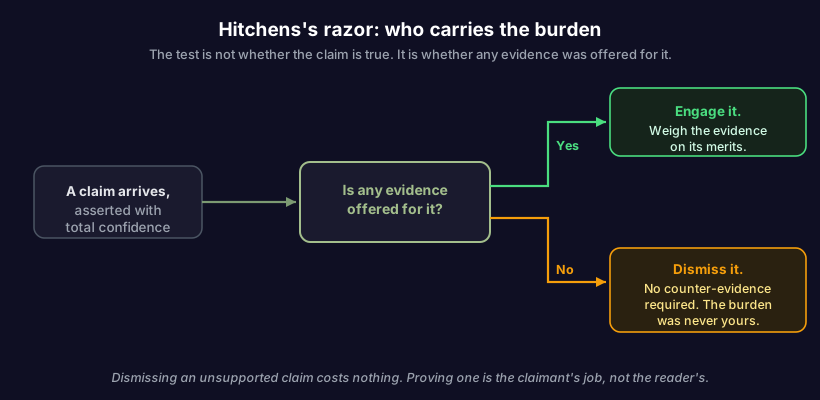
Hitchens's razor is an epistemological principle stating that what can be asserted without evidence can also be dismissed without evidence. It was put this way by the writer and journalist Christopher Hitchens in his 2007 book God Is Not Great, though the idea is old. It is a modern rendering of a Latin legal maxim, quod gratis asseritur, gratis negatur, "what is freely asserted is freely denied." A razor, in philosophy, is a rule of thumb that lets you shave off, or set aside, an unpromising line of reasoning without having to chase it down. This one shaves off the obligation to disprove claims that arrive with nothing behind them.
The core of it is a rule about the burden of proof. If you make a claim, the job of supporting it is yours. Until you offer something, the person on the other side owes you no rebuttal, no counter-study, no refutation. They can set the claim down and walk on, and they have lost nothing by doing so. The razor does not say the unsupported claim is false. It says it has not earned a response yet, and that treating "I could not immediately disprove it" as a reason to believe it is a mistake. The quietest and most common version of that mistake is accepting a statement simply because no rebuttal came to mind fast enough.
Why the burden sits with the claimant
The razor looks one-sided until you see the alternative, which is unworkable. If the person doubting a claim had to disprove it, then anyone could win any argument by generating assertions faster than they could be checked. Disproving things is slow and often impossible; you cannot prove that an invisible, undetectable object is not in the room. Producing a claim is nearly free. Hand the burden to the skeptic and you have built a machine that manufactures belief for whoever talks fastest, because the cost of asserting and the cost of refuting are wildly out of balance.
That imbalance is itself a named idea. Refuting a piece of nonsense costs an order of magnitude more than producing it, which is why a debate conducted on the skeptic's dime is lost before it starts. Hitchens's razor is the defense against that asymmetry. It refuses to let the costs land on the wrong side. By keeping the burden with the person making the claim, it stops a conversation, a feed, or a knowledge base from filling up with things that are treated as true only because nobody had the time or the obligation to knock them down. The razor is a burden-allocation rule, not a verdict on content, and that distinction is the whole thing. It decides who acts next, not what is real.
Hitchens's razor versus the other razors
The razors get blurred together, and keeping them apart is half of using any of them well. Each one shaves off a different kind of unpromising move, and they answer different questions. The table sorts the four that come up most, including the Sagan standard, which is best understood as Hitchens's razor with a dial on it.
| Principle | One-line form | What it decides | Use it when |
|---|---|---|---|
| Hitchens's razor | What is asserted without evidence can be dismissed without evidence | Who carries the burden of proof | A claim arrives with nothing behind it and you are tempted to disprove it |
| Occam's razor | Prefer the explanation with the fewest assumptions | Which of several explanations to favor first | You already have evidence and are choosing between competing accounts of it |
| Hanlon's razor | Never attribute to malice what is adequately explained by error | How to read the cause of a bad outcome | An outcome looks hostile and you are about to assume intent |
| The Sagan standard | Extraordinary claims require extraordinary evidence | How much evidence a claim needs | Something is offered with evidence, but the claim is far outside the ordinary |
The row that matters for this post is the last one. The Sagan standard is not a rival to Hitchens's razor; it scales it. Hitchens tells you an unsupported claim can be dismissed. Sagan adds that the amount of support a claim needs rises with how surprising it is. A mundane claim with a little evidence is fine; an astonishing claim with a little evidence is still, for practical purposes, an assertion, because the evidence offered is nowhere near the size of the claim. Together they form one usable test: is there evidence, and is there enough of it for a claim this large? Occam's razor and Hanlon's razor sit in a different lane, because both assume you are already past the evidence gate and are now interpreting what you have.
Hitchens's razor in the age of AI
Hitchens was arguing about religion and the supernatural. The place the razor earns its keep now is the one the opening described: the output of a language model. Generated text has produced unsupported assertions at a scale and a polish that no human debater could match, and it has stripped the usual warning signs off them.
A model states a claim it is sure of and a claim it is improvising in the same fluent, even register. It does not flag which parts of an answer are grounded in something and which are pattern-completion that happened to sound right. So a specific-looking figure, a named source that does not exist, a confident summary of a study it never read, all arrive wearing the same clothes as the parts that are solid. This is the core reason an AI assistant's confidence tells you nothing: fluent certainty is the one thing the system produces for free, for every claim, true or not. It is the uniform-tone problem that also makes a machine-written passage impossible to read for sincerity or intent. The confidence is not a signal. It is the absence of one.
Hitchens's razor turns that from a worry into a procedure. An AI claim offered with no source is, exactly, something asserted without evidence, which means you are entitled to dismiss it, or more usefully to hold it, until a source appears. You do not have to disprove the figure. You have to decline to carry it forward until the model, or you, can point to where it came from. The cheapest moment to apply that test is the moment the claim is produced, while the question is fresh and the context is in front of you. That is the same discipline as checking a claim against the world before you let it into your notes: the razor decides that the burden is the claim's, and the verification is how the claim meets it.
Examples: applying the razor
The razor is easy to state and easy to skip in the moment, so it helps to see it run against the kinds of claims that actually cross your desk. In each case the first move is the same question: has evidence been offered, and is it enough for a claim this size?
| The claim | Evidence offered | What the razor says |
|---|---|---|
| "Studies show this feature lifts retention 40%." | None, no study named | Dismiss or hold. A number with no source is an assertion wearing a lab coat. |
| An AI answer citing a specific court case | A case name you cannot find anywhere | Hold until verified. A citation that does not resolve is worse than none. |
| "Everyone knows this library is faster." | None | Dismiss as stated. "Everyone knows" is the phrase that marks a missing source. |
| A benchmark result with a linked methodology | A reproducible setup you can read | Engage it. Evidence was offered; now weigh it on its merits. |
| "This approach cannot possibly scale." | A stated reason and a worked example | Engage it. A supported claim earns a real response, agreement or rebuttal. |
| A saved note that reads "X is the best option" | None you captured | Treat as unproven. Past you asserted it; present you owes it no belief. |
The pattern across the rows is that the razor never asks you to decide truth on the spot. It asks you to route the claim: dismiss it, hold it, or engage it, based on whether the claimant did their job. Two of the rows pass the gate and get a genuine hearing, which is the point. The razor is not a way to wave things away. It is a way to spend your attention on the claims that have earned it and to stop spending it disproving the ones that have not.
How to apply Hitchens's razor well
The razor is a reflex worth building, and a few habits do most of the work.
Ask one question first: who is supposed to prove this? Before you reach for a counter-argument, check whether the claim came with any support at all. If it did not, the burden has not moved to you, and the honest response is to ask for the evidence rather than to manufacture a rebuttal. This single reframe saves an enormous amount of wasted effort arguing against things that were never backed up in the first place.
Let the burden shift when evidence actually appears. The razor is not a license to ignore anything you dislike. The moment someone offers real support, the dynamic flips: now you do owe the claim a genuine engagement, and dismissing it anyway is just the razor abused. Using it honestly means applying it only to the unsupported case and dropping it the instant the support shows up.
Keep "dismissed" separate from "disproven." Setting an unevidenced claim aside is not the same as proving it false. It stays provisional, and it reopens the moment evidence arrives. Holding a claim as unproven rather than declaring it wrong is more accurate and leaves you free to update, which matters most for claims you will revisit. Deciding which ambiguous claims are even worth the effort to resolve is its own judgment, made deliberately rather than by reflex.
Mark your own claims with their evidence. The cheapest way to respect the razor is to never hand other people, or future you, an assertion with nothing behind it. When you write something down, attach where it came from. A claim saved with its source survives the razor; a claim saved bare invites exactly the dismissal you would apply to a stranger's.
The version hiding in your own notes
The sharpest place to turn the razor is inward, on your own knowledge base. Every claim you save arrives with some grounding, a source, a measurement, a reason you believed it, and the grounding is the first thing lost in the capture. You write down the conclusion and drop the evidence, because in the moment the evidence is obvious and the conclusion is what you want. Six months later the note reads as a flat, sourceless assertion, indistinguishable from something you made up, and you tend to believe it anyway, because it is in your own handwriting.
That is Hitchens's razor pointed at your past self, and by its own logic those bare notes should be held as unproven until their evidence is recovered. The defense is structural, not a matter of being more disciplined in the moment. Capture the source with the claim: a link, a figure, a line on why you believed it and how far. A note that carries its evidence answers the razor on reuse; a note that does not is a claim you will have to re-prove or quietly re-dismiss every time you reach for it. This is the same failure mode that lets notes go stale and start misleading you: a line that was once well-grounded, or never grounded at all, hardens into something you treat as settled. It is also why a source you once caught asserting things without backing should lose some standing on the next reuse, which is the habit behind not re-extending full trust to a source you already caught being wrong.
When Hitchens's razor does not apply
The razor gets overextended, so a guard is worth stating. It is narrow on purpose. It is about the burden of proof for a specific claim that arrives with no support, and nothing more.
It is not a rule that lets you dismiss anything inconvenient by pretending no evidence was offered. If support was given and you ignore it, that is not the razor, that is avoidance. It is not a claim that unsupported statements are false; plenty of true things get asserted badly, and the razor only parks them until the case is made, it does not bury them. And it does not apply to the ordinary background knowledge a conversation rests on. Well-established facts already carry their evidence in the shared record, so demanding a fresh citation for every commonplace is not skepticism, it is obstruction. The razor earns its keep at the edges, on the novel claim, the surprising figure, the confident assertion with nothing attached, which is also where a question-mark headline quietly signals that the evidence ran out. Point it there, not at everything.
Getting started
Hitchens's razor is not a way to disbelieve the world. It is a way to stop doing other people's work for them, and to stop pretending you have weighed a claim you only failed to disprove. The test is small and mechanical: before you argue, check whether anything was offered; if not, hold the claim rather than adopt it or refute it; and when evidence does arrive, engage it honestly. It is most valuable exactly where unsupported claims are cheapest to produce, which today means the fluent, sourceless confidence of an AI answer.
Start with your own knowledge base, where the bare assertions are quietly the most expensive, because you trust them by default. Capture each claim with its evidence, a source and a line on why you believed it, so a note does not come back years later as an assertion you have to take on faith. Verify claims at the moment you save them, while the grounding is still in front of you. And treat a confident AI answer as a claim with no marker of proof, to be checked rather than carried forward. Try Scribelet free and let it keep your notes with their sources attached, and re-check them against the world, so the evidence you had today is still there the day you rely on the claim.
Share this article