Second-Order Thinking: See the Consequences of Consequences
Table of contents
Britain's colonial government in Delhi had a cobra problem, so it offered a bounty for dead cobras. First-order thinking: pay for dead snakes, get fewer snakes. Then people started breeding cobras to collect the bounty, the government scrapped the program, the breeders released their now-worthless snakes, and Delhi ended up with more cobras than before it started. That is the cobra effect, and it is what first-order thinking looks like from one step downstream. It is also the textbook case of Goodhart's law: the bounty turned dead cobras into a target, and the moment a measure becomes a target, people optimize the measure instead of the thing it was supposed to stand for. When the stakes on that measure climb high enough, the damage spreads to the underlying activity and not just the number.
Second-order thinking is the habit of not stopping at the first consequence. Every roundup will define it for you in a sentence and hand you the "and then what?" prompt, and that is where they all stop. Two things are missing from that version. The first is a worked trace you can actually copy, run three orders deep on a real decision, because the skill lives in the doing and not the definition. The second is quieter and more expensive: second-order effects arrive later, sometimes years later, which means the only way to know whether your reasoning was any good is to have written the prediction down and gone back to check it. This guide covers both, including how a note that fights its own decay turns that second half from a chore into something automatic.
What is second-order thinking?
Second-order thinking is a mental model for tracing the downstream effects of a decision instead of stopping at the immediate one. First-order thinking answers "what happens if I do this?" Second-order thinking asks the follow-up that separates good judgment from fast judgment: "and then what?" You keep asking it, one link at a time, until the chain of consequences stops teaching you anything new.
The idea has two well-known homes. Shane Parrish's Farnam Street essay frames it as the thing that separates careful decision-makers from everyone chasing the obvious win, and the investor Howard Marks built a career on what he calls "second-level thinking," the observation in his Oaktree memo "It's Not Easy" that you cannot beat the average by making the average, first-order forecast. Both are pointing at the same move: the first consequence is usually visible to everyone, so it is already priced into the situation. The edge is in the second and third. A first-order read of a single aggregate is a classic version of the trap, because a pooled number can reverse the moment you split it by group. It is cousin to the habit of hunting for answers where the light is good instead of where you actually dropped them, which quietly decides what evidence you ever put in front of yourself.
It helps to name the orders explicitly:
- First-order thinking is the immediate, obvious result. "If I cut the price, we sell more units." Fast, cheap, and often right about the short term.
- Second-order thinking is the effect of that effect. "We sell more units, so a competitor matches the cut, so we are both selling more for less and the margin is gone."
- Third-order thinking is the next link. "Margins compress across the category, a smaller rival cannot survive it, and we end up with one fewer competitor and a price war we cannot easily exit."
Almost nobody needs a fourth order in practice. The value is almost entirely in getting past the first.
First-order versus second-order thinking
The difference is not intelligence, it is where you let yourself stop. First-order thinking is not wrong; it is incomplete, and it is incomplete in a way that feels complete, which is exactly what makes it dangerous.
| First-order thinking | Second-order thinking | |
|---|---|---|
| The question | "What happens if I do this?" | "And then what happens?" |
| Time horizon | Immediate, obvious | Delayed, often hidden |
| Effort | Instant, feels like the whole answer | Deliberate, requires walking the chain |
| Typical failure | Solving the visible problem, creating an invisible one | Overthinking a decision you could just reverse |
| Who does it by default | Everyone | Almost no one |
The trap is that first-order thinking is usually fine. Most of the day is made of two-way doors where the immediate answer is the whole answer. The skill is not applying second-order thinking to everything. It is recognizing the small number of decisions where the second order is where all the cost lives, and slowing down for exactly those.
A worked example: trace it three orders deep
Here is the part the definitions skip. Pick a real decision and walk it, one column at a time, writing down the consequence at each order before you judge any of them. The point of putting it in a table is that it forces you to keep going after the first cell, which is the cell you would have stopped at.
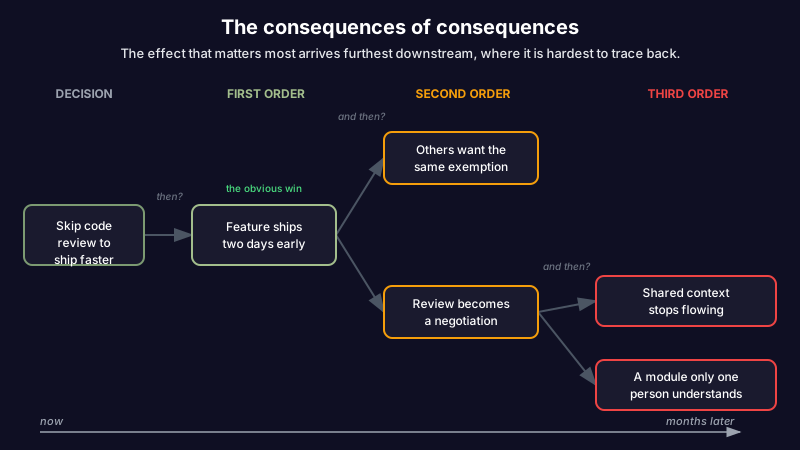
Say you are a team lead and you decide to let one strong engineer skip code review to move faster on a deadline.
| Order | Consequence | What it feels like at the time |
|---|---|---|
| First | That engineer ships the feature two days early | A clear win, exactly what you wanted |
| Second | Two other engineers ask for the same exemption, because the rule now visibly bends for output | Reasonable, they are strong too |
| Third | Review stops being a norm and becomes a negotiation; the one place shared context was passed around quietly disappears | Nobody notices, because nothing breaks yet |
| Fourth | Six months on, the engineer who never gets reviewed leaves, and their code is a bus factor of one that no one else understands | The original deadline is long forgotten |
The first-order effect was real and good. The decision was still a bad one, and you could only see that by refusing to stop at column one. Notice also that the damage compounds through a system, not through a single line of cause and effect. Second-order effects love to travel along the structure of an organization, which is why Conway's Law shows up here: change how a team communicates and you have quietly changed what it can build, whether you meant to or not.
Run this table on any decision where reversing it would be expensive. You do not need every cell to be certain. You need the habit of asking "and then what?" enough times that the non-obvious consequence has a chance to show up before you commit, not after.
When second-order thinking is worth the effort
Second-order thinking has a real cost: it is slow, and applied everywhere it curdles into analysis paralysis. The move is to spend it only where the downstream matters, and the cleanest way to sort for that is the one Amazon uses. In Jeff Bezos's 2015 shareholder letter, a two-way door is a decision you can walk back cheaply, so you should make it fast; a one-way door is expensive or impossible to reverse, so it earns the slow, deliberate treatment.
| The decision | Reversible? | Second-order thinking? |
|---|---|---|
| A choice you can undo in an afternoon | Yes | Skip it. Decide and move; the reversal is your safety net |
| A recurring policy or incentive | Usually not, once people adapt to it | Yes. Incentives are where cobra effects breed |
| A one-way door: a hire, a migration, a public commitment | No | Yes, and slowly. This is the whole reason the skill exists |
| Anything involving other people reacting to your move | Rarely | Yes. Their reaction is the second order you cannot see from your desk |
If you already run decisions through a decision-making framework, second-order thinking is not a competing method; it is the step you add to the high-stakes branch, after you have sorted the decision by reversibility and before you commit. The reversible calls do not need it. The irreversible ones cannot be made responsibly without it.
How to practice it: the "and then what?" template
You do not need a tool for this. You need a prompt you actually run, and a place to write the answers so they do not evaporate. The prompt is four questions, and the fourth is the one that gets skipped:
Decision: what I am about to do
And then what? (2nd order): how will people, systems, or markets react to it?
And then what? (3rd order): what does that reaction cause in turn?
Who else adapts? the effect you cannot see from your own seat
Prediction + revisit date: what I expect to be true by [date], so I can check
Two things make this work. First, force at least two rounds of "and then what?" before you allow yourself to judge any consequence as good or bad; the instinct is to evaluate the first-order effect and quit, and that instinct is the entire problem. Second, and this is the field nobody includes, write down what you actually expect to happen and when you will check. Second-order effects are predictions, and a prediction is a map of a territory you have not reached yet: one you never revisit teaches you nothing.
Where second-order thinking goes wrong
The skill has its own failure modes, and most of them are the result of applying it with more enthusiasm than judgment.
| Failure | What it looks like | The fix |
|---|---|---|
| Analysis paralysis | Running a four-order trace on a reversible, low-stakes call | Sort for reversibility first; only slow down for one-way doors |
| Infinite regress | Chasing consequences to the tenth order until every option looks equally doomed | Stop when the next link stops changing the decision |
| Spurious precision | Assigning confident probabilities to consequences that are genuine guesses | Write the assumption next to the guess, then flag it as a guess |
| Hindsight theater | "Trace" written after the outcome is known, to look wise | Record the prediction before the result, with a date |
| Never checking | Tracing consequences beautifully and never going back to see who was right | A revisit trigger, honored |
The last two are the same mistake wearing different clothes, and they are why the next section matters more than the table above.
The part every guide skips: second-order effects unfold over time
Here is what the "and then what?" advice quietly assumes and never says: the second-order effect is in the future. That is the entire point. The immediate consequence is visible now; the one worth predicting shows up in three months or three years. Which means your second-order reasoning is a bet on the future, and a bet you never settle is not reasoning, it is a feeling you had once.
This is the same half-life problem that sits under every written artifact. A prediction you made about the second-order effects of a decision is knowledge with a shelf life: it was your best reasoning at the time, and time is precisely the thing that will prove it right or wrong. If you do not record it, you get the worst of both worlds. You never learn whether your second-order thinking was any good, so it never improves, and the confident story you told yourself about the consequences hardens into a belief that has quietly gone stale while everyone keeps acting on it.
The fix is not a better mental model. It is a recorded prediction with a revisit date, the same instinct engineers formalize when they record the assumptions behind a decision and note what should trigger a re-check. Capture the "and then what?" while you still know why you believed it. If you write predictions down as the decision happens rather than reconstructing them at review time, the reasoning is still honest, because you had not yet seen how it turned out.
That is the problem Scribelet is built around. A note is not a place you record a prediction and forget it; it is something that fights its own decay, holding the assumptions you wrote down and telling you when a decision or a document you are still relying on has drifted out of date since anyone last checked. You can try it free and keep your second-order predictions somewhere they get re-read against what actually happened, which is the only way the thinking ever gets better.
The whole discipline, in three moves
Second-order thinking is not a trick for looking clever in meetings. It is three habits stacked on each other. Sort the decision first, so you only spend the effort on the one-way doors where the second order carries the cost. Then trace it, at least two rounds of "and then what?" past the obvious answer, paying special attention to how other people and systems will adapt to your move. Then, and this is the move almost everyone drops, write the prediction down with a date, and go back to read it. The first two habits improve the decision in front of you. Only the third improves the decisions you have not made yet.
Share this article