The Map Is Not the Territory: Why Good Models Mislead
Table of contents
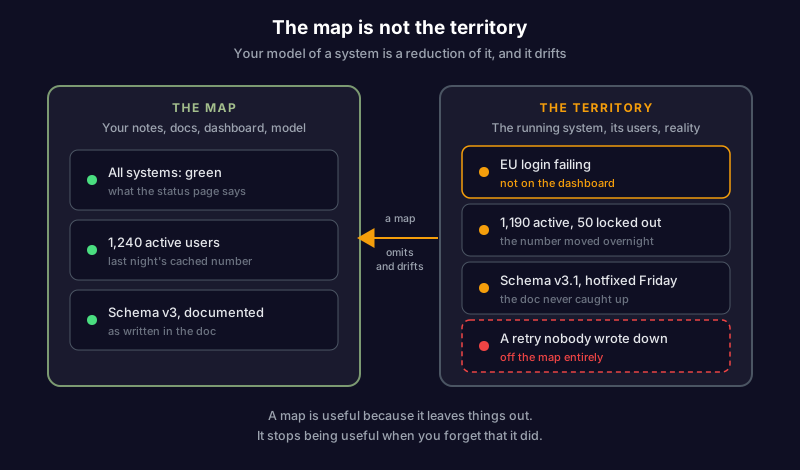
At 2:47 on a Tuesday afternoon the status page is a wall of green. Every service healthy, latency flat, 1,240 active users, the number from last night's rollup. The on-call engineer glances at it, sees nothing to do, and goes back to the ticket they were working on. Meanwhile, in the actual running system, logins from the EU region have been failing for eleven minutes, fifty people are locked out, and a retry loop nobody ever wrote down is quietly swallowing the errors before they reach the dashboard. The map says everything is fine. The territory is on fire.
That gap, between the tidy model you are looking at and the messy reality it claims to describe, has a name that is almost a hundred years old. The map is not the territory. It is one of the most useful mental models there is, precisely because the failure it warns about is so easy to walk into: we build a representation of something, the representation is genuinely useful, and then we quietly start treating it as the thing itself. Here is what the phrase actually means, why every map leaves something out on purpose, how the trap shows up in notes and docs and dashboards and AI output, and how to keep a model honest instead of confusing it for the ground it stands on.
What does "the map is not the territory" mean?
"The map is not the territory" is the idea that any representation of a thing, a map, a model, a description, a set of notes, is never the thing itself, and treating the two as identical leads you astray. The representation is a reduction. It keeps some features of reality and discards the rest, and the features it discards do not stop existing just because they fell off the page.
The phrase comes from Alfred Korzybski, a Polish-American scholar trained as an engineer, who introduced it in a 1931 paper and developed it in his 1933 book Science and Sanity, the founding text of a field he called general semantics. His formulation was careful: "A map is not the territory it represents," but a good map has a structure similar to the territory, and that similarity is exactly what makes it useful. Korzybski was warning against a specific confusion, the habit of mistaking words, labels, and abstractions for the reality they point at. A menu is not a meal. The word "dog" will not bite you. A five-year financial forecast is not the next five years.
The trap matters most for people who work mostly in representations. If your day is spent in documents, dashboards, tickets, diagrams, and models, then almost everything you touch is a map, and the territory, the running system, the real users, the actual market, is something you only ever see through one of those maps. The discipline is to remember, every time, that you are reading a reduction. The cheapest way to do that is to keep the thing a note describes attached to the note itself, so the representation carries a pointer back to the reality it came from instead of floating free as if it were the reality.
Why every map leaves something out
A map that kept every feature of the territory would be the same size as the territory, and useless. Jorge Luis Borges wrote a one-paragraph story about an empire whose cartographers made a map so detailed it covered the land point for point, and was promptly abandoned because nobody could use it. The whole value of a map is in what it omits. A subway map throws away distance, scale, and surface geography so that the one thing a rider needs, which line connects to which, becomes legible. Its uselessness as a walking map is the price of its usefulness as a transit map.
So omission is not a defect to be fixed. It is the function. The problem is never that a map simplifies; the problem is forgetting which simplifications it made, and for whom. The dashboard shows aggregate health because that is usually what you want, which means it is blind to a regional failure by design. The architecture doc shows the components and their intended relationships, which means it is silent about the undocumented retry that is actually load-bearing. Each map answers one question well by refusing to answer the others. When you ask it a question it was never built to answer, it does not warn you. It just gives you a confident, wrong reading, because a map cannot tell you about the territory it left off.
There is a second reason maps mislead, and it is worse than omission because it is invisible. A map is drawn at a moment in time, and the territory keeps moving. The forecast was reasonable the week it was made. The runbook matched the system the day it was written. The note was true when you saved it. Then the territory shifted, the map did not, and the gap between them opened silently, with nothing to mark the moment the two stopped agreeing.
The map is not the territory in knowledge work
For a team that builds and documents software, almost every artifact is a map of some territory, and each one drifts in its own way. Naming them makes the trap concrete.
| The map | The territory it claims to represent | How it drifts |
|---|---|---|
| A monitoring dashboard | The system's real behavior right now | Aggregates hide a regional or edge-case failure; the metric was defined for last quarter's architecture |
| An architecture diagram | How the code actually talks to itself | A hotfix added a path the diagram never drew; a service was split and the boxes never moved |
| The org chart | Who actually decides and who actually talks | The real communication structure the system ends up copying rarely matches the boxes |
| A spec or a doc | What the system is supposed to do | The code shipped a change; the doc never caught up |
| Your notes | What you once learned and believed | The fact changed, or you misread it, and the note still reads as settled truth |
| A model or forecast | What will actually happen | Reality took a path the model's assumptions ruled out |
The common failure in every row is the same. You act on the map, the map is stale or lossy, and the action lands in a territory that no longer matches it. You deploy against the diagram and hit the path it never drew. You reassure a customer from the green dashboard while they cannot log in. You make a six-month plan from a forecast whose central assumption quietly stopped being true in month two. The map did not lie to you on purpose. It just kept saying what it said the day it was drawn, and you kept reading it as the present tense.
This is also why "it's documented" is a weaker guarantee than it sounds. A document is a map. Its existence tells you a representation was created at some point; it tells you nothing about whether the representation still matches the ground. The useful question is never "is there a doc?" but "when was this last checked against the thing it describes?" That single question, asked out loud, catches more stale maps than any amount of writing more docs.
When the map and the territory disagree
The rule for the moment of conflict is short: when the map and the territory disagree, the territory wins, every time. This sounds obvious written down and is remarkably hard to practice, because the map is right in front of you and the territory usually is not.
Watch what people actually do when a measurement contradicts the model. The benchmark comes back three times slower than the design predicted, and the first instinct is "the benchmark must be wrong." The user says the feature is confusing, and the response is "but the flow is clearly labeled in the spec." A test fails and the reflex is to doubt the test before the code. In each case the map (the prediction, the spec, the assumption) is being defended against the territory (the measurement, the user, the test) that is actually reporting reality. That reflex has its own name, the knee-jerk dismissal of evidence that contradicts what you already believe, and the map-territory framing is why it is a mistake: the evidence is a reading from the territory, and the thing it contradicts is only ever a map.
None of this means the territory is always legible. Sometimes the measurement is noisy, the user is unrepresentative, the test is flaky. The point is not to trust every signal blindly. It is to resolve the conflict by going to the ground, not by defending the model from your chair. When a number surprises you, the move is to look at the thing the number came from before you decide the number is wrong. Checking a claim against the world it describes, rather than against the other claims you already hold, is how you keep a map accountable to its territory instead of to your preferences.
The map is not the territory in the age of AI
Large language models make this mental model more useful, not less, because a model's output is a particularly seductive kind of map. When you ask an assistant to summarize a document, explain a system, or tell you what your notes say about a topic, you get back a clean, confident, well-structured representation. It reads like the territory. It is a map of a map: a reduction of whatever text the model was given, which was itself already a reduction of some reality.
Each layer loses something. The notes were a lossy capture of what you learned. The retrieval step pulled a subset of those notes. The model compressed that subset into a fluent paragraph. By the time you read the answer, you are three reductions away from the ground, and the fluency hides every omission along the way. The AI overview that now sits at the top of most search results is the same shape: a competent summary that reads like the final word and is actually a map drawn from whichever sources were handy, blind to everything they left out.
The practical discipline is to treat an AI's confident output the way you would treat any other map: useful for orientation, never a substitute for the territory when the stakes are real. A model will state that your system does X because the docs it read said X, even if the code has done Y since Friday. It is faithfully reporting the map it was handed. The fix is not to distrust the assistant, it is to keep its answers pointed at checkable ground, which is the same reason you would ask what the second-order effects of a decision actually were rather than trusting the prediction you made before it played out.
The version hiding in your own notes
The most personal map you own is your own notes, and they drift exactly like every other one, only more quietly, because you trust them more. You trust a note because you wrote it, not because it still matches reality. That is backwards. The note's authorship tells you it was true to someone, once. It says nothing about whether the territory it described is still there.
A note is a snapshot of your understanding at the moment you saved it. The library you benchmarked was fast in that version. The API returned that shape in that release. The person owned that project before the reorg. The claim was defensible given the study you had read so far. Every one of those can go stale without the note changing a character, and when you reach for the note months later it presents its stale reading with exactly the same confidence it had on day one. This is the slow, silent decay of a knowledge base: not notes being wrong when written, but notes staying frozen while the territory moves on under them.
The defense is to make your notes behave less like a finished map and more like one that knows when it was last surveyed. Keep the source attached, so a claim can be re-checked against where it came from. Keep the date and the uncertainty attached, so a six-month-old benchmark reads as a six-month-old benchmark and not as current fact. Treat a note that drives a real decision as a claim to re-verify, not a truth to inherit. This is the same instinct that makes you investigate why a strange piece of code exists before you delete it: the artifact in front of you is a map of a decision, and you do not know whether it still matches the territory until you go and look.
Don't throw away the map
The mistake this mental model warns about is confusing the map for the territory. It is not a case against maps. Maps are how finite minds navigate an infinitely detailed world; a team with no shared model of its own system is not more in touch with reality, it is just lost. The cure for a stale map is a fresher map, not no map, and the cure for a lossy abstraction is usually a second abstraction that keeps the features the first one dropped. Korzybski's own point was that a good map, one whose structure genuinely tracks the territory, is enormously valuable. The failure is forgetting that even a good map is a reduction drawn at a moment in time.
So the working version of the principle is not "distrust all models." It is three habits. Know which territory each of your maps describes, and which questions it was never built to answer. When a map and the ground disagree, go to the ground. And treat every representation you keep, the doc, the dashboard, the note, the model's summary, as something with a survey date, due for a re-check against reality before you bet anything important on it. A map you keep honest is one of the most powerful tools you have. A map you forgot was a map is how confident teams walk into walls they had already drawn and then stopped looking at.
For a longer treatment of the idea as a thinking tool, Farnam Street's essay on the map and the territory is the standard reference, and it makes the same core point from a decision-making angle: the models we use to simplify complexity are useful right up until we mistake them for the complexity itself.
Getting started
The map is not the territory is worth keeping near the front of your mind precisely because the trap is so comfortable. The representation is clean, it is right in front of you, and the reality it stands for is messy and somewhere else. Reaching for the map instead of the territory is the path of least resistance almost every time.
You can push back on that with a few durable habits: ask when each map was last checked against the thing it describes, resolve a conflict by going to the ground rather than defending the model, and keep every claim you save attached to its source and its date so a frozen note cannot pass itself off as current fact. Try Scribelet free and let it hold your notes as living maps, with their sources attached, their freshness visible, and an assistant that checks a claim against the world instead of trusting the map because it reads well. Deciding which framework or model fits the problem in front of you is its own skill; our guide to choosing a decision-making approach is a good next step once you have stopped mistaking the map for the ground it covers.
Share this article