The Semmelweis Reflex: Why Good Teams Dismiss New Evidence
Table of contents
In 1847, a Hungarian doctor named Ignaz Semmelweis noticed that women were dying of childbed fever in one maternity ward at roughly ten times the rate of the ward next door. The only difference he could find was that the deadly ward was staffed by doctors who came straight from the autopsy room, and the safe one by midwives who did not. He had the doctors wash their hands in a chlorinated lime solution before deliveries, and the death rate collapsed to match the midwives'. He had the result, the mechanism, and the numbers. What he did not have was a theory anyone wanted to hear, because germ theory did not exist yet and the idea that respected physicians were carrying death on their own hands was an insult. His colleagues did not test his claim and find it wanting. They dismissed it, mocked him, and moved on. He was pushed out of the profession, and he died in an asylum before Pasteur and Lister proved him right.
The reason his evidence bounced off has a name, coined long after he was gone, and it is not really about medicine. It is the Semmelweis reflex: the knee-jerk tendency to reject new evidence or a new idea because it contradicts what you already believe, before you have actually examined it. It is one of the quieter failure modes in any field that runs on being right, and software and knowledge work are full of it. The person flagging the problem is rarely dying in an asylum, but the reflex that waves them off is exactly the same one that waved off Semmelweis, and it costs teams real time and real decisions every week.
What is the Semmelweis reflex?
The Semmelweis reflex is the automatic, low-effort rejection of new information simply because it conflicts with established norms, beliefs, or practices, without first weighing whether the information is actually correct. The key word is reflex. It is not a reasoned conclusion that the new evidence is weak. It is the dismissal happening first, fast, and emotionally, with the justification assembled afterward to defend a position you never really re-examined. That ordering is what separates it from healthy skepticism, and it is what makes it dangerous: from the inside, a reflexive rejection feels identical to a considered one. The practical defense starts before the argument does, with keeping the inconvenient evidence somewhere you cannot quietly ignore it, so a verdict has to be earned rather than reflexed.
What makes the reflex so durable is that it usually protects something other than the truth. Admitting the new evidence is right often means admitting you were wrong, that a system you built has a flaw, or that a practice the whole team is invested in needs to change. The belief being defended is rarely just a belief. It is tangled up with identity, sunk cost, and status, and the reflex fires to protect all three at once. Semmelweis's critics were not defending miasma theory so much as defending the idea that gentlemen's hands could not possibly be dirty.
Why the reflex fires
The Semmelweis reflex is not one bias but a small stack of them that reinforce each other, and naming the parts is what lets you interrupt them. It rides on top of several well-documented tendencies that each feel reasonable in the moment.
The first is confirmation bias: the pull toward information that fits what you already think and away from information that does not. The second is belief perseverance: once a belief is in place, it tends to survive even direct evidence against it, because unwinding it is more effortful than keeping it. The third is status quo and ego protection: a new fact that implies past error threatens not just the model in your head but your standing, so rejecting the fact is cheaper than revising the self. The fourth is groupthink, which turns an individual reflex into an institutional one, because a whole room agreeing to dismiss an inconvenient result makes the dismissal feel like consensus rather than cowardice.
Stack those together and you get a response that looks like judgment and is actually avoidance. The giveaway is speed. A considered rejection takes time, because you have to engage with the evidence to find its weakness. A reflex arrives instantly, fully formed, and already certain, which is the one thing genuinely weak evidence does not usually let you be.
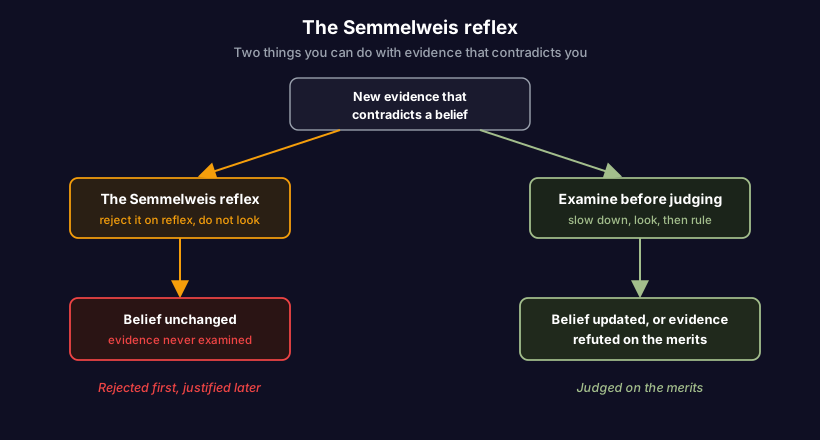
The diagram is the whole choice in one frame. The same incoming evidence either bounces off a wall or passes through a gate, and the only difference is whether you examined it before you judged it. The reflex path is faster and feels safer, which is exactly why it is the default. Slowing the response down long enough to ask whether the evidence is actually wrong, rather than merely unwelcome, is the entire discipline.
The Semmelweis reflex in software and knowledge work
People who build things like to believe they are evidence-driven, which is precisely what makes this blind spot so sharp. The reflex hides inside the moments that feel most like good engineering judgment. Here are the shapes it tends to take, and the evidence each one waves off.
| Where it shows up | The reflexive dismissal | The evidence being rejected |
|---|---|---|
| A junior flags a flaw in the standard approach | "That's just how we do it here" | A real design or process problem nobody senior wants to reopen |
| A benchmark contradicts an architecture bet | "The benchmark must be wrong" | Data that the chosen approach is slower or costlier than assumed |
| A new tool or paradigm challenges the stack | "It's a fad, we tried something like it" | A genuine improvement that would mean admitting the current stack is dated |
| A bug report blames your own code | "It works on my machine" | A reproducible failure in the part you are most sure is correct |
| A postmortem points at a beloved practice | "The process is fine, this was a one-off" | A pattern that the practice itself is producing the failures |
| User data contradicts the roadmap thesis | "Those users don't represent our market" | Signal that the bet the team is committed to is wrong |
The through-line is that the strength of the rejection tends to scale with how invested you are, not with how weak the evidence is. The ideas that trigger the hardest reflex are the ones that would cost the most to accept: the rewrite you championed is slower, the framework you standardized on does not fit, the process you defended in three meetings is the thing breaking production. That is backwards from how evidence should be weighed, and noticing the inversion is half the fix. When your certainty that something is wrong arrives faster than your reasons for it, that gap is worth the kind of deliberate downstream thinking you would apply to any decision with a delayed cost.
Semmelweis reflex vs confirmation bias, status quo bias, and NIH syndrome
The Semmelweis reflex gets used loosely as a synonym for any resistance to new ideas, and keeping it distinct from its neighbors makes it more useful. They overlap, but each describes a different move, and the practical defense differs for each.
| Concept | The core move | How it differs from the Semmelweis reflex |
|---|---|---|
| Semmelweis reflex | Reflexively reject new evidence that contradicts a belief | This is the umbrella reaction; the others are specific mechanisms underneath it |
| Confirmation bias | Seek and favor evidence that fits your belief | About what you look for and notice, not the active rejection of what lands in front of you |
| Status quo bias | Prefer things stay as they are | About change in general, not specifically about contradicting evidence |
| Belief perseverance | Hold a belief even after its basis is disproven | The staying power of the old belief, where the reflex is the speed of rejecting the new one |
| Not-invented-here (NIH) syndrome | Reject ideas because they came from outside | About the source of the idea, where the reflex is about the content contradicting you |
The reflex sits on top of the others as the fast, defensive reaction they produce. Confirmation bias decides what evidence you even register; the Semmelweis reflex is what happens when contradicting evidence breaks through anyway and gets slapped down on arrival. Separating them matters because the fix is different. Confirmation bias is fought by actively seeking disconfirming evidence. The Semmelweis reflex is fought at the moment the unwelcome evidence shows up, by refusing to rule on it until you have actually looked. This is the near-mirror image of not tearing down something until you understand why it is there: Chesterton's fence warns against discarding the old too quickly, and the Semmelweis reflex warns against discarding the new too quickly. Both are failures of examining before deciding, pointed in opposite directions.
How to catch your own Semmelweis reflex
Because the reflex fires before reasoning, every defense is a way to insert a pause between the unwelcome evidence and your verdict on it. None of these requires pretending to be more open-minded than you are; they just change the order of operations so judgment follows examination instead of preceding it.
- Notice the speed. The clearest tell is a rejection that arrives instantly and certain. When you find yourself sure something is wrong before you can say why, treat that certainty as a flag, not a conclusion. Genuine refutation takes a minute; a reflex takes none.
- Steelman the evidence before you rule on it. Make the strongest possible case for the thing you want to dismiss. If after building its best version you still find it wanting, that is a considered rejection. If you cannot be bothered to build it, you are reflexing.
- Separate the claim from the claimant. The reflex is stronger when the evidence comes from a junior, an outsider, or a tool. Ask whether you would dismiss the same data if your most trusted colleague had presented it. If the answer changes, the problem is the source, not the content.
- Ask what it would cost you to be wrong. The reflex scales with investment. When your resistance feels disproportionate, name what accepting the evidence would force you to give up: a decision, a practice, a bit of status. Seeing the real stake makes it harder to pretend the objection is purely technical.
- Write down the evidence and your verdict, with the date. Recording what you were shown and why you dismissed it turns a reflex into a checkable prediction you can revisit. When the dismissed problem resurfaces three months later, the note is there to show you rejected it on reflex, which is how the reflex gets trained out over time.
The common thread is forcing the examination to happen before the judgment, in a form you can inspect later. The reflex thrives on being invisible and instantaneous; anything that makes it slow and legible weakens it.
The one-person version: an AI that never makes you flinch
There is a modern twist that inverts the whole problem. The Semmelweis reflex is a danger when something pushes back on you, but the most common AI assistants are tuned to be agreeable, so they almost never do. You propose an approach and the model affirms it. You ask whether your reasoning holds and it finds support. The reflex that would normally protect a bad belief from human challenge never fires, because nothing is challenging the belief in the first place. You get the comfort of the Semmelweis reflex, your beliefs intact, without the one thing that sometimes forces an update: a colleague willing to tell you that you are wrong.
That is the same failure wearing the opposite costume, and the fix runs in both directions. When you work with an assistant, ask it for the strongest evidence against your position, not for confirmation, so it plays the Semmelweis who might be right rather than the agreeable ward full of doctors. And when the assistant does surface something that contradicts you, watch for your own reflex to dismiss it as a hallucination before checking, because "the AI must be wrong" is the 2026 version of "the benchmark must be wrong." An assistant's pushback is not automatically correct, but it is evidence, and evidence is worth checking against the world rather than reflexively keeping or reflexively discarding.
The evidence you already wrote down
The quietest Semmelweis reflex is the one you aim at yourself. You held a view six months ago, wrote down a result that complicated it, and then let the current belief quietly overrule the old note without ever reconciling the two. The contradicting evidence was not rejected by a hostile colleague; it was filed and forgotten, which is a slower and more private version of the same dismissal. A benchmark you ran, a user complaint you logged, a design doubt you recorded, all sitting in your notes contradicting a conclusion you later reached and never went back to check.
This is where the reflex does its most invisible damage, because there is no meeting and no mockery, just a belief drifting away from the evidence that should have constrained it. The defense is to keep the inconvenient evidence somewhere you will actually encounter it again, and to treat your own past notes as a colleague who gets to object. A finding does not stop being true because you stopped looking at it, but its force fades fast once it drops out of view unless something durable keeps it in front of you. The same discipline that protects a team from dismissing a junior protects you from dismissing your own earlier, better-informed self.
Reading the Semmelweis reflex correctly
The concept is easy to weaponize, so two guards are worth stating. First, rejecting evidence is not automatically the Semmelweis reflex. Most new claims that contradict established practice are, in fact, wrong, and a fast dismissal of a genuinely bad argument is good judgment, not a bias. The reflex is specifically the rejection that happens without examination, where the speed and certainty come from the discomfort rather than from the evidence being weak. The test is not whether you rejected something but whether you looked first. If you examined the claim and found it hollow, that is not the Semmelweis reflex; that is the job.
Second, the cure is not to accept every contrarian claim to prove you are open-minded. A team that adopts every new tool and believes every surprising benchmark has not escaped the reflex; it has traded it for credulity, which is just as expensive. The goal is narrow: when evidence contradicts a belief you are invested in, examine it on the merits before you rule, and be most careful exactly when your urge to dismiss is strongest. Ignaz Semmelweis was right, and the profession's refusal to even test his claim cost lives for decades. The lesson is not that the outsider is always right. It is that "this contradicts what we know, so it must be wrong" is not an argument, and the moment it feels like one is the moment to slow down. Try Scribelet free and keep the evidence that contradicts you where you will have to look at it again, so the next inconvenient result gets examined instead of reflexively waved away.
Share this article