The Abilene Paradox: When a Team Agrees to Something Nobody Wants
Table of contents
The meeting ran twenty minutes and everyone said yes. The proposal was to rewrite the service from scratch, a six-month detour that would freeze new features and carry every risk a rewrite carries. The tech lead presented it, looked around the room, and got nods. The senior engineer who had lived through the last rewrite said it sounded reasonable. The product manager, who privately thought the current service was fine, did not object because engineering seemed to want it. The engineer who had actually filed the bug that started the conversation stayed quiet, because everyone more senior than her was already on board. The plan was approved with what looked like complete agreement, and the team spent the next two quarters on a rewrite that, when it was finally cancelled, not one person in that room had actually wanted.
Afterward, in ones and twos, the truth came out. The tech lead had floated the rewrite as a trial balloon and assumed the enthusiasm was real. The senior engineer had misgivings but read the room as decided. The product manager had deferred to engineering. The junior engineer had deferred to everyone. Every single person had privately been against it, and every single person had publicly supported it, each one managing their own doubt out of a fear that they were the lone holdout, a doubt that never made it anywhere the team could see it. That is not a failure of analysis or a lack of talent. It is a specific, named, repeatable failure of agreement, and it has been studied since 1974. It is called the Abilene paradox.
What is the Abilene paradox?
The Abilene paradox is a situation in which a group collectively agrees to a course of action that no individual member actually wants, because each person mistakenly believes everyone else is in favor and does not want to be the one to object. It is a failure to manage agreement rather than a failure to manage conflict, and that is what makes it so hard to see: nothing looks wrong. There is no argument, no deadlock, no visible dissent. The group moves smoothly toward a decision that quietly contradicts the private preferences of everyone in it.
The term was coined in 1974 by management professor Jerry B. Harvey, who illustrated it with a story about his own family. On a hot afternoon in Coleman, Texas, everyone was content playing dominoes on the porch when someone suggested driving fifty-three miles to Abilene for dinner. Harvey thought it was a bad idea but agreed because he assumed the others wanted to go. His wife agreed because she thought her parents wanted to go. Her parents agreed for the same reason about everyone else. They made the long, hot, miserable round trip, ate a bad meal, and came home exhausted, only to admit one by one that none of them had wanted to go in the first place. They had driven to Abilene to satisfy a consensus that did not exist. The useful thing to carry forward is not the anecdote but the mechanism, and the mechanism shows up far more often at work than it ever did on that porch.
Why agreement fails where conflict would not
The Abilene paradox runs on a handful of mental moves that each feel reasonable in the moment and combine into something absurd. Harvey's original paper, archived by MIT, traces the chain, and it is worth naming the parts because you can intervene on each one.
The first is pluralistic ignorance: every person privately disagrees but assumes they are the only one, because everyone else is publicly going along. The second is action anxiety: the fear of what will happen if you speak up, which almost always turns out to be worse in your head than in the room. The third is what Harvey called negative fantasies, the vivid imagined consequences of objecting, being seen as difficult, blocking the team, looking foolish, that make silence feel safer than honesty. Stack those together and you get a group where every member is privately braking and publicly accelerating.
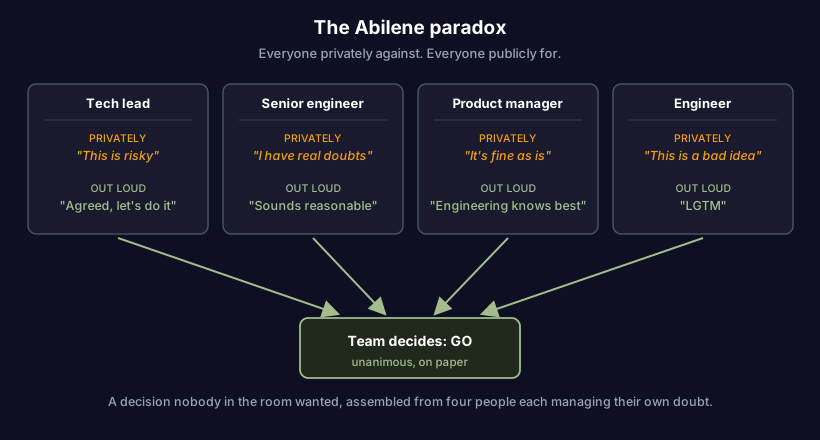
The diagram is the whole trap in one frame. The private column and the public column point in opposite directions, and only the public column reaches the decision. What makes this different from an ordinary bad call is that the information needed to stop it was in the room the entire time. Four people knew the plan was weak. The failure was not ignorance; it was that nobody's private knowledge ever became public, so the group acted on a phantom agreement instead of on what its own members actually believed. If you capture the quiet doubts before they evaporate, which is the kind of thing worth writing down somewhere you can actually check later, the phantom has nowhere to hide.
The Abilene paradox in software and knowledge work
Teams that build things are unusually prone to this, because so many decisions are made in rooms full of smart people who all want to seem aligned and capable. The paradox hides inside the moments that feel most collaborative. Here are the shapes it tends to take, and the private doubt each one buries.
| Where it shows up | What the room says out loud | What people privately think |
|---|---|---|
| A from-scratch rewrite or big migration | "Agreed, this is the right time to do it" | "The current system is fine and this is a huge risk" |
| Adopting a new framework or tool | "Everyone's using it, let's standardize on it" | "This does not fit our problem and nobody vetted it" |
| A sprint commitment in planning | "Yep, we can hit that" | "That estimate is fantasy and we all know it" |
| Approving a design or architecture doc | "Looks good, ship it" | "I have real concerns but the author seems set" |
| A rubber-stamp pull request approval | "LGTM" | "I did not actually read this closely" |
| Keeping a painful recurring meeting | "It's useful, let's keep it" | "No one on this call wants to be here" |
The through-line is that silence gets read as consent, and consent gets read as enthusiasm. In a sprint planning session, the Abilene paradox is why teams commit to timelines nobody believes in; the moment one person says the estimate is achievable, agreeing is cheaper than being the one who says it is not. In a design review, it is why a document with real problems sails through: the author looks committed, each reviewer assumes the others are satisfied, and "looks good" costs nothing while "I have concerns" costs a hard conversation. The "LGTM" on a pull request nobody read is the smallest, most frequent trip to Abilene there is. Noticing when a decision is being made by phantom consensus is exactly the sort of downstream reasoning worth doing deliberately rather than by reflex, because the cost of the trip does not arrive until later.
Abilene paradox vs groupthink
The Abilene paradox gets conflated with groupthink constantly, and keeping them apart makes both sharper. They look identical from the outside, a group agreeing to a bad decision, but the internal state of the people in the room is the opposite in each case, which means the fix is different too.
| Abilene paradox | Groupthink | |
|---|---|---|
| What members privately believe | They disagree with the decision | They have talked themselves into agreeing |
| The core failure | Mismanaged agreement; nobody voices real dissent | Suppressed doubt; the group manufactures consensus |
| Why people go along | Each assumes everyone else is in favor | Pressure to conform; dissent feels disloyal |
| The giveaway | Private regret surfaces immediately afterward | The group defends the decision even after it fails |
| The fix | Surface genuine individual preferences | Protect and reward real dissent |
In groupthink, the group genuinely convinces itself a bad idea is good, and members will defend the decision long after it goes wrong. In the Abilene paradox, nobody is convinced of anything; they privately disagree the whole time and the regret shows up the instant the meeting ends. That difference matters because the remedy is not the same. Groupthink needs you to break a false consensus that people believe in. The Abilene paradox needs you to reveal that the consensus was never real. One is about changing minds; the other is about reading them accurately in the first place.
How to avoid the trip to Abilene
The paradox is a communication failure, so every defense is a mechanism that forces private preferences into the open before a decision locks in. None of these requires a personality transplant or a braver team. They just change where and how the agreement gets tested.
- Ask for the strongest objection, not for agreement. "Does anyone disagree?" invites silence. "What is the best argument against this?" or "What would have to be true for this to be a mistake?" gives the quiet dissenter permission and a script.
- Have the leader speak last. The moment the most senior person states a preference, everyone below recalibrates to it. Harvey's own prescription, echoed across the practitioner write-ups, is that whoever holds the authority withholds their view until everyone else has shown their hand.
- Collect input privately before the group converges. A quick written round, each person noting their real position before anyone speaks, defeats pluralistic ignorance directly, because you cannot assume everyone else is in favor once you can see that they are not. Harvey recommended anonymous input for exactly this reason.
- Separate the trial balloon from the commitment. A lot of Abilene decisions start as someone thinking out loud and getting mistaken for a proposal. Name which one it is: "I am floating this, not proposing it."
- Write down the real reasoning, including the doubts. A decision that records why it was made, and what reservations people had, is far harder to drift into by accident, and it leaves a trail you can check when the decision is questioned later. This is the same discipline as recording the reasoning behind any decision so a choice can be understood, and reversed, by whoever inherits it.
The common thread is that you are trying to make the cost of honesty lower than the cost of silence, right at the point of decision. The paradox feeds on the asymmetry where going along is free and speaking up is expensive. Flip that asymmetry and the trip to Abilene mostly cancels itself.
The one-person Abilene paradox: an agreeable AI
There is a version of this that needs no group at all, and it is getting more common. An AI assistant that is tuned to be helpful and agreeable will tend to endorse whatever you propose. You float a plan, it tells you the plan is sound. You ask whether an approach is a good idea, it finds reasons it is. You have, in effect, assembled a one-person Abilene paradox: you are the group, the assistant is the member who will not rock the boat, and the two of you can nod your way into a decision you would never have reached if either had pushed back.
The fix is the same as it is for a team. Ask the assistant for the strongest case against your plan, not for validation. Make it argue the other side. And treat its agreement the way you should treat a quiet room: pleasant, but not evidence. An assistant that always agrees is not giving you a second opinion, and a note that records only the conclusion you liked, stripped of the objection you never raised, is the same phantom consensus in slow motion, the kind of claim worth checking against the world rather than inheriting whole.
The dissent that never got recorded
The lasting damage of an Abilene decision is not the one bad trip. It is that the reasoning never gets written down, because officially there was no disagreement to record. The rewrite that nobody wanted goes into the record as "team decided to rewrite," full stop, with none of the four private objections attached. Six months later, when someone asks why the team committed to it, there is no honest answer in the archive, only the phantom consensus, and the real reasons, each person's unspoken doubt, are gone.
This is how a team's decision-making memory rots. A choice made by mismanaged agreement looks, in hindsight, like a choice the team actively made, which teaches exactly the wrong lesson for next time. The defense is to capture the real state of the room, not the official one: the objections raised and waved off, the reservations nobody wanted to be the first to voice, the fact that the "yes" was softer than it sounded. A decision record that holds the doubts alongside the decision is the difference between a team that learns from an Abilene trip and one that takes the same drive again next quarter, because the reasoning behind a choice decays fast once the meeting ends unless something durable holds it.
Reading the Abilene paradox correctly
The concept is easy to overextend, so two guards are worth stating. First, not every agreement is a phantom. Sometimes a team says yes because it genuinely means yes, and reading real consensus as secret dissent is its own kind of paranoia. The tell for a true Abilene case is the private regret that surfaces immediately afterward; if people are still satisfied a week later, it was agreement, not the paradox. Do not go hunting for buried dissent that is not there.
Second, the answer is not to treat every smooth decision as suspect and manufacture conflict to prove the consensus is real. A team that cannot agree on anything without a staged fight has traded one dysfunction for another. The goal is narrow and specific: make it safe and cheap for a real objection to surface before the decision locks, so that when the group does agree, you can trust the agreement. The Abilene paradox is not an argument against consensus. It is an argument for making sure the consensus you are acting on actually exists. The cheapest way to do that is to give every quiet doubt a place to land, and to write the real reasoning down while the room still remembers it. Try Scribelet free and keep your team's decisions with the doubts and the reasons attached, so the next trip to Abilene gets called off before anyone gets in the car.
Share this article