Feature Creep: Why Products Bloat and How to Stop It
Table of contents
The app started as one screen. You typed a thing, it saved the thing, done. Then someone wanted tags, so tags went in. Then a customer asked for folders, and folders were reasonable, so folders went in too. A big account needed a permissions model, and you were not going to lose the account, so that went in. Two years later the settings page has forty toggles, the onboarding takes six screens, and a new user opens the thing that used to do one job and cannot find where to type. Nobody decided to build that product. It accreted, one reasonable yes at a time.
That accretion has a name. Feature creep is the slow, uncontrolled growth of a product past the job it was built to do, and it is almost never the result of a bad decision. It is the result of a hundred individually defensible ones, made by people who could not see the sum. The dangerous part is exactly that each step looks fine in isolation. You cannot fight feature creep by making better single decisions, because the single decisions were already fine. You fight it by keeping the shape of the whole in view while you make them. Here is what feature creep actually is, why it happens even to careful teams, and the specific practices that keep a product from bloating into something nobody meant to build.
What is feature creep?
Feature creep is the continuous, incremental addition of features to a product beyond its original scope, to the point where the additions start to undermine the product rather than improve it. Each new feature arrives with a real reason: a customer request, a competitor's checkbox, an internal idea nobody wanted to say no to. The problem is not any one feature. The problem is the cumulative weight of all of them landing on a product that was designed to carry less.
It shows up as a specific set of symptoms. The interface grows more surface area than a new user can learn. The codebase grows more paths than the team can test. The roadmap grows more commitments than the release can hold, so ship dates slip. And the original thing the product did well gets harder to find under everything layered on top of it. The classic shorthand is the software that tried to please everyone and ended up serving no one particularly well. The same accretion carries a hidden performance cost, the product growing heavier as it grows wider, which is exactly what Wirth's law describes: software slowing down about as fast as hardware speeds up.
Feature creep is close kin to scope creep, and the two are often used interchangeably, but the distinction is worth holding. Scope creep is a project-management problem: the agreed boundaries of a piece of work expand while it is in flight. Feature creep is a product problem: the product itself grows past the coherent thing it was meant to be, release after release, often across years and multiple teams. Scope creep blows a deadline: every mid-flight addition re-opens an estimate range that was starting to close, so the plan is measuring a target that keeps moving. Feature creep blows the identity of the product. The same pull compressed into a single afternoon, where one prerequisite task spawns the next until you have lost the thread of what you sat down to do, is yak shaving. If your notes about what the product is for have drifted out of date, you are already most of the way there, and keeping that kind of reasoning current is a problem worth solving on purpose.
Why feature creep happens even to careful teams
Feature creep is not a discipline failure. It is the default outcome of forces that push in one direction, and almost nothing pushes back. Adding is visible, additive, and easy to justify in a single meeting. Not adding is invisible, feels like loss, and requires an argument nobody has time to make. Left alone, a product only grows.
The pressure comes from a few recurring sources, and naming them is the first step to resisting them.
| Where the pressure comes from | Why it is hard to refuse |
|---|---|
| A big customer's request | Saying no risks the account, so the feature ships even when it fits nobody else |
| A competitor's feature list | "They have it and we don't" reads as a gap, even when the feature is dead weight for both of you |
| An internal idea with a champion | Someone senior wants it, and the cost of arguing exceeds the cost of building it |
| The urge to out-build the last version | The second-system effect: the follow-up to a lean first release tends to accumulate every feature the first one left out |
| The sunk-cost of a half-built thing | It is nearly done, so it ships, even though "nearly done" is where scope goes to hide |
| A vague original spec | With no clear line for what is in and out, every request looks equally in-scope |
Notice what every row has in common: the reason to add is loud and immediate, and the reason to hold the line is quiet and long-term. Each feature is a small decision with a clear upside and a diffuse, deferred cost, which is exactly the shape of decision humans make badly. This is where second-order thinking earns its place: the first-order effect of a feature is "the customer is happy," and the second- and third-order effects are the added test surface, the slower onboarding, the maintenance nobody budgeted, and the next feature that now has to be compatible with this one. Judge only the first order and you will say yes every time.
Want your product's scope to survive its own success? Start with a written boundary you can point back to. Try Scribelet free and keep the "what this is for" note somewhere it stays true.
Feature creep examples
Feature creep is easiest to recognize in products you already know. The pattern repeats across every category of software.
| Situation | What feature creep produced |
|---|---|
| A simple utility app adds "just one more" mode each release | A settings screen with dozens of toggles most users never touch and cannot understand |
| A messaging tool bolts on tasks, calendars, and docs | A slower app that does five jobs adequately and its original job worse than before |
| A B2B product says yes to every enterprise deal | A configuration surface so large that no two customers run the same product, and support cannot reproduce bugs |
| A game keeps adding systems during development | A release date that slips for years while the core loop stays unfinished under the new systems |
| An API grows a parameter for every edge case | A signature no one can call correctly without reading the whole changelog |
The shape in every row is the same. The feature that caused each problem was, on the day it shipped, a defensible call. The damage is only visible in aggregate, which is why it is so rarely caught by the person approving the individual feature. Read any single decision and it looks fine. Read the sum and the product has lost its center.
Feature creep vs. healthy growth: how to tell them apart
The hard part is that not all growth is creep. Products should add features. The skill is telling a feature that deepens the product from one that dilutes it, and that judgment can be made deliberately instead of by gut. Run each proposed addition through the same questions, and the difference gets sharp fast.
| Question | Healthy growth | Feature creep |
|---|---|---|
| Who is it for? | A core user you already serve, doing the job the product exists for | A single account, or "someone," or a hypothetical user nobody can name |
| Does it deepen the core or widen it? | Makes the main job better or faster | Adds a new, unrelated job the product now half-does |
| What is the real cost? | Understood and accepted, including maintenance | Estimated as build time only, with the ongoing cost ignored |
| What does it displace? | A conscious tradeoff against something less valuable | Nothing named, because "we can do both" was assumed |
| Would you build it if it were not free? | Yes, it earns its place against alternatives | Only because refusing felt worse than building |
A feature that answers the left column is worth adding even though it grows the product. A feature that answers the right column is creep wearing the costume of progress. The bias to protect is the one the whole keep-it-simple principle was written to defend: when two designs solve the same problem, the smaller one is usually the better product.
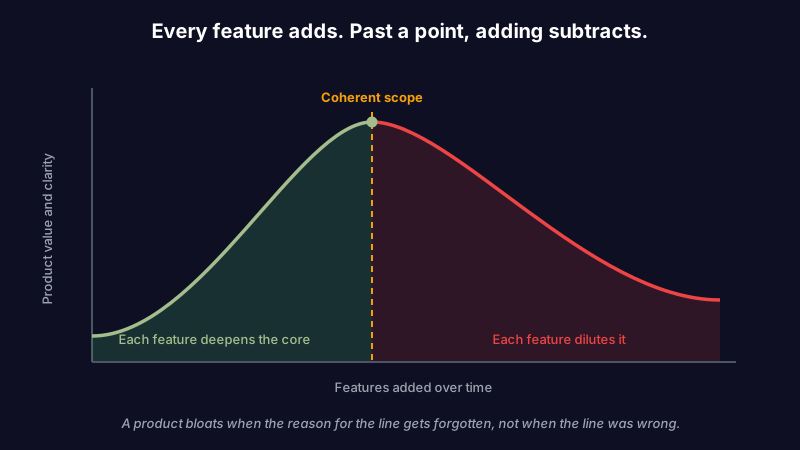
The peak is the point worth naming. Before it, every feature you add makes the product better at its job. After it, every feature you add makes the product worse at its job even though each one, in isolation, still looks like an improvement. Feature creep is simply the failure to notice you have crossed the peak, and you cross it one reasonable yes at a time. The questions matter more than any single answer, because they force the diffuse cost into the open where it can lose to a better use of the same effort. This is a decision worth making with a framework rather than by whoever asked most recently or most loudly.
How to prevent feature creep
Preventing feature creep is not about saying no to everything. It is about making the cost of "yes" visible at the moment of decision, so the easy add has to earn its place against the quiet long-term price. A few practices do most of the work.
Write the scope down before you build, and name what is out. A product or design document that states the job the release is for gives every later request a line to be measured against. The out-of-scope list matters more than the in-scope one, because it is the thing you will be tempted to quietly violate. A technical spec with an explicit "what we are not building" section is the cheapest anti-creep tool there is.
Record every feature decision, including the noes. The reasons a feature was rejected are the first thing a team forgets, and a forgotten no becomes a yes the next time someone asks. Capturing the decision the way you would an architecture decision record, with the rationale attached, means the second request for the same feature meets the first answer instead of starting fresh.
Make someone accountable for subtraction. Addition has a hundred champions; removal has none unless you assign it. A product owner whose job explicitly includes cutting and simplifying, not only shipping, is the counterweight the default is missing.
Budget the ongoing cost, not just the build. Every feature is a permanent liability: it has to be tested, documented, supported, and kept compatible with everything that comes after. Estimate that recurring cost when you approve the feature, and a surprising number of "quick wins" stop looking cheap.
Use a short, standing record for each request so the decision and its reasons survive the meeting. Something this simple is enough:
| Field | What to capture |
|---|---|
| Request | The feature, in one line, and who asked |
| Job it serves | The core user and the job, or "none identified" |
| Real cost | Build plus the ongoing test, support, and maintenance burden |
| Decision | In, out, or deferred, with the date |
| Why | The one-sentence reason, so the next person who asks meets it |
| Revisit | When this should be re-examined, if ever |
The point of writing it down is not bureaucracy. It is that the reasoning is the thing that decays, and a decision you can no longer explain is one you cannot defend when the same request comes back.
The part nobody maintains: your scope decays too
Here is the failure mode underneath all of this. Feature creep is usually framed as a willpower problem, as if teams just need to say no more often. That framing misses why careful teams still bloat their products. The real cause is that the reasons behind the product's boundaries go stale, and once the reasons are gone, the boundary is indefensible.
Think about what actually happens. On the day you decided not to build calendar integration, you had good reasons: it served a user you were not targeting, the maintenance cost was high, it pulled focus from the core. Those reasons lived in someone's head, or in a Slack thread, or in a spec nobody has opened since. A year later a new PM gets the same request, cannot find the reasoning, and cannot see any reason not to build it. So it ships. The boundary did not fall because anyone disagreed with it. It fell because the argument for it decayed and left the boundary standing there naked, and a boundary you can no longer explain is a boundary you will eventually cross.
This is the same rot that hits every kind of working knowledge, and it hits scope decisions especially hard because they are rarely written down as decisions in the first place. This is the problem Scribelet is built for. Its background agents re-check your notes and docs against reality on a schedule and show you a diff when something no longer holds, so the reasoning behind a "no" stays attached to the "no" instead of evaporating. Your keys, your model, your data: the agents run on the provider you choose, and you see exactly what changed and why. A product scope document that has quietly gone out of date is worse than none, because the team still trusts it while it silently permits the next feature. Keeping the why current is what turns a one-time decision into a boundary that actually holds, and it is the same discipline that fights knowledge decay everywhere else in your work. When only one or two people remember why the product is shaped the way it is, you also have a bus factor problem sitting on top of your feature-creep one.
Getting started
Feature creep is not a moral failing and it is not solved by heroic restraint. It is the predictable result of a system where adding is easy and remembering why you said no is hard. Fix the second half and the first takes care of itself.
Start with one document: write down what your product is for and, more importantly, what it is not for. Then record each feature decision against it, the noes as carefully as the yeses, with the reasoning attached. The reasoning is the part that decays, so it is the part worth maintaining. Try Scribelet free and let it keep your scope notes honest as the requests keep coming. A product stays focused not because its team never adds anything, but because it can still explain, a year later, why it drew the line where it did.
Share this article