The Second-System Effect: Why Rewrites Balloon
Table of contents
The first version shipped in four months and it was a little ugly and it worked. You cut the reporting module, you hardcoded the thing that should have been configurable, you shipped one integration instead of the five people asked for. Every corner you cut, you cut because you were not sure you would make it, and you noted each one with a quiet promise: next time, we do it right. Now the product is a success, you know the domain cold, and the rewrite is greenlit. This is the one you build properly. Every deferred idea goes back in. The config system will be fully general this time. All five integrations. A plugin architecture so you never have to cut a corner again. Eighteen months later the rewrite is late, twice the size, slower than the thing it replaced, and the team that shipped the scrappy first version in four months cannot get the "proper" one out the door.
That is the second-system effect, and it is one of the oldest traps in software. It is not a skill problem, which is the unsettling part. The team is more experienced than it was the first time, the requirements are better understood, and the effect gets them anyway, precisely because they now feel competent enough to build everything they once had the humility to skip. Every roundup will give you Fred Brooks's one-line definition and move on. What it will not give you is the thing you actually need at the moment the rewrite is being scoped: a way to tell the disciplined second system from the bloated one before you have spent a year finding out. Here is what the second-system effect is, why experience makes it worse rather than better, the real examples worth learning from, and a decision you can run before you commit to the rewrite that eats your year.
What is the second-system effect?
The second-system effect is the tendency to over-engineer the successor to a small, successful system by piling in every feature, generalization, and edge case that the lean first version left out. Fred Brooks named it in his 1975 book The Mythical Man-Month, after watching clean early designs at IBM get followed by bloated, late, over-ambitious replacements. His formulation is precise: an architect's first system tends to be "spare and clean" because the designer is cautious and unsure; the second one is where all the restraint goes to die.
The mechanism is a confidence trap. On the first system you do not know what you are doing, so you keep the design small and defensible out of a healthy fear of failure. The first system succeeds. Now you have proof you are good at this, plus a list of everything you wished you had done, and the next project looks like the chance to do all of it. The restraint that made the first system work was never a principle you held. It was a side effect of not being sure, and success removes it exactly when the scope gets bigger and the restraint matters most.
It is also called the second-system syndrome, and the symptoms are consistent: a schedule that slips for quarters, a feature list far longer than the first release, a pile of generalizations added for hypothetical future needs, and a finished product that is slower and more complex while being no better at the core job. An input layer rebuilt to accept every conceivable format, generous to a fault, is one common form of it: the robustness principle stretched past its limit into an interface nobody can reason about. A second system running slower than the lean one it replaced is software slowing down faster than hardware speeds up, the deferred features and general abstractions spending every gain the newer hardware was meant to deliver. The tell that separates it from ordinary ambition is the phrase "while we're at it." A second system is not one big wrong decision. It is a hundred "while we're in here anyway" additions, each defensible, landing on a project that was sold as a clean rewrite.
Why experience makes it worse
Most engineering mistakes get rarer as a team gets better. The second-system effect runs the other way, and understanding why is what lets you catch it. Three forces push a confident team toward a bloated second system, and all three get stronger with success, not weaker.
| Force | What it sounds like in the room | Why experience amplifies it |
|---|---|---|
| Deferred-wish backlog | "We finally get to build it the right way" | The more you shipped around the first time, the longer the list of corners you are itching to uncut |
| Overconfidence from the win | "We know this domain now, we can handle the scope" | The first success is read as proof the bigger scope is safe, when it only proved the smaller one was |
| Generalization fever | "Let's make it configurable so we never hit this wall again" | Experience shows you every wall you hit, and tempts you to build a general system to avoid all of them at once |
Notice that none of these is stupid. Each is a reasonable response to a real lesson from the first system. The deferred features were real gaps. The domain knowledge is real. The walls you hit were annoying. The second-system effect is what happens when every reasonable lesson is acted on at once, in the same release, by a team whose fear of failure has been replaced by the memory of a win. This is the same dynamic behind feature creep, with one difference: feature creep accretes slowly across a live product's life, while the second-system effect front-loads the whole accumulation into a single planned rewrite. The rewrite is where a team commits, in one decision, to carrying everything it ever wished it had.
If you are staffing or scoping a rewrite right now, the single cheapest safeguard is a written boundary you can point back to when "while we're at it" starts. Try Scribelet free and keep the "what this rewrite is and is not" note somewhere it stays true.
Second-system effect examples
The effect is easiest to see in systems you already know. The pattern is identical each time: a lean, successful first version, a rewrite scoped to fix everything, and a successor that arrived late and heavy.
| First system | Second system | What specifically ballooned |
|---|---|---|
| IBM 7000-series operating systems (small, clean) | OS/360 | A single system meant to span all hardware and every use case; late, enormous, and the case Brooks wrote the book about |
| Windows XP (stable, widely loved) | Windows Vista | An ambitious rewrite of the driver model, security, and graphics stack at once; slow, incompatible at launch, widely skipped |
| AngularJS (simple, popular) | Angular 2 | A total framework rewrite with a new language and mental model; broke existing apps and sent many developers to simpler options |
| Python 2 (pragmatic, ubiquitous) | Python 3 | A correctness-driven redesign whose migration cost stretched the transition across more than a decade |
Every one of these was built by capable people who had earned their confidence on the first system. None of them failed for lack of talent. They over-reached because the first win made a much larger second scope feel safe, and because the rewrite was the moment every deferred idea could finally be let in. Some of these systems eventually became good. The point is not that a second system is doomed; it is that the cost of the balloon was enormous and mostly avoidable, and the teams that paid it did not see it coming while they were scoping.
The related trap worth naming is "things you should never do," Joel Spolsky's argument that a full rewrite throws away the hard-won knowledge baked into the messy first version. It is the same warning Gall's law makes about building from scratch: a complex system rebuilt whole from a clean design usually fails, because the working system it replaced had evolved into shape for reasons the rewrite cannot see. That knowledge is the hidden cost the second system pays twice: once to rebuild what the first system already did, and again to rediscover the reasons the first system was shaped the way it was.
How to avoid the second-system effect: the rewrite decision
The useful move is not "never rewrite." Sometimes the first system genuinely cannot carry the load and a rebuild is correct. The move is to decide deliberately between the options instead of defaulting to the total rewrite because it is the most satisfying one. Most "we need to rewrite" situations are better served by a narrower choice, and naming them side by side makes the second-system risk visible before you commit.
| Approach | What it is | Best when | Second-system risk |
|---|---|---|---|
| Refactor in place | Improve the existing system incrementally, keeping it running | The architecture is sound and the pain is local | Low: you cannot balloon what you are not rebuilding |
| Strangler pattern | Build the new system around the old one, route traffic piece by piece, retire the old gradually | You need a new design but cannot afford a big-bang cutover | Moderate: scope is bounded one slice at a time, which is the point |
| Incremental rewrite behind a stable interface | Replace internals module by module while the outside stays fixed | The interface is good but the implementation rots | Moderate: the fixed interface caps the scope |
| Full rewrite from scratch | Rebuild the whole thing on a clean design | The core model is genuinely wrong and nothing else works | High: this is the one the second-system effect targets |
The full-rewrite row carries a trap the table cannot show: "the core model is wrong" is a judgment about the documented interface, but callers were never only depending on that. They were depending on every observable quirk of the old implementation, which is Hyrum's law showing up as the reason a supposedly clean rewrite still breaks half its integrations on launch day. When the honest answer is a full rewrite, the discipline is to treat it with the same fear you brought to the first system, not the confidence you earned from it. The Martin Fowler strangler-fig approach exists precisely because it forces the bounded-scope discipline the second-system effect erodes: you cannot balloon a system you are replacing one route at a time. When the rewrite does start fresh, the same restraint says to begin with one thread that walks end to end and thicken it, rather than rebuilding every layer at full width before anything runs.
Warning signs you are building a second system
The effect is cheap to catch early and expensive to catch late, so the leverage is in the warning signs. If several of these are true about a rewrite you are scoping, you are in second-system territory and the scope needs a hard look before another week goes in.
| Warning sign | What it looks like |
|---|---|
| The "while we're at it" list is growing | Every planning meeting adds a deferred feature, and none get cut |
| The scope is justified by the future, not the present | Features exist for users and loads you do not have yet and cannot name |
| Generality is a goal in itself | "Make it configurable / pluggable / generic" appears with no concrete second use case |
| The new version is already bigger than the old one | More modules, more config, more surface, before it does anything the old one did |
| The timeline has slipped with nothing shipped | Quarters pass and there is no running, usable slice in production |
| Nobody can state what is out of scope | There is an in-scope list and no out-of-scope list |
The last row is the one that matters most, because it is both the surest sign and the cheapest fix. A second system balloons when no one wrote down what it is not for. A technical spec with an explicit non-goals section, or a design document whose "what we are not building" list is longer than its feature list, is the single most effective counterweight to the effect. The boundary has to exist in writing before the confidence arrives, because once "we know this domain now" takes hold, every addition will sound reasonable.
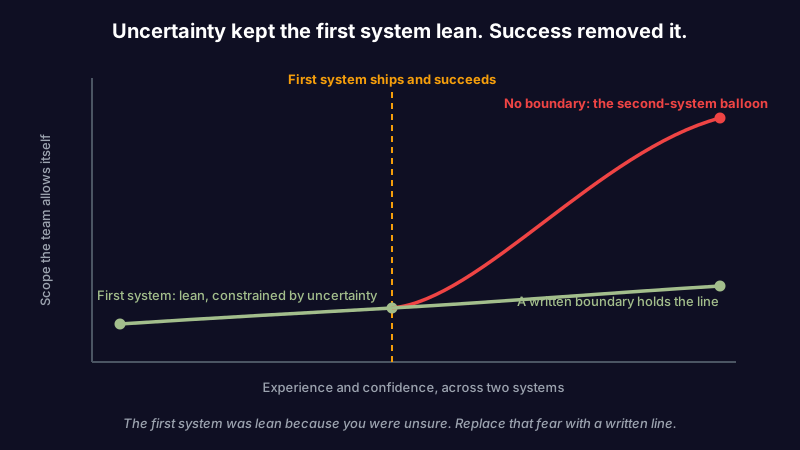
The curve is the whole story. The first system stays lean because constraint is forced on it by uncertainty. Success lifts confidence, and confidence removes the constraint right as the scope grows. The second system balloons not because the team got worse but because the thing that was quietly keeping the first one honest, the fear of failing, is gone. A written boundary is how you replace a feeling you have lost with a rule you can point at. This is a decision worth making with a framework rather than by whoever is most excited about the clean-slate rewrite.
The part nobody maintains: the reasons behind the first system decay
Here is the deeper reason a full rewrite is so dangerous, and it is the part the textbook definition misses. When you rebuild from scratch, you do not just re-type the code. You throw away every undocumented reason the first system was shaped the way it was, and those reasons are almost never written down.
Think about what the messy first system actually contains. That odd retry count, the field that is nullable for one weird customer, the validation that looks redundant until you remember the incident that caused it, the module boundary that seems arbitrary until you recall the team that owned each side. Each of those is a decision someone made for a real reason, and the reason lived in a head, a Slack thread, or a ticket nobody will find. The code records what the first system does. It almost never records why, and the why is exactly what a rewrite needs and cannot see. So the second system re-solves, at great cost, problems the first system had already quietly solved, and it re-learns the same lessons by re-suffering the same incidents. This is the second-system effect's secret engine, and it is the same knowledge decay that rots every other kind of working knowledge, hitting a rewrite at the worst possible moment.
This is the problem Scribelet is built for. Its background agents re-check your notes and decision records against reality on a schedule and surface a diff when something no longer holds, so the reasoning behind a constraint stays attached to the constraint instead of evaporating by the time someone proposes rebuilding around it. Your keys, your model, your data: the agents run on the provider you choose, and you see exactly what changed and why. Capturing the why the way you would an architecture decision record is what lets a second system keep the hard-won judgment of the first instead of paying to rediscover it. A first system whose reasoning has silently gone out of date is one you will feel forced to rewrite, because you can no longer tell which of its oddities are scars and which are mistakes. And when the reasons live in only one or two people's heads, you have a bus factor problem feeding directly into your second-system one: the rewrite looks safe precisely because the people scoping it cannot see what they are about to discard.
Getting started
The second-system effect is not cured by being smarter, because it is caused by being confident. The first system is lean because you are afraid; the second balloons because you are not. The fix is to manufacture, on purpose, the discipline that uncertainty used to provide for free.
Do three things before you commit to a rewrite. Write down what the new system is not for, and make that list longer than the feature list. Decide honestly between refactoring, a strangler migration, and a full rebuild, rather than defaulting to the rewrite because it is the most fun. And capture the reasons behind the first system's strange choices before you throw the first system away, because those reasons are the asset, not the code. Try Scribelet free and let it keep the reasoning behind your system current, so your second system inherits the first one's hard-won judgment instead of repeating its mistakes at twice the size.
Share this article