Walking Skeleton: Ship a Thin End-to-End Slice First
Table of contents
Two months in, the backend is beautiful. The data model is normalized to within an inch of its life, the service layer has clean interfaces, the repository pattern is textbook, and the test suite is green. There is only one problem: nothing has ever run end to end. Nobody has watched a request travel from a browser, through the API, into the database, and back out as a rendered page, because the front end is a stub and the deploy pipeline is a plan on a wiki. Then integration week arrives, and it turns out the auth token the front end sends is not the shape the backend expects, the deploy target cannot reach the database subnet, and the "clean" service interface assumes a synchronous call the real client makes asynchronously. Each of those is a day. None of them was visible while the layers were being built in isolation, because the failures live in the seams between the layers, and the seams did not exist yet.
A walking skeleton is the discipline that catches all of those on day two instead of month three. It is a small, unglamorous idea with an outsized payoff, and most one-line definitions miss the part that makes it work. Here is what a walking skeleton actually is, why building one first front-loads the risk that usually ambushes you at the end, how it differs from the MVP it gets confused with, what belongs in one and what does not, and the part of the practice that quietly rots if nobody maintains it.
What is a walking skeleton?
A walking skeleton is a tiny implementation of a system that performs a small end-to-end function and exercises every major architectural layer, from the user interface through the business logic to the data store and out to wherever it is deployed. Alistair Cockburn coined the term, and the C2 wiki entry that popularized it puts the emphasis exactly where it belongs: it "need not use the final architecture, but it should link together the main architectural components." The skeleton walks because it moves under its own power from one end of the system to the other. It is a skeleton because it has almost no flesh: one thin feature, or even a hard-coded stand-in for one, is enough.
The distinction that matters is between thin and small. A small system is one with few features. A thin system is one that touches every layer but does the least possible in each. A walking skeleton is deliberately thin rather than merely small. You could build a small system that is all database and no interface, or all interface and no persistence, and learn nothing about whether the pieces fit. The skeleton's whole value is that it runs a single request through the entire pipeline you intend to use in production, so the connections between components are proven to work before you pour real functionality into them.
The word carrying the weight is "walking." A skeleton that has been assembled but never stood up is just a pile of components with interfaces defined on paper. The point is to deploy it, run a real request through it, and watch it come back. If you are starting a system today, the highest-leverage first move is to define the one thread that has to travel end to end, then make only that thread work. Try Scribelet free and keep that first thread written down somewhere it stays visible while the rest of the system grows around it.
Why a walking skeleton works: front-loading integration risk
The reason a walking skeleton pays off is the same reason big up-front builds fail so reliably: the hardest and least predictable parts of a system are not the components, they are the integrations between them. A component you can reason about alone. The behavior at a seam only appears when two components run together against a real environment, and it is almost always where the nasty surprises hide: the authentication handshake, the network boundary, the serialization format, the deploy target's permissions, the difference between how a call behaves on your laptop and how it behaves in staging. These are the risks that turn a confident estimate into a two-week slip, and they are exactly the risks a layer-by-layer build defers to the very end.
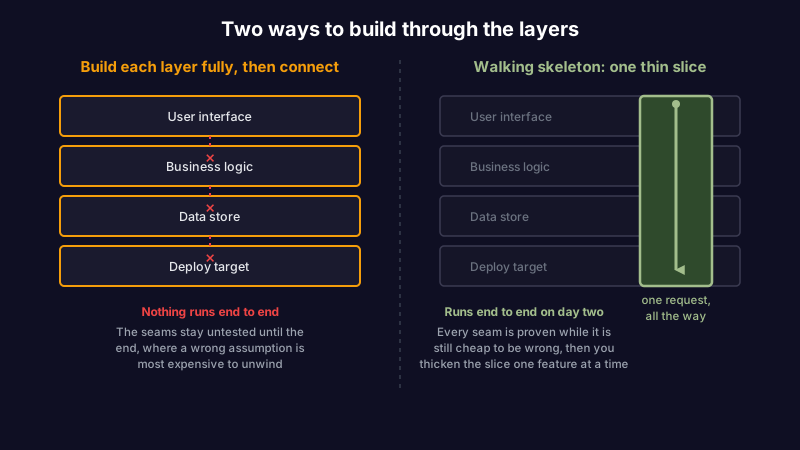
A walking skeleton inverts the order. By forcing a single request through every layer on day two, it drags the integration risk to the front, where it is cheap to be wrong about because almost nothing is built on top of it yet. This is the practical mechanism behind Gall's law: a complex system that works is grown from a simple system that worked, and the skeleton is the simplest possible system that genuinely works end to end. It is also how you narrow the range on your estimate early: the widest part of any estimate's uncertainty comes from unknowns in the integrations, and a walking skeleton resolves the biggest of them in the first days rather than the last. You do not remove the risk. You move it to where a wrong assumption costs a day instead of a quarter. Try Scribelet free and keep a running list of which integration assumptions the skeleton has actually proven, so you can tell what is verified from what is still a guess.
Walking skeleton vs MVP vs prototype vs spike vs tracer bullet
The single most common confusion is the walking skeleton against the minimum viable product, and they answer different questions. The skeleton is a technical proof that the architecture connects; the MVP is a business proof that customers want the thing. They are not rivals, and a mature project often uses both: a walking skeleton to de-risk the build, growing into an MVP once the thread is thick enough to deliver real value. The related terms get muddled the same way, so here is the whole family in one place.
| Term | Question it answers | What it optimizes for | What you do with it after |
|---|---|---|---|
| Walking skeleton | Does the architecture connect end to end? | Proving the integrations and the deploy path | Keep it and thicken it into the real system |
| Minimum viable product (MVP) | Do users want this enough to keep it? | Learning from real customers with the least product | Keep it and grow the product from real feedback |
| Prototype | What should this look like or feel like? | Exploring a design or interaction quickly | Throw it away; the learning is the deliverable |
| Spike | Is this technical approach even feasible? | Answering one narrow technical question | Throw it away; keep only the answer |
| Tracer bullet | Does a real feature work through the real stack? | A production-quality thin thread you keep building on | Keep it; it is the skeleton's grown-up sibling |
The tracer bullet, from Andrew Hunt and David Thomas's The Pragmatic Programmer, is the closest relative and is often used interchangeably. The useful distinction is that a tracer bullet is production-grade code for one real feature threaded through the real system, while a walking skeleton can start with stand-ins and hard-coded values in each layer, as long as the request genuinely travels the whole path. Both are things you keep. A prototype and a spike are things you discard, and treating a walking skeleton as disposable is the misread that wastes the whole exercise.
What goes in a walking skeleton (and what to leave out)
The hard part of building a skeleton is resisting the urge to make it good. Its job is to be thin, and every feature you add before the thread is proven is a feature you are betting on integrations you have not yet verified. Include the load-bearing structure. Leave out everything that is polish on a thread that might not hold.
Put in:
- One real request path that starts at the user interface and ends at the data store, then returns a visible result.
- The actual deployment target, running the skeleton where production will run, not only on a developer laptop.
- The real boundaries you intend to cross: the network hop, the authentication step, the serialization format, the database connection.
- Just enough of a build and deploy pipeline that pushing a change and seeing it live is one command, not a ritual.
- A single automated test that drives the whole thread, so a broken seam is caught the moment it breaks.
Leave out:
- Every feature beyond the one thread. Breadth is what you add after the skeleton walks, not before.
- Error handling for cases the thread does not yet hit, styling, and any optimization. None of it survives contact with a seam that turns out not to fit.
- The "real" architecture where a stand-in proves the connection just as well. A hard-coded response from a service you have not built yet still proves the caller can reach it.
- Anything you would be reluctant to change. The skeleton exists to be reshaped as the integrations teach you what the system actually needs.
If a piece is not either part of the end-to-end thread or part of proving an integration works, it does not belong in the skeleton yet. The restraint is the same one that keeps a shipped product from bloating: adding before you have earned the addition is how feature creep starts, and a skeleton is where the habit either forms or does not.
A walking skeleton, worked
Concretely, imagine you are building a notes app with AI chat over the notes. The full system will have a rich editor, sync across devices, encryption at rest, a vector index, and a retrieval pipeline feeding a language model. The from-scratch instinct is to build the storage layer properly, then the sync, then the editor, then wire in the model last. The walking-skeleton instinct is different: on day two, a plain text box in the browser sends one string to an API, the API stores it in the real database on the real deploy target, reads it straight back, passes it to the model with a hard-coded prompt, and returns the model's reply to the screen. No editor, no sync, no encryption, no vector search. One string, all the way through, deployed where it will really run.
That skeleton is almost useless as a product and enormously useful as a de-risking tool. It proves the browser can reach the API, the API can reach the database in the deploy environment, the credentials for the model provider work from production rather than from a laptop, and the round trip is fast enough to bother continuing. Every one of those is an assumption that a layer-by-layer build would not have tested until the end. Once the thread walks, you thicken it one integration at a time: swap the text box for the editor, the single string for real documents, the hard-coded prompt for retrieval, and so on, each addition landing on a foundation that is already proven to connect.
How to misread a walking skeleton
The idea is simple enough that most of its failures come from misapplying it rather than misunderstanding it. Four traps account for nearly all of them.
| The misread | What it looks like | Why it fails |
|---|---|---|
| Treating it as disposable | Building the skeleton to throw away, then starting the "real" version from scratch | You discard the one thing you proved works and re-inherit all the integration risk you just retired |
| Making it too fat | Adding features "while we are in there" before the thread walks | Every feature bets on seams you have not verified; when one does not fit, you unwind real work |
| Making it too thin | A skeleton that skips the deploy target or a real boundary "for now" | The skipped seam is usually the one that breaks; a skeleton that never leaves the laptop proves nothing about production |
| Skipping the hard integration | Stubbing the risky part and threading only the easy path | The point is to front-load the risky integration; routing around it defers exactly the surprise you built the skeleton to find |
The through-line is that a walking skeleton is a bet on the seams, and each misread quietly removes a seam from the test. The version that pays off is the one that runs the least code through the most integrations, including the scary ones, on the real target.
The part nobody maintains: why the skeleton's shape is what it is
A walking skeleton makes a series of early, load-bearing decisions: this deploy target, this boundary here, this serialization format, this order of thickening. Those decisions are made when the integration risk is fresh in everyone's mind, and then they vanish into the running system as unremarkable facts. Six months later a new engineer looks at the shape of the codebase and cannot tell which structural choices were deliberate risk-reduction and which were accidents of the first week. The reasons decayed even though the structure they produced lives on, which is the same knowledge decay that hollows out every other kind of working knowledge, arriving here at the foundation of the system.
The cheap defense is to record why the skeleton was shaped the way it was, at the moment you shape it: which integration each early decision was de-risking, which assumption it was testing, and what you would change if that assumption turned out wrong. A short technical spec for the thread, or a handful of architecture decision records for the load-bearing choices, keeps the reasoning attached to the structure. Without that record, a later team inherits a skeleton whose bones they are afraid to move, and the from-scratch rewrite that Gall's law warns against, the one that balloons into a second-system effect, starts to look tempting again, precisely because nobody can explain why the current shape is the shape it is.
Getting started
Building a walking skeleton is one decision followed by a lot of restraint. Pick the single thread that has to travel end to end, make only that thread work on the real deploy target, and refuse to add anything else until it walks. Then write down why you shaped it the way you did, so the reasoning survives as long as the structure does.
Scribelet is built for keeping that kind of reasoning alive: the assumptions a skeleton is testing, the integrations it has proven, and the decisions behind its shape, all in notes that an AI can help you keep current as the system grows. Try Scribelet free and start your next system with a thread that walks and a record of why it walks the way it does.
Share this article