Sayre's Law: Why Trivial Decisions Cause the Biggest Fights
Table of contents
The pull request had two changes in it. One migrated the primary datastore to a new schema, a decision the team would live with for years and could not easily undo. The other renamed a helper function from getUserData to fetchUserData. The migration was approved in under a minute with a single thumbs-up. The rename drew nine comments, two of them from people who had not looked at the migration at all, and by the end of the afternoon the thread had branched into a debate about whether the codebase should prefer get or fetch as a verb, which nobody resolved and everybody remembered. The team was not being careless. It was obeying a rule of human behavior that a political scientist named Wallace Sayre noticed decades ago, and that every engineering team re-discovers the hard way: the less a decision matters, the harder people will fight about it.
Sayre's law is usually quoted as a wry line about faculty meetings and left there. What none of the summaries give you is the part an engineer actually needs: why the pattern is so reliable, how to tell the argument worth having from the one that is only loud, and how to stop the same trivial fight from erupting again every few months. Here is what Sayre's law is, why the smallest decisions pull the most heat, what it looks like inside a software team, a way to separate a bike shed from a real decision, and the maintenance habit that ends the recurring version of the argument for good.
What is Sayre's law?
Sayre's law states that in any dispute the intensity of feeling is inversely proportional to the value of the issues at stake. The corollary, the part usually quoted on its own, adds that this is why academic politics are so bitter: the stakes are so low. The line is attributed to Wallace Stanley Sayre, a Columbia University political scientist, and it has survived because it describes something far beyond universities. Anywhere people argue, the heat of the argument and the importance of the question tend to move in opposite directions.
The claim is not that people never argue about things that matter. They do. The claim is about proportion. A genuinely consequential decision tends to be handled with a kind of wary economy, because everyone can feel the weight of being wrong. A trivial one has no such brake, so it fills with the energy that had nowhere else to go. The result is a curve you can almost draw: the closer a decision gets to not mattering at all, the more feeling it attracts.
That curve is worth internalizing before your next design review, because it means the volume of a discussion is not evidence of its importance. It is often the reverse. When a thread is on fire, the useful reflex is not to join it but to ask why a question this small is generating this much heat, and what quieter, larger question is being avoided while everyone is busy. Try Scribelet free and keep the decisions that actually matter written down where the noise cannot bury them.
Why the smallest decisions attract the most heat
Sayre's law can feel like a paradox until you look at the forces underneath it. Trivial decisions are not loud by accident. Several things make low stakes and high feeling go together, and naming them lets you spot the pattern in the moment rather than after the thread has gone to forty comments.
| Force | Why it inflates trivial fights |
|---|---|
| Low barrier to entry | Everyone can hold an opinion on a variable name or a button color. Almost nobody can hold one on the sharding strategy, so the small question gets a hundred qualified participants and the large one gets three. |
| No cost of being wrong | When a decision is reversible and cheap, there is no penalty for arguing your preference to the end. The brake that consequence provides is simply absent. |
| Ego is safe | Being wrong about a rename costs nothing real, so it is safe to plant a flag and defend it. Being wrong about the architecture is expensive and exposing, so people hedge. |
| It is visible | A naming convention shows up in every file and every review. The load-bearing decision is buried in one migration nobody reads. Visibility invites comment. |
| It is a refuge | The trivial fight is often a way to avoid the hard one. Debating the bike-shed color feels productive while the real, intimidating decision waits, unexamined. |
The last row is the one that matters most, and it is where Sayre's law stops being a curiosity and becomes a diagnostic. A team pouring energy into a small decision is frequently a team flinching away from a large one. The tell is not the small fight itself, it is the large decision sitting quietly beside it with nobody's attention on it.
Sayre's law in a software team
Engineering has its own name for the effect: bikeshedding, from Parkinson's law of triviality. C. Northcote Parkinson's original example was a committee that approved a multi-million-pound nuclear reactor almost without discussion, because none of them understood it, then spent the bulk of the meeting arguing about the materials for the staff bicycle shed, because everyone had an opinion about bike sheds. The reactor was Sayre's high-stakes, low-heat decision. The bike shed was the low-stakes, high-heat one. Software teams build a new bike shed roughly every sprint.
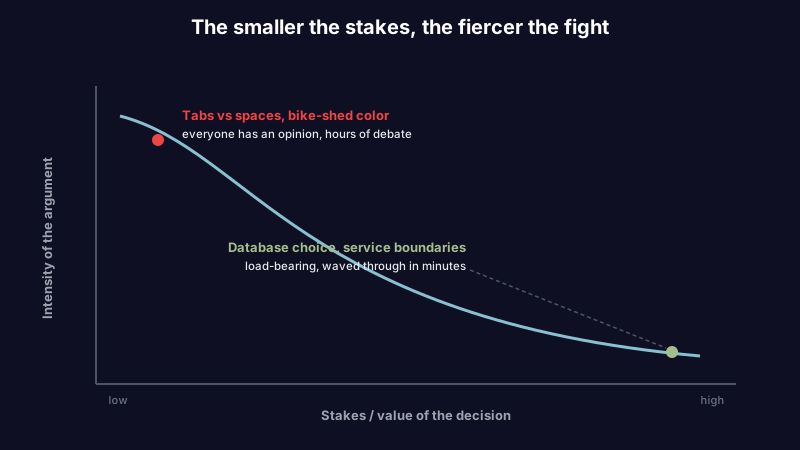
The familiar bike sheds are almost a genre. Tabs versus spaces, which spawned a decade of arguments that a linter settles in one line. The exact wording of an enum, litigated while the state machine it belongs to goes unreviewed. Pull request nitpicks about formatting on a change whose actual logic nobody has traced. The name of a new service, or the color and label of a dashboard, debated for an hour in a meeting that had ten minutes budgeted for the migration plan. Each one is cheap, reversible, and universally accessible, which is exactly why it swells to fill the room. Meanwhile the decision that will still be shaping the system in three years, the one that deserved the hour, gets a nod and a merge.
This is also where Conway's law quietly makes things worse. A team already prone to friction along a communication seam will find the bike shed a socially safe place to have the fight it cannot have about ownership or direction. The trivial argument becomes a proxy, which is why some naming debates feel weirdly personal: they are not really about the name.
Telling a bike shed from a real decision
The practical value of Sayre's law is not that it lets you dismiss small arguments. It is that it gives you a way to sort, in the moment, which fights deserve the energy they are attracting and which are miscalibrated. The sort is fast if you ask the right questions, and it maps onto the same reasoning a good decision framework uses.
| Question | Bike shed | Real decision |
|---|---|---|
| Is it reversible? | Yes, cheaply, any time | No, or only at real cost |
| What is the blast radius if it is wrong? | A rename, a reformat, a shrug | Data loss, a rewrite, a stuck migration |
| Who is genuinely affected? | Whoever reads this one file | Every team building on top of it |
| Does deciding it need expertise most people lack? | No, everyone can weigh in | Yes, and the experts are quiet |
| Will anyone remember it in a year? | No | It will still be shaping the system |
When the answers cluster in the left column, the honest move is to spend as little energy as the decision deserves: pick something reasonable, make it consistent, and move on. When they cluster in the right column and the room is quiet, that silence is the warning. A high-stakes decision attracting little discussion is the exact failure Sayre's law predicts, and it is far more dangerous than a loud argument about a small one. Try Scribelet free and keep a running note of the decisions that scored right-column, so the important ones are not the ones that slipped through unexamined.
How to defuse a trivial-stakes fight
Once you can name a bike shed, you can end it quickly instead of letting it end the meeting. A few moves do most of the work.
- Name it out loud. Saying "I think this might be a bike shed" is often enough to break the spell, because it reminds everyone the decision is small. It reframes the argument from a matter of principle back into a matter of taste.
- Timebox it. Give the trivial decision two minutes and a decider. The energy is not proportional to the stakes, so capping the time simply forces the proportion the decision should have had.
- Give it one owner. Most bike sheds do not need consensus, they need a choice. Delegate the call to a single person, accept that it will not be everyone's preference, and let the reversibility that made it trivial also make the choice safe.
- Automate it away. The best answer to tabs versus spaces is a formatter in the pipeline; the best answer to formatting nitpicks is a linter and a shared config in the pull request template. A decision a machine can enforce is a decision that never has to be argued again.
- Redirect the energy. If a small fight is a refuge from a large one, the fix is to name the large one and put it on the agenda. Point the room at the migration, the boundary, the technical spec that actually deserves the hour.
None of these require winning the argument. They require ending it, which is the only outcome a trivial decision is worth.
The misreadings
Sayre's law is quotable, which means it gets misused. Three misreadings in particular can do real damage if you carry them into a team.
| Misreading | Why it is wrong |
|---|---|
| "All disagreement is trivial." | The law is about the mismatch between heat and stakes, not a claim that nothing matters. Some loud arguments are loud because the stakes are genuinely high. The tool is calibration, not dismissal. |
| "Strong feelings mean the issue is small." | Feelings are a weak signal in both directions. People also argue hard about things that matter. Use the reversibility and blast-radius test, not the volume, to judge the stakes. |
| "Small stakes mean it is fine to ignore." | Consistency in small things still has value; a codebase with ten naming styles has a real cost. The point is to settle trivial questions cheaply, not to leave them permanently unsettled. |
The law is a lens for spotting a specific distortion, the fight that is louder than its subject. It is not a license to wave away polish, disagreement, or the accumulated weight of small decisions, which is its own failure mode when small additions are never questioned and quietly become feature creep.
The fight you keep having
Here is the part no summary of Sayre's law mentions, and it is the part that turns a one-time annoyance into a recurring one. Teams do not just have bike-shed arguments. They have the same bike-shed argument, again and again, every few months, with new people and no memory of the last time.
The reason is decay. A team decides, reasonably, to use two-space indentation, or to prefix event names a certain way, or to keep dashboards to one color scheme. The decision was fine. But the why behind it, the small context that made it the right call, is never written down, because the decision felt too trivial to record. Six months later a new engineer, or an old one who forgot, reopens the question in perfect good faith, and because the reasoning is gone there is nothing to point them at except opinion. So the argument runs again from zero. The trivial decision is not expensive to make. It is expensive to keep re-making, and that cost is invisible precisely because each instance is small.
This is the same mechanism that makes an architecture decision record valuable for the large decisions, applied to the small ones. The fix is not more debate, it is a one-line record: the rule, who decided it, and the single reason it was chosen. That record is what a resurrected argument dies against. It is also the thing that most reliably goes out of date and quietly disappears, which is why it needs a home that stays current rather than a Slack message that scrolls away. Try Scribelet free and let it hold the reasoning behind your team's settled rules, so the trivial fights you already won stay won.
Getting started
Sayre's law is not a reason to stop caring about small things. It is a way to notice when the caring has come unmoored from the stakes, so you can put the energy where it belongs. The next time a thread catches fire over something small, resist the pull to join it and ask the quieter question instead: what large decision is sitting unexamined while everyone argues about the bike shed?
Do three things with it. Learn to sort a fight fast on reversibility and blast radius, so you spend energy in proportion to the stakes rather than in proportion to the noise. End trivial arguments by timeboxing them, giving them one owner, or automating them away, rather than by winning them. And record the why behind the small rules you settle, because the reasoning decays faster than the rule and its loss is what makes you fight the same battle twice. Try Scribelet free and keep the decisions that matter, and the reasons behind the ones that do not, somewhere they will still make sense a year from now.
Share this article