Hofstadter's Law: Why Software Always Takes Longer
Table of contents
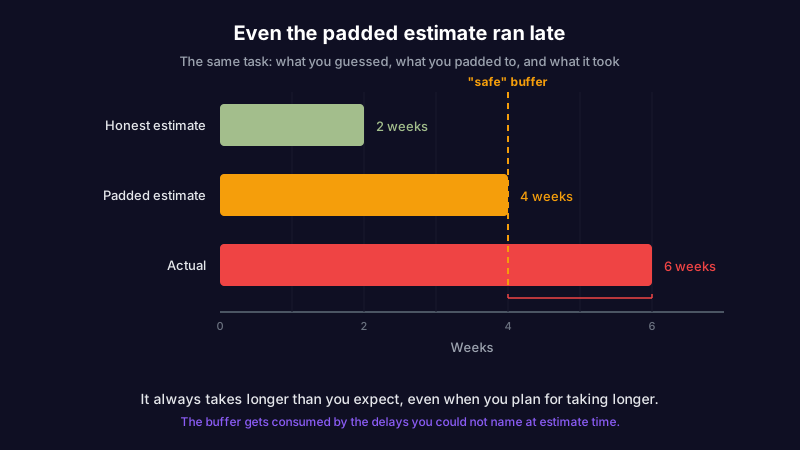
You already know you run late, so you padded the estimate. The honest guess was two weeks, and because you have been burned before, you doubled it to a month and called that safe. The task shipped in six weeks. Not because anything went catastrophically wrong, but because a dependency needed updating, then the update broke a test, then the person who understood the test was on leave, then the "quick" migration turned out to touch three services. Every delay had a reason. None of them was in the plan. And the padding you added, the buffer that was supposed to absorb exactly this, got eaten in the first ten days.
That is Hofstadter's Law, and the cruel part is baked into its own wording: it always takes longer than you expect, even when you take into account Hofstadter's Law. It anticipates your padding and beats it anyway. Every productivity blog will give you the one-line definition and a shrug about optimism bias. What none of them gives you is the thing you actually need the next time you have to put a number on a plan: why the padding fails, which estimation methods survive contact with a real project, and a way to turn "everything runs late" from a running joke into a number you can actually calibrate.
What is Hofstadter's law?
Hofstadter's law states that a task always takes longer than you expect, even when you account for the fact that tasks take longer than you expect. Cognitive scientist Douglas Hofstadter coined it in his 1979 book Gödel, Escher, Bach: An Eternal Golden Braid, while discussing how chess programmers kept predicting a computer would beat the world champion "in ten years," a prediction that stayed ten years away for decades. The law is self-referential on purpose. It does not just say you underestimate. It says the underestimation survives your attempt to correct for it.
That recursion is what makes it more than a complaint. A normal estimating error you can fix by padding: add 50%, move on. Hofstadter's Law is the observation that padding does not work the way you think, because the same optimism that produced the original estimate also produces the buffer. You pad against the risks you can imagine. The project runs late on the risks you could not.
It is cited most often in software, and for a reason software people will recognize immediately. Writing code is not the slow part. The slow part is everything the estimate assumed would go smoothly: the integration that has one undocumented quirk, the review that surfaces a design problem, the environment that behaves differently in staging, the requirement that was clear until someone actually used the feature. Any one of those can open into a cascade of prerequisite fixes that pulls you further and further from the task you were trying to estimate, the pattern known as yak shaving. If you keep your plans and their outcomes in one place, Scribelet can hold the estimate next to what actually happened, which is the only raw material you have for getting better at this.
Why your estimates blow up, even when you pad them
Hofstadter's Law is a symptom. Underneath it are a handful of specific forces, and once you can name them you can aim a fix at each one instead of just adding a bigger buffer and hoping. The buffer is not the fix, because the buffer is subject to the same forces as the estimate.
| Why the estimate is wrong | What it looks like in practice | What actually helps |
|---|---|---|
| The planning fallacy | You picture the happy path and estimate that, ignoring how similar tasks actually went | Estimate from the outside view: pull the real duration of the last five similar tasks |
| Hidden complexity | The work reveals dependencies and edge cases only once you are inside it | Break the task down until each piece is a day or less; the pieces you cannot break down are where the risk hides |
| The recursive trap | You add a buffer, and the work quietly expands to consume it | Track estimate against actual so the buffer is calibrated from data, not guessed from optimism |
| Scope creep | The target moves while you build, so the estimate is measuring a thing that no longer exists | Fix the scope in writing before you estimate, and re-estimate explicitly when it changes |
| Coordination cost | Adding people to a late task adds communication overhead faster than it adds output | Do not staff your way out of a slip; Brooks's Law says it makes the slip worse |
| Optimism as default | The estimate is really a wish about the best case, stated as a prediction | Ask for the estimate you would bet your own money on, not the one you hope for |
The through-line is that most of these are invisible at estimate time. You cannot list the dependency you have not discovered yet, so you do not budget for it, so the plan is optimistic by construction. This is the same dynamic that drives feature creep: each individual addition looks reasonable, and the total is a schedule nobody signed up for. The difference is that feature creep moves the target, while Hofstadter's Law says even a fixed target comes in late.
The estimation techniques that actually help
You cannot beat Hofstadter's Law, but you can stop being surprised by it. Different methods fit different kinds of uncertainty, and the common mistake is using a precise-looking technique on work too novel to support it. Match the method to what you actually know.
| Technique | Best for | How it works | Where it fails |
|---|---|---|---|
| Gut estimate plus a multiplier | Small, familiar, low-stakes tasks | Take your honest guess, apply your known personal or team multiplier | The multiplier is a fiction until you have tracked real ratios |
| Three-point (PERT) | Tasks with a known shape but real variance | Average optimistic, likely, and pessimistic as (O + 4L + P) / 6 | Garbage in, garbage out if all three numbers are optimistic |
| Historical velocity | Teams with a track record on similar work | Estimate against how much comparable work the team actually finished per week | Breaks when the new work is unlike the history |
| Reference-class forecasting | Large, novel, or high-stakes projects | Compare the project to the real distribution of outcomes for similar past projects | Requires honest data about how comparable projects actually went |
| Relative sizing | Early, coarse planning across many items | Size items against each other rather than in absolute hours | Tells you relative effort, not a calendar date |
The single highest-leverage move is the one the planning fallacy research keeps confirming: switch from the inside view to the outside view. The inside view builds an estimate from the specific steps you imagine. The outside view asks how long this kind of thing has actually taken before, and it is consistently more accurate, because it captures the delays you cannot yet name. Reference-class forecasting is just the disciplined version of that instinct, and it works because it borrows from projects that already hit the walls you have not seen. It also explains why an honest early estimate is a wide range rather than a single number: before you start, the walls you have not seen are exactly the ones that set the outer edge of the range.
What Hofstadter's law looks like at scale
The law is funny on a two-week ticket and sobering on a budget. The pattern is identical, only the units change. These are not obscure cases; they are among the most studied schedule overruns on record.
| Project | Planned | Actual | Overrun |
|---|---|---|---|
| Sydney Opera House | $7M, open 1963 | $102M, open 1973 | ~14x cost, 10 years late |
| Denver Airport automated baggage | ~16 months | Scrapped after delaying the airport ~16 months | Abandoned, hundreds of millions lost |
| Berlin Brandenburg Airport | Open 2011, ~€2B | Open 2020, ~€7B | 9 years late, ~3.5x cost |
| Windows Longhorn / Vista | Ship ~2003 | Reset in 2004, shipped 2007 | Roughly 4 years, a full development restart |
None of these was run by amateurs. The teams were experienced, the budgets were real, and the estimates were made by people who knew the work was hard. That is the point. Research by Oxford's Bent Flyvbjerg found that one in six IT projects had a cost overrun of 200% and a schedule overrun of nearly 70%, and that the risk is not evenly spread: a small share of projects blow up catastrophically, which is exactly the fat tail Hofstadter's Law predicts. The lesson is not that these teams were careless. It is that expertise does not exempt you, and the confidence that comes with expertise can make the estimate worse, the same way it fuels the second-system effect when a team rebuilds a product it now feels it understands.
Track the estimate against the actual
Here is the practice that turns the law from a shrug into a skill. Almost nobody records their estimates, so almost nobody learns their own error rate. You feel like you always run late, but "feel like" is not a multiplier. Write the estimate down, write the actual down next to it, and after a dozen tasks you will have something no amount of intuition gives you: your real ratio.
Keep a running log with one entry per task. It costs a minute and pays for itself the first time you can answer "how long will this take" with data instead of hope.
Task: what you are estimating
Estimated: hours or days, and the date you estimated
Assumptions: the happy path you pictured when you gave the number
Actual: hours or days it really took
Ratio: actual divided by estimate
What I missed: the dependency, review, or complexity that ate the time
Next time: the specific adjustment for this kind of work
The "what I missed" line is the one that compounds. After ten entries you stop seeing random bad luck and start seeing patterns: integrations always take twice as long, anything touching auth needs a review buffer, the first estimate after a context switch is always low. Those patterns are your personal reference class, and they are worth more than any generic multiplier because they are built from your actual work. An estimate is a prediction, and predictions have downstream consequences you can only grade if you wrote the prediction down.
The part nobody keeps: your estimates are predictions that decay
There is a reason the log matters beyond arithmetic, and it is the reason most estimation advice quietly fails. An estimate is a bet on a set of assumptions, and those assumptions expire.
When you estimated two weeks, you were assuming a specific set of facts: this library works the way it did last quarter, this API is stable, this teammate is available, this requirement is final. Every one of those can change between the estimate and the work, and when it does, the estimate is wrong for a reason that has nothing to do with your math. If you never wrote down why you thought two weeks, you cannot tell, later, whether you estimated badly or the ground moved under you. The number decays, and so does the reasoning behind it. This is the same knowledge decay that rots every other kind of working knowledge: the estimate outlives the assumptions it was built on, and nobody notices until the plan is already late.
This is where Scribelet fits. Its background agents re-check your notes and records against reality on a schedule and surface a diff when something no longer holds, so the assumptions behind a plan do not silently expire while you are looking away. Your keys, your model, your data: the agents run on the provider you choose, and you see exactly what changed and why. Keeping the reasoning attached to the estimate, the way you would attach the rationale to a technical spec or a design document, is what lets next quarter's estimate learn from this quarter's instead of repeating it. A plan whose assumptions have gone stale without anyone noticing is a plan that will run late for reasons you will never diagnose, because the record of what you were betting on is gone.
Getting started
Hofstadter's Law is not a problem you solve. It is a property of doing hard things, and the goal is not to eliminate the overrun but to stop being blindsided by it. You do that by replacing optimism with data.
Do three things. Estimate from the outside view: before you guess, pull how long the last few similar tasks actually took, and start there instead of from the happy path. Keep an estimate-versus-actual log so your padding is calibrated from your real error rate rather than your hopes. And write down the assumptions behind each estimate, because the estimate that runs late usually does so when one of those assumptions quietly stopped being true. Try Scribelet free and let it keep the reasoning behind your plans current, so the next estimate inherits what the last one learned instead of repeating the same surprise at a bigger scale.
Share this article