Illusion of Explanatory Depth: You Know Less Than You Think
Table of contents
Ask an assistant to explain how something works, something you have always half understood but never really sat with. How a language model turns a prompt into a sentence, say, or how a zip file gets smaller without losing anything. The answer comes back clean and confident, it clicks, and you close the tab satisfied that you now understand. Then a week later someone asks you to explain it, and you get one sentence in before the floor gives way. You knew the shape of it. You could not reconstruct a single step.
That is the illusion of explanatory depth, and it is one of the more reliably humbling findings in cognitive science. The feeling of understanding and the ability to explain are produced by different machinery, and the first runs far ahead of the second without ever telling you. For anyone who reads to learn, saves what they read, or leans on an AI assistant to explain things, this is not an academic curiosity. It is a description of how a shallow understanding gets filed away as a deep one, inside your own head and your own notes. Here is what the illusion of explanatory depth is, why it happens, where it bites, and how to stop it from quietly inflating what you think you know.
What is the illusion of explanatory depth?
The illusion of explanatory depth is the tendency to believe you understand how complex things work far better than you actually do. It was named in 2002 by the psychologists Leonid Rozenblit and Frank Keil, in a paper with the pointed title "The Misunderstood Limits of Folk Science." Their method was simple and merciless. They asked people to rate, on a scale of one to seven, how well they understood an everyday object: a zipper, a flush toilet, a bicycle, a speedometer. Confidence was high. Then they asked those same people to write a step-by-step explanation of how the thing actually works. Confidence collapsed. Forced to produce the mechanism, people found they could not, and their self-rating dropped to match.
The crucial detail is what the illusion attaches to. It targets explanatory knowledge, the how and why of causal systems, and it mostly leaves facts, procedures, and stories alone. You know your own phone number, and you do not feel you understand it. But ask how the phone connects a call and the gap opens, because the subject is a mechanism with hidden parts, and hidden parts are exactly what the feeling of understanding papers over. A knowledge base that stores the mechanism and the source behind a claim, not just the conclusion, is the difference between a note you can rebuild an explanation from and one that only reminds you that you once felt you understood.
Why the illusion of explanatory depth happens
The root cause is a confusion between two things that usually travel together: familiarity and understanding. You have seen a zipper ten thousand times. You used one this morning. That fluency, the ease with which the thing comes to mind, feels like knowledge, and most of the time the distinction never gets tested, so the proxy holds. Reading a crisp explanation does the same at second hand. The author did the work of organizing the mechanism into clean prose, and the ease of following it registers as the ease of knowing it. You borrow the structure of their understanding and mistake it for your own.
Three features make the illusion worse than ordinary overconfidence.
The first is that it is invisible from the inside. You cannot feel the steps you are missing, because the missing steps are the very thing you do not have. The sensation of understanding stays smooth precisely where the knowledge is absent, which is why no amount of introspection surfaces it. The second is that it collapses the instant you try to produce an explanation, and only then. Thinking you understand costs nothing. Explaining out loud, or writing it down for someone who will push back, forces you to lay out the causal chain and find the broken link. The third is that it scales with complexity. The more moving parts a system has, the more room there is to feel you grasp the whole while holding almost none of the parts, which is why people hold their most confident and least examined views on the most complicated subjects.
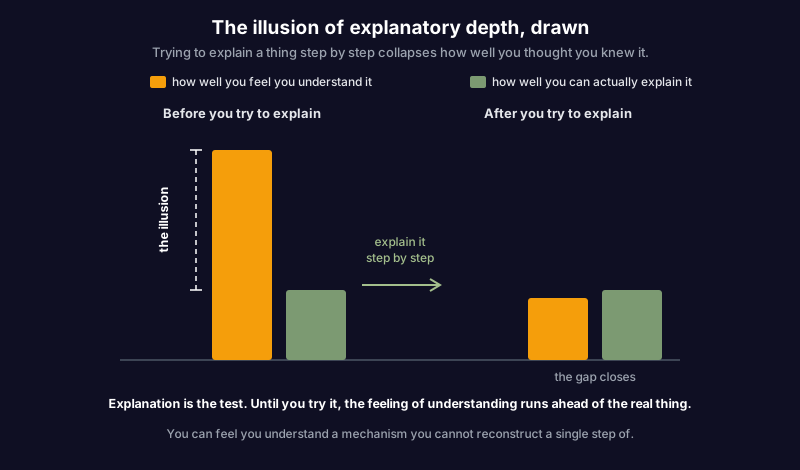
The chart above is the whole effect in two panels. On the left, before any test, the felt understanding stands well above the real one, and the distance between them is the illusion. On the right, after you try to explain the thing step by step, the felt bar drops to meet the real one. Nothing about your actual knowledge changed. The only thing that moved was the honesty of your estimate.
Where the illusion of explanatory depth shows up
Once you have the shape of it, you start seeing it everywhere, and naming the instances makes them easier to catch.
| Where it operates | How the illusion forms | The tell |
|---|---|---|
| Reading an AI explanation | A fluent, confident answer reads as your own understanding | You feel you learned it but cannot say it back without rereading |
| Technical docs you skim | Recognizing the terms feels like knowing the system | You can describe what it does, not how or why it does it |
| Strong opinions on hard topics | Repeated exposure to a debate stands in for grasping the mechanism | You hold the position firmly and cannot explain the thing behind it |
| Code you copied that works | Working output feels like comprehension | You cannot predict what breaks if you change one line |
| A note you reread | Familiarity with your own words feels like mastery | The note restates a conclusion and reconstructs no steps |
The effect reaches past trivia into things that matter. In studies of political opinion, people asked to explain how a policy actually works, step by step, rather than just state whether they back it, come away less certain and less extreme, because the demand to explain exposes how little of the mechanism they were holding. The strongest positions often sit on the thinnest explanations.
Every row runs on one engine. Something becomes familiar, familiarity feels like understanding, and no test ever forces the difference into the open. This is the near-cousin of why experts write documentation nobody can follow: the curse of knowledge is understanding so deep you forget other people lack it, and the illusion of explanatory depth is understanding so shallow you have not noticed you lack it yourself. Same missing step, opposite ends of the same staircase.
The illusion of explanatory depth inside your notes and AI tools
For most people the sharpest version is not the zipper. It is the gap between a note that holds a conclusion and a note that holds an understanding, and it hides in the exact place you built to make yourself smarter: your own knowledge base.
Here is how it gets in. You read something, or an assistant explains it, and the explanation lands cleanly. You save the takeaway, the one line that felt important, because the mechanism felt obvious at the time. Weeks later the note is still there, in your own words, carrying the authority of something you chose to keep. But the mechanism was never captured, because you never felt you needed to, and that feeling was the illusion. Each reread of the conclusion deepens the sense that you understand, and the slow way a note drifts from something you knew into something you only recognize does the rest. A note that only reminds you that you once understood is not a note you can act on.
AI tools make the trap smoother. An assistant produces explanation on demand, fluently, in an even and confident register, and the fluency of the output is easy to mistake for the fluency of your own grasp. You read a clean paragraph about how something works, feel the click, and move on, never testing whether you could regenerate a word of it with the model closed. The writer David Epstein described one version of the test for drafts: if an idea cannot be explained cleanly to someone who will push back, it is not understood well enough to put on the page yet. That is the defense in one line. The point is not to distrust the explanation. It is to make producing the explanation yourself the thing that happens before you file it, because reconstructing and checking a claim at the moment you capture it is the one cheap moment to find out whether you actually have it.
How to catch the illusion of explanatory depth
You cannot feel the gap directly, so the only reliable move is to run the test that exposes it. A few habits do most of the work.
- Explain it before you trust it. When something feels understood, take sixty seconds and explain it out loud or in writing, as if to someone who will interrupt. The feeling survives or it does not, and either way you learn something introspection cannot tell you.
- Make your notes reconstruct, not restate. A note that repeats a conclusion is a bookmark. A note that lays out the mechanism, the why, and the conditions under which it fails is an understanding you can reload. Write the second kind, especially when the first kind feels like enough.
- Separate "I followed it" from "I could produce it." Following a clean explanation is a low bar that feels like a high one. Before you count something as known, check whether you could rebuild it with the source closed.
- Capture the mechanism, not just the takeaway. The takeaway is what the illusion lets you keep. The mechanism is what it quietly drops. When you save something, save the part you will not be able to regenerate later.
- Be most suspicious of your most confident understandings. The views that feel most settled have usually had the least explanation-testing, not the most. Confidence and examination tend to run in opposite directions, so treat a strong feeling of understanding as a reason to test it, not a reason to skip the test.
None of this requires doubting everything you read. It requires moving the bar from recognizing an explanation to producing one, and doing it early, while the source is still in front of you.
Illusion of explanatory depth vs related biases
The illusion gets filed next to several cousins, and the differences are worth pinning down, because the defenses differ.
| Idea | What produces the false confidence | How it differs from the illusion of explanatory depth |
|---|---|---|
| Illusion of explanatory depth | Mistaking familiarity with a system for a grasp of how it works | The baseline case: you overrate how well you could explain the mechanism |
| Dunning-Kruger effect | Low competence leaves you unable to see your own gaps | About overall skill, not the specific gap between feeling and explaining |
| The curse of knowledge | Knowing something so well you cannot imagine not knowing it | The inverse: too much understanding to model a novice, not too little to notice your own |
| The illusory truth effect | Sheer repetition makes a claim feel true | About a claim feeling true, not a mechanism feeling understood |
| The map is not the territory | Treating a model of a thing as the thing itself | About a representation standing in for reality; a note that points at an understanding is not the understanding |
The row that matters most is the contrast with the curse of knowledge, because the two are mirror images that both end in a document nobody can use. The curse comes from knowing too much to see the reader. The illusion comes from knowing too little to see yourself. Catching either one depends on the same move: forcing the explanation out of your head and into the open, where its gaps become visible.
The one move that matters
The illusion of explanatory depth is not a flaw you can reason your way out of in the moment, because in the moment the feeling of understanding is all you have, and it feels exactly like the real thing. The only reliable intervention is a test run early: try to produce the explanation yourself before you decide you have it, and capture the mechanism rather than just the conclusion so the understanding survives being filed. A shallow understanding you never tested is the kind you end up building a decision on without seeing what follows from it. A knowledge base that holds the mechanism, the why, and the source behind each note, not just the takeaway that felt obvious at the time, is how you keep what you think you know honest about what you can actually explain. Try it free.
Share this article