Dead Internet Theory: When the Web Fills With AI Slop
Table of contents
You search for a straight answer to an ordinary question, and the first page is a wall of articles that all say the same thing in the same confident, frictionless voice. Each one restates the question, lists five generic points, and ends with a paragraph that commits to nothing. You scroll a forum thread hoping for a real person who has actually done the thing, and half the replies read like they were generated too: fluent, agreeable, and empty. For a moment you wonder whether anyone is actually on the other end of any of it, or whether you are reading a conversation machines are having with each other while you watch.
That unease has a name. It is the dead internet theory, and it has moved in a few years from a fringe forum idea to a phrase serious people use to describe what the open web now feels like. The headline version is easy to state and easy to wave away as paranoia. What is worth more is understanding which part of it is literally a conspiracy theory and which part is just a measurable description of the incentives, why generative AI turned a slow drift into a flood, and what it means for the notes and sources you rely on, because a web where you cannot tell what was written by a human is a web where provenance becomes the thing you have to protect. If you keep a knowledge base, a tool that holds each note with its source and context is no longer a nicety. Here is the dead internet theory in full, with where it came from, how to keep real signal, and the version of it running quietly inside your own sources.
What is the dead internet theory?
The dead internet theory is a concept asserting that the public internet is no longer driven primarily by human beings, but has instead been overtaken by bots, automated accounts, and algorithmically generated content, to the point that much of what you see and read was neither written by nor intended for a real person. In its strongest form it is a claim about scale: that the majority of activity online is now non-human, and that authentic human expression is a shrinking minority of what the open web actually contains.
The idea splits cleanly into two very different claims, and keeping them apart is the whole trick to using it well. The paranoid version holds that a deliberate actor, a government or a set of corporations, is manufacturing synthetic content to steer what people think. That part is a conspiracy theory, unproven and mostly unprovable. The practical version makes no claim about intent at all. It says only that cheap automation plus engagement-maximizing algorithms produce a web increasingly filled with bot traffic, content farms, and machine-written filler, because those things are profitable, not because anyone planned a takeover. The practical version does not need a villain. It only needs incentives, and the incentives are real.
Where the theory came from
The phrase surfaced around 2016 on fringe imageboards and gained wide attention in 2021 through a long forum post by a user called IlluminatiPirate, who argued the internet had "died" sometime around 2016 and been replaced by AI and curated content. In that original framing it carried the full conspiracy weight, and for a few years it stayed a niche, slightly tinfoil idea traded in the same corners that produce most internet folklore.
What changed is that the measurable half caught up with the mythology. By the mid-2020s the mainstream press had picked it up, not to endorse the conspiracy but to note how much of the plain description had come true. The Guardian described the shift from humans being nudged by algorithms to act like bots, to bots posting like humans at scale. Security firms that count traffic for a living began reporting that automated bots generate roughly half of all internet traffic, a figure that turns the theory from a vibe into a number. By 2026 The Atlantic was noting that the dead internet theory was "back," this time in mainstream conversation rather than on the fringe. The leaner version of the idea, the one without the shadowy puppeteer, had quietly become the default way to talk about an web where you genuinely cannot assume a person is behind what you are reading.
Why the web keeps filling with automated content
The practical version is not a mystery. It is the predictable output of a few incentives that all point the same direction, and seeing them laid out is more useful than any single statistic.
The first driver is that generation became almost free. A language model will write a plausible article, a review, a comment, or a reply in seconds, at a cost rounding to zero per piece. The same is true of synthetic images and video. When producing content costs nothing, the economically rational move is to produce an enormous amount of it, and a flood of formulaic, low-effort material, often called AI slop, is exactly what you would expect. It is not that every page is fake. It is that the cost floor that used to limit how much filler could exist has been removed.
The second driver is the engagement economy rewards volume, not truth. Platforms and search engines surface whatever gets clicks, and algorithms cannot easily tell a careful human post from a tuned-for-virality machine one. So the system pays out for high-volume, controversial, or formulaic content regardless of who or what produced it, which incentivizes click-farming bots, fake accounts, and content mills. The third driver is the slow decay writer Cory Doctorow named enshittification, the way platforms degrade over time as owners squeeze users for short-term profit. Put the three together and you get a web where the share of what you encounter that is human and placeable keeps shrinking, while the automated share keeps growing.
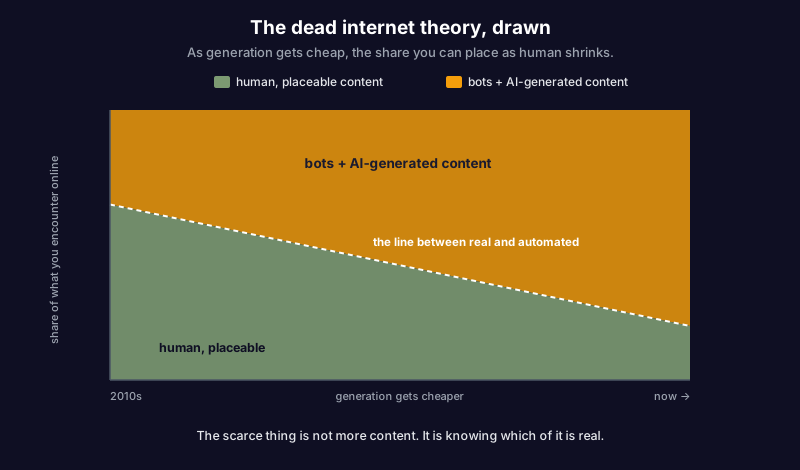
The result is not that the internet is literally empty. It is that the signal you actually want, a real person who knows something, is harder to find in the noise, and harder to verify once you find it. That is the same shift Sturgeon's law describes with the production cost removed: most of everything was always mediocre, and now the mediocre can be generated without limit, so the filtering problem is worse, not different.
Dead internet theory and the sources you trust
For most readers the stakes are not philosophical. They are practical, and they land the moment you save something. If you take notes, keep a research base, or run an AI assistant over your own documents, the dead internet theory is not a story about strangers. It is a description of the raw material flowing into your knowledge base.
Every claim you capture from the open web now arrives with an unanswered question attached: was this written by a person who knew something, or generated by a system optimizing for clicks? The surface no longer tells you. A fluent, confident, well-structured passage is exactly what a content mill produces, and exactly what a careful expert produces, and you cannot read the difference off the prose. When you save that passage without its provenance, the uncertainty does not go away. It gets baked into your notes, and six months later you are relying on a line whose origin you can no longer reconstruct. This is a close cousin of the way notes quietly go stale and start misleading you: a source you could not vouch for on the way in becomes a fact you trust by default on the way out.
The sharpest version involves no human source at all. When you ask an AI assistant a question, it hands you an answer in the same even, confident tone whether it is repeating something solid or improvising. That is a claim asserted with no evidence, which you are entitled to hold rather than adopt, and it is also the dead internet theory in miniature: machine-generated content entering your workflow with no marker of where it came from or whether a human ever checked it. The defense is not to distrust everything. It is to verify a claim against the world at the moment you save it, while the context is still in front of you and the check is cheap.
Dead internet theory vs related ideas
The theory gets stretched to cover every bad feeling about the modern web, so it helps to pin down exactly what it claims and how it differs from the ideas it travels with. Each of these describes a real failure, but they are different failures with different defenses.
| Idea | What it is about | How it differs from dead internet theory |
|---|---|---|
| Dead internet theory | Who produced the content: bots and AI versus humans, at scale | The baseline question, about provenance and authenticity of the whole environment |
| Poe's law | Whether a message is sincere or parody | About reading intent in one message, not who or what created it |
| Sturgeon's law | Most of everything is low quality | About the quality distribution, not whether a human made it |
| Brandolini's law | Refuting nonsense costs far more than producing it | About the cost of cleanup once slop exists, not its volume |
| Gell-Mann amnesia | Trusting a source you already caught being wrong | About source reliability over time, not automation |
| Betteridge's law | A question-mark headline can be answered "no" | About one clickbait pattern, a symptom of the content economy |
The point of the table is not to rank them. It is that the dead internet theory sits underneath the others as the environmental claim: once most of the environment is automated, Sturgeon's crud is generated without limit, Brandolini's cleanup cost explodes, and the clickbait patterns Betteridge's law catches get mass-produced. The related ideas are tools for navigating a web the dead internet theory describes.
How to keep real signal
You cannot fix the open web, and pretending most content is human when it is not is its own kind of error. The achievable goal is narrower: stop letting unverifiable, automated-by-default content enter your thinking as if it were trusted. A few habits do most of the work.
Treat provenance as a field, not an afterthought. When you save something, capture where it came from and how you judged it, not just the claim itself. A note that records "from X, confirmed against Y" survives the dead internet in a way a bare copied sentence never will, because the one thing automation strips is the trail back to a knowable source.
Verify on the way in, while it is cheap. The moment to check a claim is when you save it, with the surrounding context still visible. Later, the context is gone and all you have is a confident-sounding line of unknown origin, which is exactly the thing the theory warns you not to trust. This is Brandolini's law applied to your own base: checking now costs seconds, refuting a wrong note you have already relied on costs far more.
Prefer sources you can place, and rate them over time. A known author, an outlet with a track record, a person who has actually done the thing: the source often carries the authenticity the individual message cannot. And when a source turns out to be a content mill or an unreliable generator, lower the trust you extend it next time, instead of trusting it again the moment you turn the page.
Treat a confident AI answer as unplaced content. An assistant's fluent reply has no provenance marker by default. Use it as a draft to check, not a fact to file. The same discipline that protects you from a stranger's AI-generated post protects you from your own assistant's.
Move the real conversation somewhere you can see the people. One honest implication of the theory is that authentic exchange is migrating to smaller, gated spaces where accounts are known. For your own knowledge, the equivalent is a base you control, where every entry is one you placed deliberately, rather than a feed where anything could be anyone.
When the dead internet theory is overstated
A guard is worth stating, because the idea invites two opposite errors. The first is treating the conspiracy version as established fact. There is no proof of a coordinated plot to replace humans with bots, and claiming there is undercuts the part that is actually defensible. The honest position is the leaner one: automation and engagement incentives are measurably flooding the web with non-human content, no villain required.
The second error is sliding into blanket cynicism, deciding nothing online is real and no source can be trusted. That is paralysis, not skepticism, and it is its own inaccuracy. Plenty of the web is still human, still expert, still worth reading, and a great deal of automated content is perfectly useful. The theory does not ask you to believe nothing. It asks you to stop assuming authenticity you have not checked, which is a specific and manageable discipline. Deciding which sources are even worth that effort is itself a judgment worth making deliberately rather than by reflex, so you spend your attention where it buys the most.
Getting started
The dead internet theory is not a reason to log off in despair. It is a reason to stop treating the open web as a pool of trustworthy human knowledge you can scoop from without looking, in a moment when bots and generated content make up a large and growing share of what is there. The fix is not grand. It is to protect provenance in the one place you fully control: your own notes and sources.
Start there. Capture each claim with where it came from and how far you believed it, so a line of unknown origin does not harden into a fact you rely on. Verify sources at the moment you save them, while the context that tells you whether they are real is still in front of you. And treat a confident AI answer as unplaced content to check, not to file. Try Scribelet free and let it keep your notes with their sources and their context, and re-check them against the world, so the signal you can trust today is still something you can trust the day you rely on it.
Share this article