The Illusory Truth Effect: Why Repetition Makes Things Feel True
Table of contents
There is a particular kind of fact you have never actually checked. You know it the way you know a jingle. You have seen it in three articles, a friend repeated it at dinner, it turned up in a podcast, and by now it sits in your head with the quiet confidence of something settled. Then one day you go to use it, to cite it in a document or build an argument on it, and you reach for the source and find there isn't one. You never verified it. You just kept encountering it, and somewhere along the way the encountering turned into believing.
That is the illusory truth effect, and the unsettling part is not that it fools gullible people. It is that it fools everyone, including the people who pride themselves on not being fooled. The sensation of truth and the fact of truth are produced by different machinery, and repetition reliably moves the first without touching the second. For anyone who takes notes, saves sources, or runs an AI assistant over their own documents, this is not a trivia-night curiosity. It is a description of how bad information gets promoted to trusted information inside your own head and your own files. Here is what the illusory truth effect is, why repetition feels like truth, where it bites hardest now, and how to keep it out of the knowledge you rely on.
What is the illusory truth effect?
The illusory truth effect is the tendency to believe a statement is true because you have encountered it before, regardless of whether it is actually true. Repeated exposure to a claim, even a false one, raises the odds that you will rate it as accurate the next time you meet it. The effect was first documented in a 1977 study by Hasher, Goldstein, and Toppino, and it has held up across hundreds of experiments since: show people a set of plausible-but-false statements, repeat some of them, and the repeated ones are judged more true, by the same people, with no new evidence introduced.
What makes it dangerous is that it operates below the level of argument. You are not being persuaded by a better case. You are being worn into agreement by familiarity, and familiarity does not discriminate between a fact that is repeated because it is true and a falsehood that is repeated because it is cheap to repeat. If you keep a knowledge base, a tool that stores each claim with its source and context is the difference between a note you can stand behind and a note that merely feels right because you have reread it a dozen times.
Why repetition feels like truth
The mechanism has a name: processing fluency. The second time your brain meets a statement, it processes it faster than the first. That ease is a real, physical sensation, and your mind treats it as a signal. The trouble is that it reads the signal wrong. The fluency means "I have seen this before," but the brain hears "this is true," because in everyday life the two usually travel together. Things you encounter repeatedly often are true, so familiarity became a cheap proxy for accuracy, and the proxy works well enough that nobody notices it is a proxy until it is exploited.
Three features of the effect make it worse than an ordinary bias.
The first is that no one is immune. Intelligence does not protect you. Being careful does not protect you. Even subject-matter expertise does not reliably protect you: studies find that experts fall for the effect on claims inside their own field when they do not stop to actively retrieve what they know and instead coast on familiarity. The default mode is to let fluency decide, and the default mode is where most of your reading happens.
The second is that a single exposure is enough to start the slide. You do not need a propaganda campaign. One prior encounter measurably raises belief on the next, and the effect compounds with each repetition. The third is that it works even when you were told the claim was false. Warning someone that a statement is untrue, then repeating it, can still raise their later belief in it, because the familiarity outlives the correction. The retraction fades and the fluency remains.
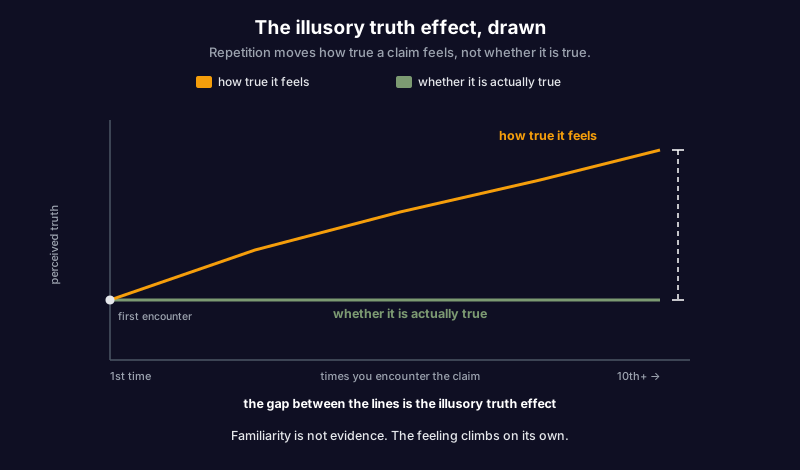
Put those together and you get the shape in the chart above: the feeling of truth climbs with every repetition while the actual accuracy of the claim sits exactly where it started. The whole effect lives in the gap between those two lines, and the gap is invisible from the inside, because the feeling is all you have access to.
Where the illusory truth effect shows up
The effect is not confined to the lab. It is the operating principle behind several things you already half-notice, and naming them makes them easier to catch.
| Where it operates | How repetition does the work | The tell |
|---|---|---|
| Advertising and slogans | A brand claim repeated across every channel starts to feel like consensus | You "know" a product is the best without having compared anything |
| Political messaging | A talking point or rumor repeated through a campaign reads as credible | A phrase feels true but you cannot name where you first checked it |
| Viral misinformation | A false claim reshared across feeds manufactures a sense of agreement | "Everyone is saying it" stands in for "it has been verified" |
| Repeated AI output | An assistant restates the same confident claim across sessions | You stop questioning an answer you have now seen it give four times |
| Your own notes | Rereading a saved claim makes it feel more settled each pass | A line in your notes feels like a fact and has no source attached |
The pattern is the same in every row. Something gets in front of you more than once, the repetition is driven by how cheap it is to repeat rather than by how true it is, and your sense of its truth rises anyway. This is the engine underneath the broader flood of bots and machine-written filler crowding out human signal online: once generating a claim costs nothing, repeating it costs nothing, and the illusory truth effect converts that volume directly into belief.
The illusory truth effect inside your notes and AI tools
For most readers the sharpest version is not political and not commercial. It is private, and it lives in the exact place you went to protect yourself from bad information: your own knowledge base.
Here is how it gets in. You save a claim because it seemed useful, without recording where it came from or whether you checked it. Weeks later you reread your notes, and the claim is there, in your own words, in your own trusted system. Each reread is another exposure, and each exposure nudges the felt truth upward. By the time you act on it, the note carries the full authority of something you have "always known," when all that actually happened is that you reread an unverified line until it felt settled. This is the way notes quietly go stale and start misleading you with the mechanism named: the decay is not only that facts change, it is that rereading launders an unchecked claim into a trusted one.
AI tools pour fuel on this. When you ask an assistant a question, it answers in the same even, confident register whether it is reporting something solid or improvising, and if you ask again tomorrow it will likely say the same thing the same way. That repetition is pure fluency with no added evidence, and it is exactly the kind of claim asserted without support that you are entitled to set aside rather than adopt. It is also the single-source version of the reason refuting a plausible falsehood costs so much more than producing it: the claim arrives cheap and familiar, and the work of checking it never gets cheaper. The defense is not to distrust your own notes wholesale. It is to make verification a thing that happens once, at the moment of capture, so familiarity never gets to stand in for a check you never did.
How to resist the illusory truth effect
You cannot turn off processing fluency; it is baked into how reading works. What you can do is stop letting the feeling of familiarity make the truth call on its own. A few habits do most of the work.
- Separate "I have seen this" from "I have checked this." When a claim feels obviously true, treat that feeling as a flag, not a verdict. The ones that feel most settled are the ones you are least likely to have actually verified, precisely because they feel settled.
- Trace to the source at the moment you save. Asking "where did this come from?" breaks the brain's reliance on familiarity, and the cheapest time to ask is when the context is still in front of you. Verifying a claim against the world as you capture it is the one point where the check is nearly free.
- Mark unverified claims as unverified. A note that says "unchecked" cannot launder itself into a fact on reread, because every exposure now carries the warning with it. An uncaptured doubt disappears; a captured one survives.
- Count the source, not the sightings. Ten articles repeating one unsourced claim is one source, not ten. Collapse repetitions back to their origin before you let volume feel like corroboration. This is rating the source rather than re-trusting it each time you see it again.
- Be most skeptical of what everyone already "knows." The claims that circulate most freely have had the most exposure and therefore the most illusory-truth lift, which is the opposite of the most scrutiny. Widely repeated is not widely verified.
None of these require distrusting everything. They require moving the decision from how a claim feels to whether it has a source, and doing it once, early, while it is cheap.
Illusory truth effect vs related biases
The effect gets lumped in with every cousin in the bias family, so it helps to pin down what is specifically about repetition and what is about something else. Each of these is a real failure, but the defenses differ.
| Idea | What drives the false belief | How it differs from the illusory truth effect |
|---|---|---|
| Illusory truth effect | Sheer repetition and the fluency it creates | The baseline case: familiarity alone raises felt truth, with no new evidence |
| Confirmation bias | The claim already fits what you believe | About fit with prior belief, not raw exposure count |
| Availability heuristic | The claim comes to mind easily | About ease of recall when judging frequency or risk, not truth-from-repetition |
| Gell-Mann amnesia | Trusting a source you already caught being wrong | About source reliability over time, not repetition of one claim |
| Brandolini's law | Refuting nonsense costs far more than making it | About the cost of cleanup after a falsehood spreads, not why it feels true |
The distinction that matters most is the first one. Confirmation bias needs the claim to agree with you. The illusory truth effect needs nothing but repetition, which is why it can install beliefs you have no prior stake in at all, including ones you would reject on reflection if you ever stopped to reflect.
The one move that matters
The illusory truth effect is not a flaw you can argue your way out of in the moment, because by the moment of judgment the damage is already done: the claim already feels true. The only reliable intervention happens earlier, at capture, when you still have the context to ask where a claim came from and whether anyone checked it. Make that a habit, and give unverified claims a home that marks them as unverified, and repetition loses its power to promote a guess into a fact. A knowledge base that holds every note with its source and lets you check a claim against the world as you save it is how you keep the feeling of truth from quietly outrunning the facts. Try it free.
Share this article