Sturgeon's Law: Why 90% of Everything Is Crud
Table of contents
Open any feed, any inbox, any folder of half-finished drafts, and the pattern is the same. Most of what is in front of you is not worth your attention. A little of it is very good. You spend most of your time wading through the first kind to reach the second, and if you are honest, a lot of what you produce yourself lands in the first pile too. This is not pessimism. It is a rough law of large numbers about creative and intellectual output, and it has a name.
Sturgeon's law says that ninety percent of everything is crud. It sounds like a punchline, and it started as one, but it turns out to be one of the more useful lenses you can carry through a world that now generates text, code, and content faster than anyone can read it. What matters is not the exact figure. It is what the figure implies about where your effort should go: not into consuming more, and increasingly not even into producing more, but into filtering. Here is Sturgeon's law in full, why it holds, why AI has made it sharper rather than softer, and a practical way to keep the ten percent that is worth keeping.
What is Sturgeon's law?
Sturgeon's law is the adage that "ninety percent of everything is crud." It means that in any field, most of the output is mediocre or worse, and only a small fraction is genuinely good. The claim is not that a particular field is bad; it is that low quality is the normal, expected majority everywhere, so judging a whole category by its bulk is a mistake.
The line comes from the American science fiction author Theodore Sturgeon. In the 1950s, critics liked to dismiss science fiction by pointing at its worst examples and concluding the genre was junk. Sturgeon's reply, first laid down at a 1953 World Science Fiction Convention and later in print, was that yes, ninety percent of science fiction is crud, but that is because ninety percent of everything is crud. Cars, books, films, plumbing, politics: pick a domain and the same proportion holds. Judging science fiction by its worst was unfair only because you would never judge any other field that way.
There is a wrinkle worth knowing. Sturgeon called the ninety percent line his "Revelation," and he reserved the phrase "Sturgeon's Law" for a different, drier statement: "nothing is always absolutely so." Popular usage flipped the labels, and the ninety percent version is now universally called Sturgeon's law. The original wording used "crud" rather than "crap," which is the form that survives in the software-culture Jargon File. None of this changes the practical point, but it is a nice example of how the ninety percent even applies to the retellings of the law itself.
If you keep any kind of knowledge base, the law is really a question about your own folders: which ten percent of what you saved can you still find when you need it? That is the problem Scribelet is built to solve, and it is worth holding in mind through the rest of this.
Why ninety percent is crud
The number is not measured; it is a shorthand for a real asymmetry between how easy things are to make and how hard they are to make well. A few forces produce it reliably.
The first is that producing something is cheap and producing something good is expensive. Anyone can write a sentence, ship a feature, or record an episode. Making it genuinely good demands taste, revision, and a lot of discarded attempts, and most output never gets that far because most output is a first or second pass that someone shipped anyway. The distribution of quality is not bell-shaped around "pretty good." It has a long, fat tail of the merely adequate.
The second is that skill is unevenly distributed and most work is done by the majority, not the minority. In any field a small number of people or teams produce most of the excellent work, and everyone else produces the rest. When you sample the whole field at random, you are mostly sampling the everyone-else, so the average is dragged down toward the tail. The best of a field and the typical of a field are two very different things, and Sturgeon's law is a reminder to keep them separate.
The third is that quality is only visible in comparison, and comparison is work. A single piece in isolation looks fine. It is only when you line it up against the ten percent that is genuinely good that its flaws show. Since most people do not do that comparison, most crud circulates unchallenged, which is its own small proof of the law.
Sturgeon's law in the age of AI
Sturgeon was talking about human output, where the ninety percent at least took effort to produce. The modern version is harsher, because the cost of producing the crud has collapsed to almost nothing.
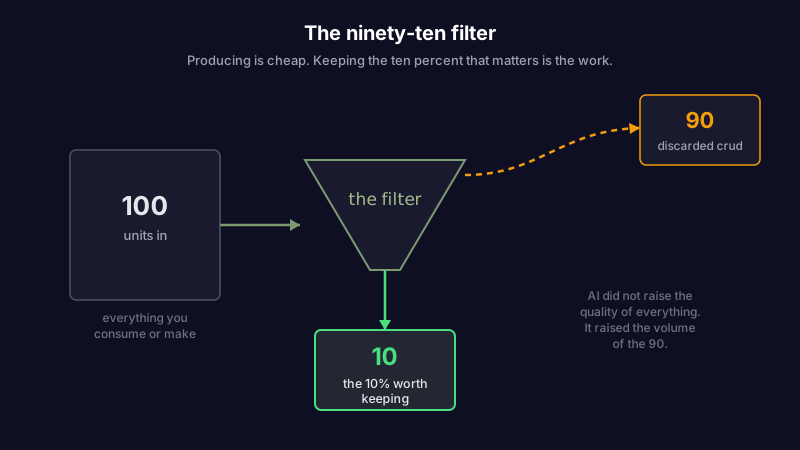
A large language model can generate a plausible blog post, a passable function, or a confident-sounding summary in seconds, at a marginal cost close to zero. The ten percent that is genuinely good has not gotten cheaper; taste and judgment are as scarce as ever. What has changed is the volume of the ninety percent. There is now effectively infinite crud, produced faster than anyone can read it, and much of it is polished enough to pass a glance. Essays titled "AI meets Sturgeon's law" already rank for the term, because the pattern is easy to recognize once you name it: AI did not raise the average quality of everything, it raised the quantity of the average.
This flips where the scarce skill lives. When crud was expensive to produce, being a competent producer was valuable. When crud is free, the bottleneck moves entirely to filtering. The person who can quickly tell the ten percent from the ninety percent, and who has a system for keeping the ten percent where they can find it again, has the advantage. Generating more is no longer the hard part. Deciding what deserves to survive is. This is the same shift that makes verifying what an AI tells you more important than getting it to produce more: the output is abundant, so the value is in the judgment applied to it.
Examples of Sturgeon's law
Once you have the lens, you see the ninety-ten split everywhere you consume or produce information. A few of the common shapes:
| Domain | The ninety percent | The ten percent worth keeping |
|---|---|---|
| Your feeds and inbox | Noise, forwards, half-read newsletters | The two posts a month you actually reference later |
| AI-generated drafts | Plausible, generic, off in the details | The occasional passage that is genuinely sharp |
| A codebase | Features and code paths that add little value | The parts that carry the load and drive outcomes |
| A field of research | Papers that are never cited and never replicate | The handful that change how you think |
| Your own notes | Captures you never reopen | The evergreen notes you return to for years |
The last row is the one most people never count, and it is the one that matters most if you keep a knowledge base. You save far more than you will ever reuse. Most of what you capture is a fleeting thought, a link you never revisit, a quote out of context. That is fine and expected; Sturgeon's law predicts it. The problem is not that the ninety percent exists. The problem is when it is mixed in with the ten percent so thoroughly that you cannot find the good notes without wading through the rest, which is how a knowledge base quietly decays into a pile you no longer trust.
The software reading is worth pausing on too. Applied to a product, Sturgeon's law says roughly ninety percent of features and experiments will not pan out, and only a small fraction will drive real value. That is not an argument against trying things; it is an argument for shipping small, measuring, and cutting fast, because the alternative is carrying the ninety percent forever as bloat. The teams that win are not the ones that produce the most. They are the ones that kill the crud quickly and double down on the ten percent.
How to apply Sturgeon's law
Knowing that ninety percent is crud is only useful if it changes what you do. The point is not to become cynical and dismiss everything, which is just a different way of failing to find the good ten percent. The point is to build filtering into your workflow so the ten percent survives and the ninety percent does not clog it. A few habits do most of the work.
Filter on the way in, not just on the way out. The cheapest place to reject crud is before it enters your system. Unsubscribe from the newsletters you skim and never act on. Prune the feeds. Ask the AI for less and demand more of what it gives you. Every piece of crud you refuse at the door is one you do not have to filter again later.
Mark the ten percent explicitly. When something is genuinely good, do not just consume it and move on. Flag it, tag it, write down why it mattered. The ten percent is only useful if you can find it again, and an unmarked good note is functionally lost inside the ninety percent around it. This is the whole reason to keep evergreen notes separate from fleeting captures.
Judge the source, not just the piece. If a source reliably produces crud, discount it as a source, and stop spending attention proving the point piece by piece. If a source reliably produces the good ten percent, weight it up. This is Sturgeon's law used as a triage rule: you cannot evaluate everything, so evaluate the source's hit rate and let that carry. It also guards against a related trap, trusting a source again right after you caught it being wrong, which is how crud from a known-unreliable source keeps getting through.
Let the tools do the first pass, but keep the final call. AI is genuinely good at the first cut, at summarizing and surfacing and clustering, at telling you what a hundred captures are roughly about. It is not good at the final judgment of what is worth keeping, because that depends on your goals, which it does not have. Use it to compress the ninety percent so you can see it, then decide the ten percent yourself.
The ninety percent hiding in your own notes
If you keep any kind of knowledge base, Sturgeon's law is not a fact about the world out there. It is a fact about your own folders. Most of what you have saved you will never reopen. That is not a failure of your note-taking; it is the expected shape of capture. The failure is only when the ten percent that is genuinely valuable is buried so deep in the ninety percent that finding it costs more than rewriting it from scratch.
This is where a filtering system earns its keep. A good knowledge base is not the one that captures the most. It is the one that makes the ten percent findable: the notes you return to, the sources that earned their place, the ideas that survived a second look. That means capture should be cheap and low-friction, so you never lose the good stuff by failing to write it down, but retrieval and curation should be strong, so the good stuff is not lost in the flood. This is exactly the problem Scribelet is built for: capture everything without friction, then let AI help surface and connect the ten percent that matters, so your notes stay a place you actually trust rather than a bigger pile of the same crud. The same discipline applies to what an AI reads back to you: if it is drawing on notes that are ninety percent noise, its answers will be too.
When Sturgeon's law is the wrong lens
Sturgeon's law is a useful default, but it can be misused, and it is worth naming the failure modes.
It is not a licence for cynicism. "Ninety percent is crud" is a reason to filter harder, not a reason to dismiss whole fields or to stop looking for the ten percent. The people who quote it to justify not reading, not trying, or not shipping have taken the observation and used it as an excuse, which misses the point entirely; the law is about the value of the ten percent, not the worthlessness of the ninety.
It also does not tell you where the ten percent is. The law describes the distribution, not the location. Knowing that most output is crud does not identify the good stuff for you; that still takes judgment, taste, and the comparison work that most people skip. Sturgeon's law tells you to filter. It does not do the filtering.
And the ninety percent figure is not literal. It is a memorable shorthand for "most," and the real proportion varies by field, by moment, and by how you define quality. Treating it as a precise measurement, or arguing about whether it is really eighty-five or ninety-five percent, is its own small piece of crud. What survives is the shape: producing is easy, quality is rare, and the scarce skill is telling them apart. That instinct pairs well with other named laws that describe how systems and quality behave over time.
Getting started
Sturgeon's law will not stop being true, and AI has only raised the volume of the ninety percent you have to move through. The response is not to consume less or produce less. It is to get deliberate about filtering, so the ten percent that is genuinely worth keeping survives and stays findable.
That starts with where you keep things. Capture without friction so you never lose the good notes, then lean on curation and AI-assisted retrieval so the ten percent does not drown in the rest. Try Scribelet free and build a knowledge base that filters for the ten percent instead of just growing the ninety.
Share this article