Interstitial journaling: the log nobody reads back
Table of contents
For a few weeks it was the best productivity habit you had ever kept. Every time you switched tasks you dropped a line in a running log with the time next to it: "10:42, finished the pricing draft, still unsure about the annual tier, next up answer Priya's thread." Interstitial journaling did exactly what it promised. Your head felt clearer between tasks, you stopped stalling before hard work, and for once you knew where the day actually went.
Scroll that log now. It is a wall of timestamps and half-sentences, hundreds of them, written to a version of you who was mid-context and needed none of it explained. "2:15, back from standup, the thing about the migration." What thing about the migration? You wrote it three months ago and you have not opened it since. The entries did their job for the ninety seconds after you typed them, and then they became sediment.
This is the quiet fate of the interstitial log. The method is genuinely good at the moment of writing and completely silent about everything that comes after. Every guide teaches you how to fill the log. None of them tells you what the log is for once the day is over. This guide gives you the template, the worked examples, and the answers to the questions people actually ask about the method, and then it covers the part everyone skips: what happens to the log after you stop writing it.
What is interstitial journaling?
Interstitial journaling is the practice of writing short, timestamped notes in a single running log during the gaps between tasks, capturing what you just finished and what you plan to do next. It combines note-taking, a to-do list, and time tracking in one stream, and it is meant to be written in the small "interstitial" moments when you switch from one thing to another.
The term was coined by Tony Stubblebine in 2017 and popularized for a wider audience by Anne-Laure Le Cunff, who describes it at Ness Labs as the simplest way to combine notes, tasks, and time tracking in one workflow. The appeal is that it needs no special tool. A notebook works. A plain daily note in Notion, Obsidian, or Roam works. The habit is the whole method.
What it is not is a diary. You are not reflecting on your feelings at the end of the day. You are logging the transitions, in real time, as a way to steer the next hour.
How interstitial journaling works
The mechanics fit in three moves, and you can learn them in a minute. Every time you finish something or switch context, you stop and write three things.
Note the time. Stamp the entry with the current time. Over a day this builds an honest record of where your hours actually went, which is usually nothing like where you thought they went.
Reflect on what you just did. One or two sentences on the task you are leaving: what you decided, what is unresolved, what you would tell yourself if you picked it up again tomorrow. This is the move that does the real work.
Plan the tiny next action. Write the literal first step of whatever comes next, small enough that starting feels trivial: "open the file and re-read the intro," not "write the report."
The reflection move is not busywork. Psychologist Sophie Leroy showed that when you switch tasks, part of your attention stays stuck on the last one, a drag she named attention residue. Writing a closing line about the task you are leaving gives your brain permission to set it down, so you arrive at the next thing with a cleaner head. That is a real, measurable benefit, and it happens entirely in the moment of writing.
An interstitial journaling template you can copy
You do not need an app to start, and you do not need to memorize anything. Every entry follows the same four-line shape. Paste this at the top of today's note and copy the block down each time you switch tasks.
[HH:MM]
Just finished: what you were doing, and the one thing worth remembering (a decision, an open question, a number).
Feeling: one word, optional, honest (focused / foggy / drained / wired).
Next: the smallest concrete first step, not the whole task.
That is the whole template. The "Just finished" line is where the value lives, so make it a sentence, not a label: "wrote the intro" is scaffolding you will delete later, but "wrote the intro, still unsure the opening stat is current, need to recheck the source" is a decision and an open question you will want back. The "Feeling" line is optional and takes one word, but over a week it quietly shows you when your focus actually breaks, which is rarely when you assumed. The "Next" line is the anti-procrastination lever: keep it small enough that starting is trivial.
If you keep the log in a tool that supports it, add one thing the paper version cannot give you: a way to mark the "Next" lines so they do not vanish into the scroll. In Scribelet a leading checkbox or an @task turns that line into something you can actually close later, which matters more than it sounds, for reasons the rest of this guide gets to.
Interstitial journaling examples
The template is abstract until you see it running. Here are three real interstitial log entries from three different kinds of day, so you can copy the rhythm rather than the words.
A product manager mid-afternoon.
14:05
Just finished: vendor integration call. They can do it but not before Q3, so the launch date is at risk.
Feeling: tense
Next: draft two sentences to the team flagging the slip, send before I forget the reason.
A writer between drafts.
09:40
Just finished: first pass on the essay intro. The Leroy citation is doing a lot of work and I never checked the year.
Feeling: focused
Next: open the paper, confirm 2009, then write the second paragraph.
A student with ADHD, switching subjects.
16:20
Just finished: two problem sets, but I burned 40 minutes reorganizing the folder instead of starting.
Feeling: scattered
Next: read exactly one page of the reading, timer on, phone in the other room.
Notice what each entry preserves that a bare "done with the call" would have thrown away: the reason the launch date moved, the fact-check you owe yourself, the honest note that folder-tidying was procrastination. Those are the parts you will want back in a week. The timestamps and the "back from lunch" lines around them are not.
What app can I use for interstitial journaling?
The honest answer is that any place you can type a timestamp works, and the method's founders wrote it for a plain notebook. The tool only starts to matter when you ask what happens to the log after the day ends, which most guides never do. Here is how the common options actually compare, on the day you write and the week after.
| Approach | Real-time capture | Reads the log back | Turns next-actions into tracked tasks | Keeps entries findable and current |
|---|---|---|---|---|
| Pen and notebook | Yes | No, by hand only | No | No, and not searchable at all |
| Notion or Obsidian daily note | Yes | Only if you reread it yourself | Manual, if you copy them out | Text search only, entries freeze at capture |
| Roam daily notes | Yes | No, links help but you still dig | No | Better linking, no accuracy check |
| A maintained system | Yes | Yes, digest surfaces decisions and themes | Yes, tasks extracted automatically | Yes, semantic search plus verification |
Pen and paper is the purest way to learn the habit and the worst way to keep the payoff. A daily note in Notion, Obsidian, or a block-based outliner is where most people land, and it is a real improvement: capture is fast and the log is at least text-searchable. The middle rows are where nearly every guide on the method stops. The last row is the difference between a log that became a record of what you actually decided and one that became a wall of timestamps you will never open again, which is the whole subject of the second half of this article.
What are the three types of journaling?
People searching for interstitial journaling often land on this question, because it helps to know where the method sits. Broadly, journaling comes in three shapes:
- Reflective journaling, the classic diary: end-of-day, feelings-first, written to process what happened.
- Structured or prompt-based journaling, such as gratitude journaling or a bullet journal, where fixed prompts or a fixed format do the thinking for you.
- Log-based journaling, which is where interstitial journaling lives: written in real time, event-triggered, and aimed at steering the next hour rather than reflecting on the last day.
Interstitial journaling is the odd one out on purpose. It is not about the end of the day and it is not about a prompt. It is a running log you write while the work is happening, which is exactly why it captures decisions the other two miss and exactly why it piles up faster than either.
What is the 3-3-3 journal method?
The 3-3-3 method is a short, structured routine, usually done in the morning: you write three of something across three categories, most commonly three things you are grateful for, three things that would make the day good, and three quick intentions or affirmations. It is a prompt-based practice, fixed in shape and done once a day.
That is the opposite of interstitial journaling, and the two solve different problems. The 3-3-3 method sets an intention before the day starts. Interstitial journaling steers the day while it runs and leaves a record of what actually happened. If you like both, run 3-3-3 at the top of your daily note and interstitial entries underneath it through the day. They stack cleanly, and the read-back problem this article describes applies to the combined log exactly the same way.
Interstitial journaling for ADHD
A lot of the enthusiasm for this method comes from people with ADHD, and it is not an accident. Interstitial journaling gives three things an ADHD brain tends to want at once: structure, because every entry has the same shape; flexibility, because there is no schedule and you write only when you switch; and instant feedback, because the timestamp shows you, without judgement, where the time actually went.
The "Next" line is the part that earns its keep here. A task that feels too big to start is the classic ADHD wall, and writing down a first step small enough to be trivial is a known way over it. The "Feeling" line helps too: naming "scattered" or "wired" in one word is a cheap form of the self-awareness that makes the next choice a little easier. The catch is the same one everyone hits, only louder: the log that helped you get through Tuesday is not going to reread itself on Friday, and the person least likely to scroll back through a thousand timestamps is the person who found them useful precisely because they required no rereading.
Why the method works, right up until it doesn't
Give interstitial journaling its due. In the moment, it delivers three things most productivity systems only promise.
It clears attention residue, so context switches cost you less. It kills procrastination, because a next action small enough to write down is small enough to start. And it produces an honest time log as a byproduct, without a single timer, so you can see that the "quick" review actually ate ninety minutes.
Every one of those benefits is consumed the instant it is produced. The residue clears now. The next action gets started now. The time log matters most for the day you are living. Interstitial journaling is a workflow optimized for the present tense, and that is exactly why the log itself gets abandoned. You were never writing it to read it later. You were writing it to get unstuck now.
So the entries pile up, each one perfectly useful for about a minute and then never again. This is the same collect-and-forget archive that swallows highlights and reading notes, just running at a faster clock. A commonplace book rots over years. An interstitial log rots by Friday.
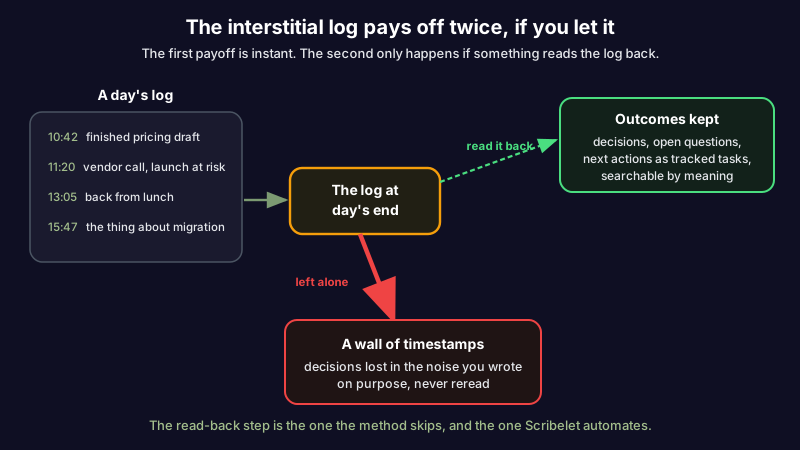
What happens to the log after the day ends
Picture what you actually have after a month of diligent interstitial journaling. Thousands of lines. Every meaningful decision you made is in there somewhere, next to every "back from lunch" and every "quick break." The signal is real, and it is buried in noise you wrote on purpose.
That log is a record of how you spent your attention, which is to say it is one of the most valuable things you produce all week. It knows why you changed the launch date. It knows the objection the client raised that you swore you would remember. It knows which task you have restarted four Mondays in a row without finishing. A work log that captured your actual decisions is gold at review time, in a retro, or the next time the same problem comes back around.
But only if someone reads it back. Left alone, the interstitial log is a diary of intentions that never becomes a record of outcomes. You logged "next: flag the slip to the team." Did you? The log captured the intention and then never checked. And the raw entries are exposed to ordinary knowledge decay on top of that: the link you dropped at 3pm rots, the "current" number you jotted gets superseded, the decision you recorded gets quietly reversed two weeks later and the old entry still says the opposite. The log fails twice, the same way collected notes always do. It fails forward, because you never distilled it into anything. And it fails in place, because even the record it preserved is going out of date while you assume it is safe.
What an interstitial log needs after you stop writing it
Strip away the method and an interstitial log needs three unglamorous things done to it, on repeat, if it is going to be worth more than the day you spent building it.
It needs to be read back and distilled. Somebody has to walk the day's stream and pull out the parts that outlive the day: the decisions, the open questions, the commitments you made to yourself. The other ninety percent, the "back from lunch" scaffolding, can fall away. Without that pass, the outcomes stay trapped in the noise that surrounded them.
It needs its intentions turned into tracked actions. Half of what you write in an interstitial log is a next action. "Draft two sentences to the team." Those are the point of the method, and they are worthless if they live and die inside a timestamped line nobody revisits. They need to become things you can actually check off, not fossils in a scroll.
It needs to stay searchable by meaning. Six weeks later you will want "that call where the integration date slipped," not the timestamp, which you never knew. A log you can only read top to bottom is a log you will never read at all.
None of this is intellectually hard. It is just relentless, on no schedule, and the person who would have to do it is the same tired person who found the log too tedious to reread in the first place. This is the step every note-taking method skips, and interstitial journaling skips it faster than most.
Interstitial journaling without the graveyard
This is the part the method leaves to your discipline, and it is the part Scribelet is built to take off your hands. The principle is simple: if an interstitial log is only useful once something reads it back, do the read-back automatically instead of hoping you will.
In Scribelet, today's daily note is the running log. You drop timestamped lines through the day the same way you would anywhere, in real time, with no extra ceremony, using the exact four-line template above. The difference is what happens overnight. A daily digest reads the day's entries back and returns the themes, the decisions, and the action items, so the outcomes lift out of the noise without you rereading a single line. The stream stays as your raw record, and the summary becomes the thing you actually keep.
The next actions you logged do not stay buried either. Scribelet pulls tasks out of your notes, so "draft two sentences to the team" becomes something you can track and close, not a line you scroll past. Semantic search means you find the call where the date slipped by describing it, not by remembering when you wrote it down. And because your notes point at the outside world, background verification can check the claims in them against the web on a schedule and show you a diff when something you logged has since changed.
Because this is AI reading your log, control is the point. Scribelet's AI works out of the box, and bringing your own OpenAI, Anthropic, or Gemini key is an optional path if you would rather your notes be read by the provider you choose than one we picked for you. Either way the digest is a summary you review, and every suggested change lands as a diff you approve, not a silent edit. You can watch it read your first day back on a log you already keep.
The log is a means, not a monument
The reason your interstitial log went nowhere is not that you journaled wrong. You almost certainly journaled well. The method simply handed you a stream that pays off in the moment and then left the far more valuable second payoff, the record of what you decided and did, to a future self who was never going to scroll back through a thousand timestamps to find it.
Treat the interstitial log as what it is: a means, not a monument. The point was never the stream. The point is the handful of decisions, questions, and commitments buried inside it, and those only surface if something reads the day back for you and keeps them where you can find them. Write your log the way the method taught you, using the template above, and let a system turn it into a record of outcomes instead of a graveyard of intentions. Start free.
Share this article