How to remember what you read when notes go stale
Table of contents
You highlighted forty passages in a book three months ago. You could not quote one of them right now, and you have never once reopened the highlights. You did the thing the advice told you to do. You still forgot almost all of it.
This is the honest starting point for how to remember what you read: most people who forget what they read are not lazy readers. They took notes. They highlighted. Some of them even reviewed. And the material still slid out of reach within weeks. The usual guides blame your memory and stop there. Your memory is only half the problem.
The other half is that the notes you took to remember the reading are quietly going stale, and nobody tells you to check on them. This guide covers both halves: why reading does not stick, and how to build a reading system that actually holds, without turning your evenings into flashcard drills.
Why you forget what you read
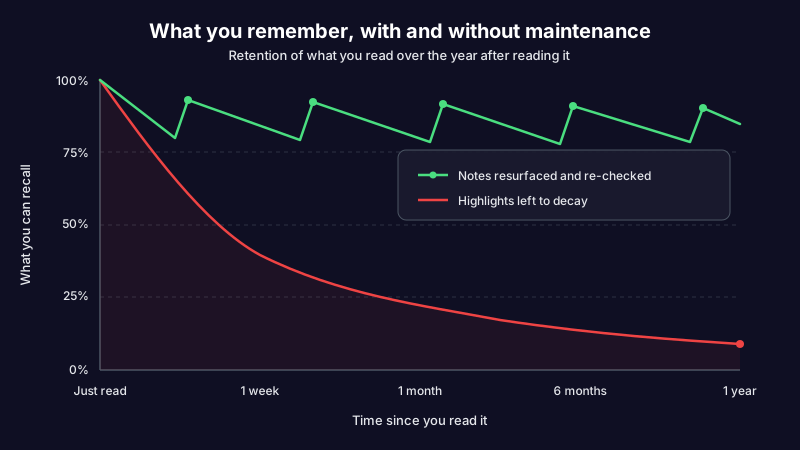
You forget what you read because reading feels like learning while it is happening and mostly is not. Passive reading moves words past your attention without forcing you to retrieve anything. Within a day, most of it is gone. This is the forgetting curve that Hermann Ebbinghaus measured in the 1880s, and it has never stopped being true.
The trap is that rereading feels productive. The second time through a chapter, the words are familiar, so your brain reports "I know this." That familiarity is not memory. It is the fluency illusion, and it is why people close a book they have read twice and still cannot summarize it. Recognizing a sentence when you see it again is a much lower bar than producing the idea when you need it. If you would rather a tool do the remembering for you, you can start free and skip to the system below.
Two techniques genuinely fight this, and both are worth doing. The first is active recall: closing the book and trying to reconstruct the argument in your own words before you look back. Retrieval is the act that builds memory, which is why testing yourself beats rereading in study after study. The friction of dredging the idea up from nothing is the whole point. The second is spaced repetition, revisiting the idea just as you are about to lose it, at widening intervals, so each pass reinforces the trace instead of wasting effort on something you still hold.
Andy Matuschak put the uncomfortable version plainly in Why books don't work: the medium assumes you absorb knowledge by looking at a page, and you don't. If you take one thing from the encoding half, take this. Recall beats rereading, and a note you had to write in your own words beats a highlight you swiped a marker across.
So do that. It is real, and it helps. It also is not enough, because there is a second reason the reading disappears that none of the top guides name.
The part the advice skips: your reading notes go stale too
Say you take the advice seriously. You keep literature notes, the layer between what you read and what you keep. You highlight in Readwise, you write summaries in Obsidian, you build the searchable archive everyone recommends. A year later you have four hundred notes and you still cannot remember what you read, because the notes have the same problem the reading did. They sit there, untouched, aging.
This is knowledge decay, and it hits collected reading harder than almost anything. A book note you wrote captures your understanding on the day you wrote it. The framework it summarized has since been revised. The statistic you copied has been updated. The link to the source is dead. The note looks authoritative and is quietly wrong, and you will never notice, because reopening old notes is exactly the thing nobody does.
Picture a developer who read a book on a web framework in the spring and wrote a careful note on its recommended auth pattern. The framework shipped a major version in the summer and deprecated that pattern. The note did not change. It still reads like current best practice, and it will keep reading that way until it causes a bug. Or a researcher whose note summarizes a study that was later corrected. The summary is now confidently repeating a finding the field walked back. In both cases the reader remembered what they read perfectly. What they read stopped being true.
This is the oldest failure in note-taking. It is what happens to a commonplace book full of passages you never read back, and it is the maintenance step that every personal knowledge management system skips. Remembering what you read is not only an encoding problem. It is a maintenance problem. You have to keep the captured version alive, or the archive becomes a graveyard you feel guilty about instead of a memory you can use.
If you want the low-effort way to try this idea, put your next book's notes somewhere that reads them back to you.
What is the 2-7-30 rule, and why intervals alone aren't enough?
The 2-7-30 rule is a spaced-repetition schedule: review new material after 2 days, again after 7, and again after 30, so each pass lands just before you would forget. It is a fine default, and it works for facts that stay fixed, like vocabulary or formulas.
It breaks for everything that changes. A fixed calendar assumes the note is still correct on day 30, which for anything tied to an external source is a bad bet. Reviewing a stale note on schedule just rehearses the wrong version more efficiently. What you want is not only review at intervals but resurfacing by relevance, the old note coming back when it connects to what you are reading now, and getting checked against the current source when it does.
A system that resurfaces and re-checks what you read
Here is what a reading system looks like when it handles both halves. It has three moves, and only the first one is manual.
Capture in your own words, not the author's. If frequent pauses disrupt your concentration, build a short note-taking session into your daily reading routine, giving yourself five minutes afterward to summarize the main ideas. A note that says "the key claim is X, and it matters because Y" is a retrieval you already performed. A raw highlight is a photograph of a sentence you will not reread. This is the literature-note idea at the heart of a zettelkasten, and it is the one step worth the friction.
Connect it, automatically. A note you can find is worth ten you cannot. When a new book note links to the three older notes it relates to, the ideas start reinforcing each other instead of decaying in isolation. Scribelet's auto-linker proposes those connections as you write, so the web builds itself instead of waiting for you to remember what you already saved.
Resurface and re-check, without you asking. This is the part manual systems cannot scale past about fifty sources. Background agents bring an old note back when it becomes relevant again, and background verification searches the web, compares what it finds to what you wrote, and shows you a diff when the source has moved on. Green for new information, red for what is now outdated. You review, accept or dismiss, and the note you took eight months ago is still true today. It is the same maintain-it-for-you idea behind an AI second brain that doesn't go stale, applied to the specific problem of holding onto what you read.
Honest tradeoff: this pays off for reading tied to external sources, technical books, research, anything with facts that move. For a novel you read once for pleasure, a maintained note is overkill, and that is fine. Not everything you read needs to be remembered.
Connect what you read to what you already know
There is a reason the same idea sticks the second time you meet it. Memory is associative. An isolated fact has nothing to hang on and slides off. A fact wired into things you already understand has a dozen handholds. This is why the strongest reading advice is not "review more" but "relate more," asking how the new idea fits, contradicts, or extends what you have already read.
The problem is that you cannot relate a new note to an old one you have forgotten you wrote. Nobody holds four hundred notes in their head well enough to notice that the chapter they just read answers a question they wrote down last year. This is where the connecting has to be done for you. Semantic search finds the older notes a new one relates to by meaning rather than by exact words, and a knowledge graph keeps those relationships so the next time you read something adjacent, the earlier thinking surfaces with it. The web of what you have read becomes navigable instead of a pile, and navigable is the difference between a note you can use and a note you technically own.
When you want to pull an idea back deliberately, you can also just ask. AI chat that searches your own notes answers "what did I read about spaced repetition" with the actual notes you wrote and a link to each, not a generic web summary. It is retrieval on demand from a library you built, which is a very different thing from a search engine.
How to remember what you read without taking notes
Sometimes you finish a chapter on a walk and the last thing you want is to sit and write. You can still hold onto it. The trick is to capture the reaction, not transcribe the passage. Say the one idea out loud, in your own words, and let it become a structured note later. Speak "the argument here is that habits beat goals, and I want to use that for the onboarding rewrite," and voice transcription turns it into a titled, tagged note with the thought intact.
It is a lower bar than the highlight-everything approach, and it retains more, because the act of saying the idea in your own words is itself the retrieval that builds memory. When you do want the reviewing done for you, our thirty-minute weekly review system covers the manual cadence, and the background version does it while you read the next thing.
Reading retention approaches, compared
Every method captures something. The differences show up months later, in whether the captured version is still there and still true.
| Approach | Captures the idea | Resurfaces it later | Stays accurate over time | Scales past ~50 sources |
|---|---|---|---|---|
| Highlights only | Weakly (a swipe, not a thought) | No | No | No |
| Flashcards (Anki) | Yes, if you make cards | Yes, on a fixed schedule | No, cards freeze on creation | Rarely (deck upkeep is heavy) |
| Manual second brain | Yes | Only if you review by hand | No, notes decay untouched | No |
| A maintained system | Yes, in your own words | Yes, by relevance and schedule | Yes, re-checked against sources | Yes, agents do the upkeep |
The first three columns are where most reading advice lives. The last two are why you still forget after doing everything right.
You don't have a memory problem
The reason last year's reading is gone is not that your memory failed. It is that the notes you made to hold it were left to rot, and no advice about active recall fixes a note that nobody reopens. Encoding gets the idea in. Maintenance is what keeps it there.
Read actively, capture in your own words, and then let a system resurface and re-check what you saved so the version you reach for a year from now is still the version that was true. That is the half the guides skip, and it is the half that decides whether you remember what you read. Start a reading system that reads itself back.
Share this article