Atomic notes: the maintenance bill nobody mentions
Table of contents
You did the work. You stopped dumping whole book summaries into one file and started splitting your reading into single ideas, each one titled like a claim, each one small enough to read in fifteen seconds. Four hundred notes later, your graph looks like the diagrams in every PKM guide you have ever read.
Now open the twelve oldest ones. Not the graph, the notes themselves. How many have been edited since the day they were written? How many cite a version number, a statistic, or a link that you have checked even once since?
That is the part the method never mentions. Atomic notes are an excellent way to write. They are also a decision to break your knowledge into hundreds of small, independent, confidently worded claims, each of which can go out of date on its own schedule, without telling you. Granularity is a writing choice. What it does to your collection over the following year is a maintenance problem, and nobody hands you a plan for that.
What is an atomic note?
An atomic note is a note that contains exactly one idea, written in your own words, and understandable on its own without the source it came from. That is the whole definition. One note, one concept, self-contained, and titled clearly enough that you can find and link it later.
The principle comes out of the zettelkasten tradition. Zettelkasten.de's guide to atomicity frames the purpose plainly: an atomic note exists to zero in and create a close-up of a single idea, while structure notes provide the higher-level view. Andy Matuschak makes the same requirement of his own system in Evergreen notes should be atomic, where notes are kept short and highly focused so they can be read on the spot and reused freely.
The argument for it is straightforward. A note about one idea can be linked from anywhere that idea comes up. A note about eleven ideas can only be linked from a place where all eleven matter, which is nowhere. Atomicity is what makes a knowledge graph combinatorial instead of a filing cabinet with prettier labels.
So the advice is good. It is just incomplete, and you can try the missing half free if you would rather not read the argument first.
Atomic notes vs zettelkasten permanent notes
People coming from a classic zettelkasten ask where atomic notes fit, and the answer explains a lot about why the collection ages the way it does.
Atomicity is a property, not a note type. In Sönke Ahrens' three-type model, literature notes capture what a source said, and permanent notes carry your own developed thought into the slip-box. Atomicity is the rule you apply when promoting something into that permanent layer: one idea per card, or the card cannot be filed cleanly.
The consequence is that a classic permanent note is finished on purpose. Luhmann's slip-box grew by writing new notes that responded to old ones, not by editing the old ones. Staleness was baked into the contract, so an old card was read as a record of what you thought in 1974, not as a claim about the world today.
Modern atomic notes quietly dropped that contract while keeping the format. Practitioners in the Obsidian community and on r/Zettelkasten have argued for years about whether atomic notes are worth the friction, with one widely read thread titled simply "Atomic notes are a trap." The complaints are usually about granularity: notes so small they lose context, hours lost to splitting, a graph that grows faster than your understanding.
The granularity critics are aiming at the wrong target. Splitting ideas finely is not the trap. The trap is that you now have four hundred independent assertions, each presented as settled, with no mechanism anywhere in the method for checking whether any of them are still true.
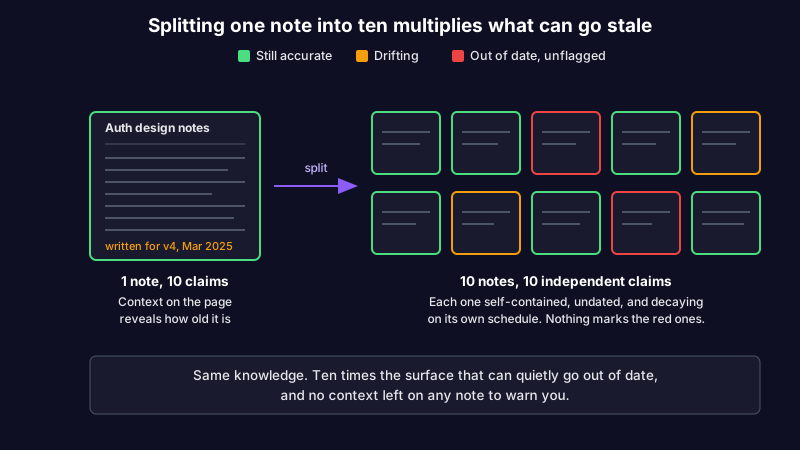
Atomicity multiplies your decay surface
Here is the arithmetic nobody runs before adopting the method.
Write one long note on a framework's authentication design and you have a single artifact holding ten claims. It is hard to link and hard to reuse, which is exactly why you were told to split it. Split it properly and you now have ten atomic notes: one on session validation, one on token lifetimes, one on the middleware order, one on rate limits, and so on. Each is linkable. Each is reusable. Each is also its own independently decaying object with its own version number, its own source link, and its own expiry date that you were never told.
Your decay surface just went up by an order of magnitude, and the tooling that helped you split the note gave you nothing to watch the pieces with. This is knowledge decay applied to a format that is unusually good at hiding it. The graph keeps looking healthy because graphs measure connections, not accuracy. A note with eleven backlinks and a dead source link renders exactly like a note with eleven backlinks and a live one.
It gets worse as the collection grows, because the rate at which claims go stale scales with how many claims you have, while the rate at which you personally revisit notes stays flat. Somewhere past a few hundred notes, those two lines cross. After that, your collection is decaying faster than you can possibly read it, which is the point where most people quietly stop trusting their own system and start googling things they already wrote down.
Why a stale atomic note is more dangerous than a stale long one
The defining virtue of an atomic note is that it stands alone. That is also what makes it dangerous when it is wrong.
A long, messy note carries its own context. Dates, a half-finished thought, a "check this later" scrawled at the bottom, the surrounding paragraphs that make it obvious you were writing about version 4. When you reread it, all that context tells you how much to trust it. You can see the seams.
An atomic note has been deliberately stripped of exactly that. It says one thing, cleanly, in the present tense: "Validate sessions server-side before rendering." No hedging, no date, no visible age. It reads like a principle. Six months after the framework deprecated that middleware order, it still reads like a principle, and now it is teaching you a pattern that will fail in code review. The polish you added when you distilled it is doing active harm, because the note no longer looks like a snapshot from a specific afternoon. It looks like a fact.
This is the same failure mode evergreen notes run into, and for the same reason. The format's authority outlives the accuracy of its contents. The better you wrote the note, the more convincingly it lies to you later.
Consider a concrete atomic notes example. A researcher keeps a note titled "SSRI response rates plateau after eight weeks," distilled from a meta-analysis, linked from six project notes. The meta-analysis is later corrected. The note does not change, because nothing in any atomic-note workflow ever revisits a note after it is filed. It keeps feeding six downstream project notes a claim that its own source has walked back. Nobody notices, because noticing was never anybody's job.
What an atomic collection actually needs
Strip away the tooling arguments and the upkeep an atomic collection needs is short. It needs three things done to every note, repeatedly, on no particular occasion.
Notes need to be resurfaced. An atomic note's whole value is being reusable in a future context, but reuse depends on the note showing up when that context arrives. If it only surfaces when you go looking, you will only ever reuse the notes you already remember writing, which is a small and shrinking fraction of the collection.
Claims need to be re-checked against the world. Every atomic note points outward at something: a version, a number, a study, a link. Those move. Keeping a collection trustworthy means periodically comparing what each note asserts against what is currently true, and seeing the difference rather than assuming there isn't one.
Notes need to be re-linked as the graph grows. A note written when you had 80 notes is under-connected once you have 400, because the adjacent ideas that should link to it arrived later. Dense linking is treated as a one-time act at creation. It decays like everything else.
This is the gap every PKM method leaves open, and atomicity widens it: the finer you slice, the more objects there are to keep honest.
None of this is intellectually hard. It is relentless, and relentless is the specific thing humans are worst at and software is best at. The reason your atomic notes stopped evolving is not that you lack discipline. It is that the method assigned you a cron job and called it a habit. You can hand that job to something built for it and see your first diff.
Automating the upkeep atomic notes assume
If a collection is going to be split into hundreds of independent claims, something other than your memory has to keep track of those claims. That is the layer Scribelet is built to be.
Background verification checks a note's factual claims against the web on a schedule you set, then shows you a diff: green for what is new, red for what is now outdated, with the source that changed. You accept or dismiss, and the note updates. For an atomic collection this matters more than for any other format, because it scales the way the problem does. Checking four hundred small claims is a worse job for a person than checking forty large ones, and a better one for a background agent.
An auto-linker watches the graph and proposes connections a note could not have had when you wrote it, which keeps wikilinks and backlinks current with the collection instead of frozen at creation. A stale checker flags notes related to your recent work that have not been touched in months, which is the resurfacing trigger the method never supplied. If you prefer to drive it by hand, a thirty-minute weekly review does the same job manually. The background version does it while you are writing the next note.
Because this is AI touching your notes, control is part of the design. Scribelet works out of the box, and bringing your own OpenAI, Anthropic, or Gemini key is the optional path if you would rather your notes were checked by a provider you picked. Either way, every change arrives as a diff you approve before it lands. Nothing rewrites your thinking behind your back.
This is also the honest answer to the "atomic notes are a trap" argument. The friction people complain about is real, but the fix is not writing bigger notes. It is making the small ones cheap to maintain.
Approaches to atomic notes, compared
Every approach here produces good notes on the day you write them. The difference shows up in year two.
| Approach | Notes are linkable | Resurfaces old notes | Keeps claims accurate | Holds up past ~300 notes |
|---|---|---|---|---|
| Long-form notes | Rarely, too coarse to link | No | No, but context reveals age | Yes, few notes to track |
| Manual atomic discipline | Yes | Only when you remember | No, nothing rechecks claims | Revisiting stalls first |
| Atomic plus a weekly review | Yes | Partly, on a fixed cadence | Only what you sample by hand | Coverage thins as it grows |
| Atomic plus background agents | Yes | Yes, by relevance and schedule | Yes, re-checked against sources | Yes, upkeep scales with agents |
The first three rows are where every guide on the method stops. The last row is the difference between a collection you keep and a collection you abandon.
Atomicity is a writing principle, not a maintenance plan
Splitting your knowledge into single ideas is still the right call. It makes notes reusable, it forces you to actually understand what you read, and it is the only way a knowledge graph becomes more than decoration. Keep doing it.
Just be honest about what you bought. Every note you split off is another claim with its own expiry date, written in a format engineered to sound settled and to hide its age. Four hundred atomic notes is four hundred small promises about the world, and the method that talked you into making them has nothing to say about keeping them.
Write the note atomic. Then let something resurface it, re-check it, and re-link it, so the note you reach for next year still says something true. Keep your atomic notes worth reusing.
Share this article