Obsidian vs Logseq: the file question just changed
Table of contents
Most people arrive at the Obsidian vs Logseq decision with the same shortlist logic. Both are local-first. Both keep your notes in plain Markdown on your own disk. Both are free. So the choice comes down to taste: do you think in documents or in bullets?
That was a fair summary until last month. On 13 July 2026, Logseq shipped its 2.0 beta and moved the canonical copy of your notes out of a folder of Markdown files and into a local SQLite database. The project is splitting into two versions in the process.
Which means the single premise every comparison of these two apps rests on, including the ones ranking above this one, is now the thing in question.
This is a fair comparison of both tools as they stand in August 2026: how each one actually models a note, who each is genuinely better for, what Logseq's database switch costs and buys, and the dimension neither of them measures.
Obsidian vs Logseq at a glance
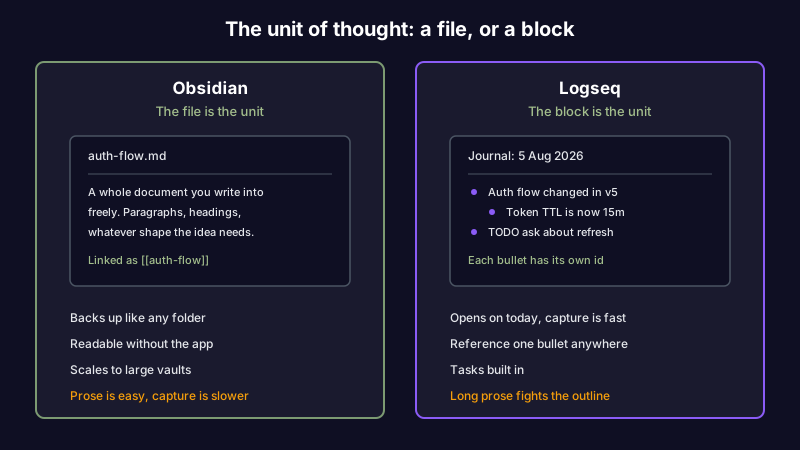
Obsidian is a Markdown editor where the file is the unit of thought. Logseq is an outliner where the block is the unit of thought, built around a daily journal. Obsidian suits long-form writing and large vaults. Logseq suits fast capture, tasks, and dense cross-referencing.
| Obsidian | Logseq | |
|---|---|---|
| Unit of thought | The file (a note) | The block (a bullet) |
| Default entry point | A vault of folders you organize | Today's journal page |
| Storage | Plain Markdown files on your disk | Markdown files, or SQLite in the 2.0 beta |
| Linking | Wikilinks, backlinks, graph view | Wikilinks plus block-level references and embeds |
| Tasks | Plugins (Tasks, Dataview) | Built in, with states and queries |
| Extensibility | 4,300+ community plugins | Smaller plugin market, more built in |
| Licence | Proprietary, free including commercial use | Open source (AGPL-3.0) |
| Cost | Free; Sync $4/mo, Publish $8/mo (annual) | Free; sync in invite-only testing |
| Note maintenance | None (manual) | None (manual) |
The last row is the one nobody benchmarks, and it is the one that decides whether a three-year-old vault is an asset or a liability. More on it below.
What changed in Logseq 2.0
For most of its life, Logseq's pitch to Obsidian users was: same guarantees, better thinking model. Your notes were Markdown files in a folder you controlled, and the outliner sat on top of them.
The 2.0 beta changes the bottom layer. Notes now live in a local SQLite database that is the source of truth, with a DB Graph Importer to convert an existing file graph across. The database unlocks things files made painful: typed properties, faster queries on large graphs, and a credible path to real-time collaboration.
It also gives up the property that made Logseq an easy recommendation. A SQLite file is not a folder of documents you can grep, diff, or open in any editor for the next twenty years. The team is explicit that this is an early beta and tells you to back up your graph before testing.
Two honest readings of this, and both are defensible. The optimistic one: files were holding the product back, and a database is the right foundation for what Logseq wants to be. The cautious one: the reason you chose Logseq over Notion is exactly the thing being traded away, and a beta is not where you find out.
If plain text is the reason you are shortlisting either app, that is worth weighing directly, because plain text keeps notes portable, not accurate, and portability is only half of what people think they are buying.
Practical read for now: if you are choosing today, choose based on the model of thought, not the storage promise. The storage promise is the thing currently moving.
What is the difference between Logseq and Obsidian?
Logseq is an outliner: every note is a tree of indented blocks, each block is individually addressable, and the app opens on today's journal. Obsidian is a document editor: every note is a whole Markdown file you write into freely, and the app opens on whatever you left open.
Everything else follows from that one choice.
Because a Logseq block has an identity, you can reference or embed a single bullet somewhere else and it stays live. That makes Logseq unusually good at accumulating a thought across many days without copy-paste. Because an Obsidian note is a file, it behaves like every other file on your computer: version control works, sync works, and any tool that reads text can read it.
The same split explains the friction each one causes. Long-form prose inside a bullet outline fights you. And a blank Obsidian vault gives you no opinion at all about where anything should go.
Where Logseq wins
Logseq is the better tool when capture speed matters more than composition.
The journal-first design removes the daily "where does this go?" tax. You open the app, you are already on today's page, and you type. Filing happens later through tags and references, or never, which is fine because block references let you pull the thought into the right context afterwards. This is the closest thing in mainstream PKM to a running log that actually gets used, which is also its risk: a log that nobody reads back is the log nobody reads back, no matter how quickly you filled it.
Tasks are built in rather than assembled. States, scheduling, and queries work out of the box, where Obsidian needs a plugin stack and a Dataview query you will maintain yourself. Flashcards and PDF highlighting ship natively too.
And it is genuinely open source under AGPL-3.0, which matters if licence terms are part of your threat model rather than a detail.
Choose Logseq if you think in bullets, capture constantly through the day, want tasks and references without assembling a plugin stack, and want an open-source licence.
Where Obsidian wins
Obsidian is the better tool when your notes need to outlive your enthusiasm for note-taking.
Files are the reason. A vault is a folder, so backups, Git, and any sync service you already trust work without the app's cooperation, and a note stays readable if the company disappears. Obsidian handles vaults in the tens of thousands of notes without the slowdown outliners tend to hit, and long-form drafting in a file simply feels better than drafting in an outline.
The plugin ecosystem is the other half, with over 4,300 community plugins, plus Bases for database-style views without leaving the file model. Pricing is straightforward: the app is free, including commercial use, with Sync at $4/month and Publish at $8/month on annual billing.
The costs are real and Obsidian's fans understate them. You own the setup and the upkeep. Sync across devices is a paid add-on or a project. There is no native AI, and every option for adding it is a plugin or an external agent you wire up yourself, which we cover in every way to add AI to Obsidian. If Obsidian is already the incumbent and you are here because something specific broke, Obsidian alternatives sorted by reason is the more useful question than this one.
Choose Obsidian if you write long-form, expect a large vault, want files you can back up and read anywhere, and are happy trading setup effort for control.
What are Logseq's disadvantages?
Three, and the first one is new.
The transition risk. The 2.0 database beta is the project's future, and it is a beta with a back-up-your-data warning. The file-based app continues on its own track as the project splits. Choosing Logseq today means choosing a side of that split, or waiting.
Everything is an outline. Block-level structure is a real advantage until you need to write four paragraphs of continuous prose, at which point the indentation is working against you.
A smaller ecosystem. Fewer plugins, fewer themes, fewer people to answer your question. Logseq builds more in the core, which is a coherent strategy, but it means fewer escape hatches when your workflow does not fit.
For balance, Obsidian's mirror-image disadvantages are the blank-vault problem, no native tasks or AI, paid sync, and a proprietary (if generously licensed) codebase.
The row neither of them fills
Here is what the whole Obsidian vs Logseq argument is about: structure. Blocks against files, outline against document, database against folder. It is a real question and both answers are respectable.
It is also a question about how notes are stored, and nobody is asking what happens to what is inside them.
Your note on a framework's auth flow was accurate the Tuesday you wrote it. The library shipped a major version in March. The Stack Overflow answer you leaned on has a correction now, and the doc you linked returns a 404. Neither app has any concept of that. A block reference points just as confidently at a stale claim as a current one, and a graph view renders a beautiful web of things that may no longer be true. This is why notes go stale in every system, regardless of how well it is organized, and it is the step every PKM system skips.
Both tools are excellent at capture, structure, and retrieval. Both stop the moment the note is saved. The upkeep is yours, forever, and in practice that means it does not happen.
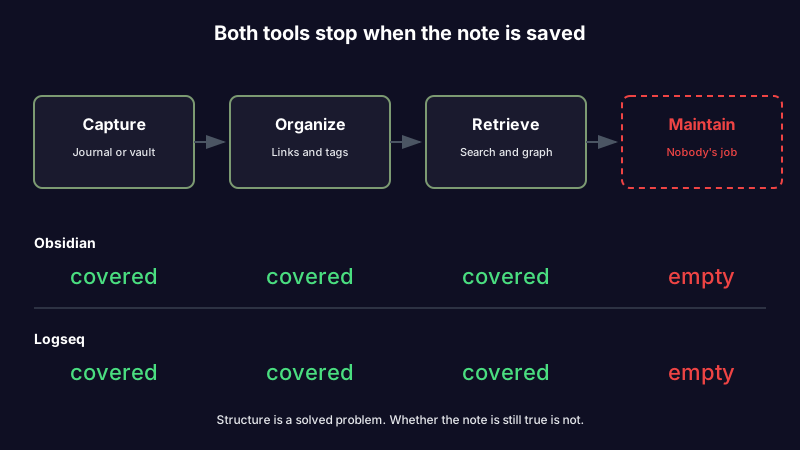
That gap is what Scribelet was built for. Background agents re-check the claims in your notes against the web on a schedule you set, and when something has moved you get a diff: what you wrote, what changed, and the source, to accept or dismiss. Nothing is rewritten behind your back. You can see how verification works before deciding whether it belongs in your setup.
So which should you pick?
If you are choosing between these two on the merits, the honest rule still holds. Run down this list and take the first line that describes you:
- You capture all day and sort later: Logseq. The journal-first design is built for exactly this.
- You write long-form: Obsidian. Prose in an outline fights you every paragraph.
- Your vault will pass 10,000 notes: Obsidian. It handles scale that outliners struggle with.
- You want tasks without assembling plugins: Logseq. States and queries are built in.
- Plain files are non-negotiable: Obsidian, at least until the Logseq split settles. If that split is pushing you off Logseq entirely rather than toward Obsidian specifically, we sorted the Logseq alternatives by the reason people leave.
- An open-source licence is a requirement: Logseq, AGPL-3.0.
- You want the notes to still be right in a year: neither, and that is the rest of this section.
If you are choosing a note app to hold work that has to stay correct, both leave you with the same job. They organize what you wrote; they never revisit it. That is the same conclusion we reached comparing two very different tools in an honest Notion vs Obsidian breakdown, which suggests the gap is in the category rather than in any one app.
Structure is a solved problem. Accuracy is not.
Scribelet keeps the parts both tools do well, linked notes you own, and adds the part neither does: AI that checks whether what you wrote is still true. Start free, and see your first diff.
Share this article