How to take smart notes (and why they stop being smart)
Table of contents
Four months ago you read the book, bought into the argument, and rebuilt your whole system around it. Fleeting notes in an inbox. Literature notes for every source. Permanent notes written in full sentences, in your own words, linked to their neighbours.
Open the box now and ask it a question. Ask it what you know about the thing you're writing this week. It probably gives you back a tidy pile of notes you already remember writing, and nothing you'd forgotten. That's the complaint underneath half the threads on r/Zettelkasten: you learned how to take smart notes, you executed the method correctly, and the slip-box still isn't talking back.
This piece covers the workflow properly, in the order it works, and then it covers the part no how to take smart notes summary gets to. The workflow is sound. What nobody prices in is what happens to a permanent note eighteen months after you write it, when the claim inside it has quietly stopped being true and the note is still sitting there in confident present tense, looking exactly as trustworthy as the day you distilled it.
What is the smart notes method?
The smart notes method is a note-taking system built around three note types and one rule: you write notes for your future writing, not for your future filing. It comes from Sönke Ahrens' How to Take Smart Notes book (first edition 2017, second edition 2022), which reverse-engineered the working habits of the German sociologist Niklas Luhmann.
Luhmann's setup was a wooden box of index cards, a Zettelkasten. The Niklas Luhmann Archive, which is digitising the whole thing, puts it at roughly 90,000 slips, alongside some 50 books and more than 600 articles that came out of it. He consistently credited the box rather than his own discipline. In his essay Communicating with Slip Boxes, he describes it as a genuine communication partner, something that had to be able to surprise him or it wasn't worth keeping.
The three note types do different jobs:
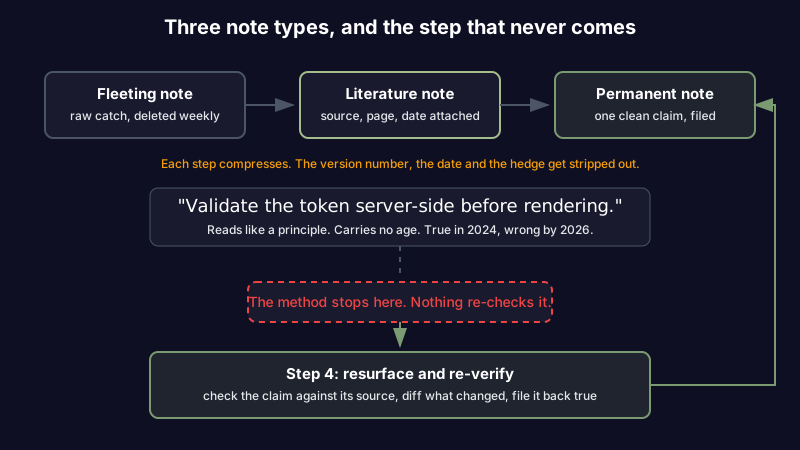
Fleeting notes are the raw catch. A phrase on your phone, a thought in the margin, anything you'd lose otherwise. They're disposable by design and should be empty again within a day or two.
Literature notes are what you write while reading. Short, in your own words, one per idea worth keeping, always with the source attached. Ahrens is strict about the "own words" part: copying a passage feels like understanding and isn't.
Permanent notes are the ones that go in the box. Each holds a single developed thought, written as if for a reader who isn't you, connected to the notes it argues with or extends. These are the notes the whole system exists to produce.
The point of the distinction is that the third type costs real effort and the first two exist to make that effort possible. If you're keeping only one kind of note, you're running a filing cabinet.
Want to see what this looks like when something else handles the linking? Set up your first desk in about five minutes.
How to take smart notes: the workflow
Here's the loop, compressed. It's less complicated than the book makes it look, and the sequence matters more than the tooling.
- Capture fleeting notes without judgement. One inbox, no structure, no decisions. Anything that survives the week gets processed; the rest gets deleted without guilt.
- Write a literature note for each source, while you read. In your own words, short, and with the page or link recorded. One note can hold several ideas as long as each one is separable later.
- Turn ideas into permanent notes the same day, or the next. Full sentences. One idea per note. Written so that a stranger could follow it, because in two years you are that stranger.
- Link every new permanent note to at least one existing one. Not by tag or folder, by argument. What does this extend, contradict, or complicate? The link is the thinking.
- Let the links suggest what to write. When a cluster gets dense enough, you have a section. When several clusters connect, you have a piece. This is the payout step and it's the one people skip.
- Empty the fleeting inbox. Every week, to zero.
Taking smart notes well comes down to steps 3 and 4. That's where the method earns its name. A note that says "spaced repetition works" is a fact. A note that says "spaced repetition works because retrieval difficulty, not exposure, drives retention, which is why rereading feels productive and isn't" is a thought, and it can be argued with by the note next to it.
Ahrens' own framing on his page for the method is that a good system is simple and keeps you focused on reading, thinking and writing. Anything you add beyond that is decoration.
The part where most systems stall
Step 5. Almost everyone builds a beautiful box and never runs step 5, because step 5 requires an actual writing project pulling on the notes.
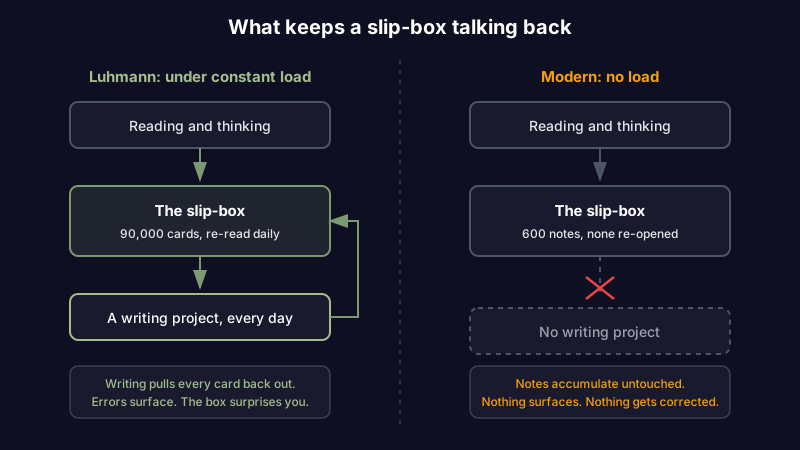
Luhmann's box worked because it was under constant load. He wrote every day, and writing meant pulling cards, reading them again, disagreeing with his younger self, and filing the disagreement as a new card. The box got re-read continuously as a side effect of being used. Nothing sat untouched for two years, because the work kept dragging things back into the light.
Most people adopting the method today have no equivalent load. There's no book. There's a vague intention to write more. So the notes accumulate, the graph gets prettier, and nothing ever pulls a card back out. A slip-box that is never read is a slip-box that never surprises you, and Luhmann's whole test for the thing was whether it could surprise him.
Why permanent notes stop being true
Now the part the book doesn't cover, and the reason "permanent" is a slightly dangerous word.
A permanent note is the output of a deliberate compression. You read a source, understood it, and rewrote the idea in clean present-tense prose with the scaffolding removed. That compression is the value. It's also what strips out every signal that would let you judge the note's age later.
Think about what you deleted when you distilled. The version number. The date you read it. The hedge the author put in the third paragraph. The "as of the current release" that made the claim conditional. What's left is a sentence that reads like a principle: Validate the token server-side before rendering. It reads that way whether the underlying framework still works that way or not.
Compare it to the messy literature note it came from. That one has a page number, a date, a half-finished thought, and an obvious seam showing where you stopped understanding. When you reread the messy note you can tell how much to trust it. The polished one gives you nothing to go on, which is exactly why it's pleasant to reuse and exactly why reusing it can bite you.
Two ways this shows up in practice. A researcher keeps a permanent note summarising a finding from a 2019 paper; the paper is later retracted, and Retraction Watch's database has catalogued tens of thousands of retractions like it, but the note in the box doesn't know that and still states the finding flatly. An engineer distils an authentication pattern into a permanent note; two major versions later the pattern is deprecated, the note still reads like a principle, and it gets quoted into a design doc.
Neither failure is a failure of the method's writing advice. Both are failures of the same missing step: nothing in the smart notes workflow ever goes back and asks whether a filed note is still correct. Ahrens tells you how to make a note worth keeping. He doesn't tell you how to keep it worth keeping, because Luhmann never had to solve that problem. Luhmann's cards were records of his own thinking, dated by handwriting and context, read as history. Ours are full of external claims about a world that keeps moving.
This is knowledge decay hitting a format engineered to hide it. The same thing that makes atomic notes reusable, one clean self-contained claim, makes each of them independently able to go wrong without any visible symptom.
Ready to see what your own box is hiding? Start free and point verification at the oldest notes you still cite.
Smart notes vs the other systems it gets confused with
The method overlaps with several neighbours, and knowing where the seams are saves you from adopting the same idea twice.
| System | Core unit | What it optimises for | Has a maintenance step |
|---|---|---|---|
| Smart notes (Ahrens) | Permanent note | Producing writing from accumulated thought | No |
| Classic zettelkasten (Luhmann) | Index card | Surprising connections under constant use | No, but constant re-reading substituted for one |
| Evergreen notes (Matuschak) | Concept note | Notes that keep evolving as understanding grows | Named as a principle, unspecified in practice |
| PARA (Forte) | Folder by actionability | Fast retrieval for current projects | No |
| Commonplace book | Quotation | Collecting other people's words | No |
Every row says no in the last column, which is the observation that motivated this article. Matuschak's "evolving" principle gets closest, but it names the requirement without giving you any mechanism for noticing which of your 600 notes needs to evolve this month.
If you want the full survey of where these methods came from and how they relate, our overview of personal knowledge management walks the whole family tree. The short version: they disagree about the unit and the folder structure, and they agree entirely about stopping the moment the note is filed.
Making smart notes that stay smart
Keep the method. All of it. The three note types are good, the "own words" rule is good, and linking by argument instead of by tag is the single best habit in the whole system. What's missing is a fourth step after "permanent," and it has two halves.
Something has to re-read the box. Not you, on a heroic Sunday. If step 5 depends on you having an active writing project, and you don't, then the resurfacing has to come from somewhere else. Relevance-based resurfacing, where working on a topic pulls the old notes about it back in front of you, does what Luhmann's daily writing did without requiring you to be Luhmann. That's the same gap literature notes fall into, one layer down: a note that never gets promoted and a note that never gets re-read fail for identical reasons.
Something has to re-check the claims. Resurfacing an outdated note only shows you the outdated note. The claims that came from outside your head, the version numbers, statistics, cited findings, and links, need to be checked against the current state of the source. Scribelet's background agents do that on a schedule you set: they search the web, compare what they find to what the note says, and show you a diff with the source cited. Green for new information, red for what no longer holds. You accept it, dismiss it, or edit, and the note goes back in the box still true. The mechanics are in the AI verification docs, and you choose the model and bring your own key if you'd rather your notes never touch a provider you didn't pick.
The practical version of this, if you want to start today with nothing new installed: put a last-verified line at the bottom of every permanent note that contains an external claim, and treat any note older than a year as unconfirmed until you check it. It's tedious and it works, which is roughly the review discipline behind remembering what you read at all. Automation removes the part where you have to remember to do it.
None of this changes how you write the note. It changes how long the note stays worth having, which is the difference between a slip-box you consult and a slip-box you feel guilty about.
The box only gets smart if it stays true
The reason Luhmann's slip-box could act like a conversation partner wasn't the index cards or the numbering scheme. It was that the box was in constant use and therefore constantly corrected, thousands of small re-readings a year, every one of them a chance to notice that a card no longer held up.
Copy the note-taking and skip the load and you've built the vocabulary of the system without the metabolism. That's why a technically perfect zettelkasten can go quiet in four months. Not because the notes are badly written, but because nothing is pulling them back out and nothing is checking whether they're still right.
Write the fleeting note. Write the literature note. Write the permanent note in your own words and link it to the one it argues with. Then give the box a way to read itself back and re-check what it's holding, so the note you pull out in 2028 still says something true. Keep your smart notes worth reusing.
Share this article