How to read a research paper (and keep what you learn)
Table of contents
You read the paper. You highlighted half of it, nodded at the clever part in the results, and told yourself you would come back to the methods section. Three weeks later you need the one number that made the whole argument work, and you cannot find it. You remember that the paper was good. You do not remember why. So you open it again and read it a second time from the top, which is the most expensive way to read anything.
That is the real problem with reading a research paper, and none of the guides that rank for this query will name it. They tell you the order to read the sections in, which matters, and then stop. Reading order gets the paper into your head. It does nothing to keep it there, and a paper you cannot recall is a paper you have to read twice. This guide covers the order, and then the part that actually pays off: how to read a research paper so that one pass leaves you with something you can use a month later without opening the PDF again.
Why you can't read a paper like a book
A book is written to be read front to back. A research paper is not. It is written to survive peer review, which means the authors front-load novelty, bury the caveats in the discussion, and put the load-bearing detail in figures and tables rather than prose. Reading it linearly means spending your freshest attention on the abstract's marketing and running out of focus before you reach the part that tells you whether to trust any of it.
The fix that every experienced reader converges on is to read in passes, each with a different question, from shallow to deep. The first pass decides whether the paper is worth your time at all. The second gets you the argument. The third, which most papers never earn, gets you the method in enough detail to build on or to challenge. You stop at whichever pass answers your question. Most papers deserve one pass. A few deserve all three. Deciding that quickly is the skill, and it compounds when every paper you read lands in one searchable place instead of a folder of PDFs you never reopen. That place is what Scribelet is for.
How to read a research paper: the three-pass method
The three-pass approach was described by S. Keshav in "How to Read a Paper", a one-page note that has outlived most of the papers it was written to help people read. Here it is as a decision table, with what each pass is for, where you look, and roughly how long it takes.
| Pass | Your question | Where you read | Time | Stop here if |
|---|---|---|---|---|
| 1. Skim | Is this worth my time? | Title, abstract, section headings, figures, conclusion | 5-10 min | It does not fit your goal, or the claim is weaker than the title implied |
| 2. Grasp | What did they actually find, and should I believe it? | Introduction, figures and tables in full, discussion and limitations | 30-60 min | You understand the argument and only needed the finding, not the machinery |
| 3. Rebuild | Could I reproduce or attack this? | Methods, assumptions, every equation, the supplementary material | 2-4 hrs | You never reach this pass for most papers, and that is correct |
Two things this table encodes that the plain advice leaves out. First, you read the conclusion during the skim, not at the end. The final paragraph of the introduction and the conclusion together tell you the gap the authors claim to fill and whether they claim to have filled it, which is the fastest way to decide if pass two is worth starting. Second, you can skip the methods section on the first two passes without guilt. Unless you plan to reproduce the study or you have a specific reason to distrust it, the dense methods prose is pass-three material. Skimming it early is how you burn your attention before you reach the discussion, where the authors admit what the study cannot show.
This also answers the two questions people actually type after the main one. To read a paper quickly, you are doing pass one and stopping: title, abstract, figures, conclusion, decision made in under ten minutes. To analyze a paper, you are doing pass two properly: reading the figures before the text that describes them, and treating the limitations section as the most honest part of the paper rather than a formality. If you want the version with more granularity, the NIH's "Ten simple rules for reading a scientific paper" breaks the same idea into a longer checklist.
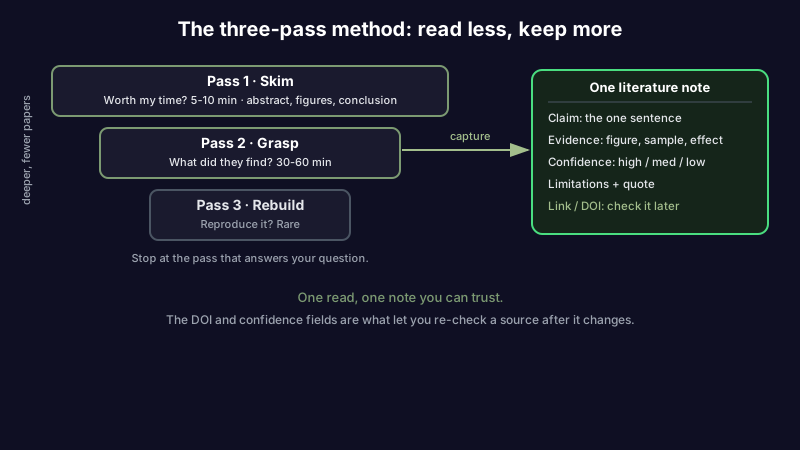
What to capture on each pass
Here is the step that separates reading a paper from keeping it. At the end of each pass, before you close the tab, you write down a fixed set of things. Not a summary of the whole paper. A small, structured note built from the questions the pass was meant to answer. Do this and the paper becomes a durable literature note you can search and cite later, instead of a highlighted PDF you will never reopen.
Use a template so you are filling in fields, not staring at a blank page. This one takes two minutes and captures what you will actually want back:
Paper: [author, year, title]
Link / DOI: [so future-you can find it in one click]
Why I read it: [the question that sent you here]

Claim: [the one sentence the paper is really arguing]
Evidence: [what backs it: sample, method, effect size, the key figure]
My confidence: [high / medium / low, and one reason]

Limitations: [what the authors admit it cannot show]
For me: [how this changes what I think or what I will do]
Quote: ["one exact line worth keeping, with the page number"]
The fields matter more than the format. "Why I read it" stops you collecting papers you will never use. "Claim" forces you to state the argument in your own words, which is the single best test of whether you understood it. "My confidence" is the field almost nobody keeps, and it is the one that saves you later: a paper you filed at low confidence should not become a load-bearing citation six months on without a second look, because the refutation tax on a claim you already trusted is far higher than the cost of checking it now. Keeping the exact quote and page number means you can pull a citation without reopening the source.
If you have read about how to take smart notes or worked with atomic notes before, this is that idea aimed squarely at papers: one paper, one self-contained note, written in your own words at the moment you understood it, not reconstructed later from highlights. The reading passes give you the material. The template gives it somewhere to live.
A worked example: one paper, three passes
Say you are reading a paper on spaced repetition for a piece you are writing about study habits.
Pass one, five minutes. The title promises that spaced review beats massed review for long-term retention. The abstract confirms it and gives an effect size. You glance at the main figure: two retention curves, spaced clearly above massed at the 30-day mark. The conclusion says the effect held across three subject areas. That is enough to know the paper fits your question, so you go to pass two. If your question had been narrower, say whether spacing helps for motor skills specifically, the skim would have told you this study is about verbal recall and you would have stopped here and moved on.
Pass two, forty minutes. You read the introduction to see what gap they claim: prior work showed the effect in lab settings, this study tests it in a real classroom over a semester. You read the figures in full, including the one showing the effect shrinking for the lowest-performing students, which the abstract did not mention. The discussion admits the sample was a single university and the spacing intervals were fixed rather than adaptive. Now you write the note:
Paper: Rowsell et al., 2024, "Spaced review in a semester-long course"
Link / DOI: 10.xxxx/example
Why I read it: does spacing hold outside the lab, for my study-habits piece

Claim: spaced review beats massed review for retention in a real classroom, not just a lab.
Evidence: semester-long classroom study, ~200 students, retention +18% at 30 days vs massed. Fig 2.
My confidence: medium. Real setting is a plus; single university, fixed intervals is a limit.

Limitations: one institution; effect weaker for lowest-performing students (Fig 4); intervals not adaptive.
For me: use as the "it works in practice, not just the lab" citation. Note the weaker effect for struggling students.
Quote: "The advantage of distributed practice persisted across all three course subjects." (p. 7)
You never reached pass three, because you are not reproducing the study. Total time: under an hour, and you now have a note you can drop into a draft with the citation, the caveat, and the exact quote already in hand.
Reading for a literature review vs. reading to stay current
Before you open anything, decide why you are reading, because the goal changes how deep you go and what you keep. These are the two goals most people are actually pursuing, and conflating them is why reading feels endless.
| Reading for a literature review | Reading to stay current | |
|---|---|---|
| Goal | Map a field: who found what, where they disagree, what is unsettled | Keep up with your area; catch what is new |
| Depth | Pass two on most, pass three on the few that anchor your argument | Pass one on most, pass two on the surprising ones |
| What you capture | The full note, plus how this paper relates to the others (agrees, contradicts, extends) | Claim and one line on why it matters; upgrade later if it becomes relevant |
| The trap | Summarizing papers one by one instead of grouping them by theme | Saving everything and reading nothing |
If you are building a literature review, the note's "how this relates to the others" line is the whole point, and it is what turns a stack of individual notes into a synthesis instead of an annotated list. Group your notes by claim or theme, not by author, and the review starts to write itself from the connections rather than from the papers. This is the same reason a second brain that you actually maintain beats a folder of PDFs: the value is in the links between notes, not the notes alone.
The part nobody mentions: the paper you read will change
Here is the assumption buried in every reading guide, including the good ones: that a paper, once read, stays read. It does not. The literature moves under you. A study you filed at high confidence gets a correction. A finding you built an argument on fails to replicate. Occasionally a paper is retracted outright, and according to Retraction Watch the rate of retractions has climbed sharply over the past two decades. Your careful note still cites it, your draft still leans on it, and nothing tells you until a reviewer or a colleague does.
This is knowledge decay, and it is not unique to research; it is just faster and higher-stakes there. We have written about why your notes go stale in general, and a cited paper is the sharpest version of the problem, because the cost of a stale citation is not inconvenience but a wrong claim in public. The reason the note template above keeps the DOI and your confidence level is exactly this: those two fields are what let you, or a tool, go back and check whether the ground has shifted.
That last part is what Scribelet is built to do. It keeps your research notes and their sources in one place, and its background agents watch the sources you rely on, so when a paper you cited is updated, corrected, or retracted, you find out from a diff instead of from a reviewer. The reading method above gets a paper into a note you can trust today. Keeping that note true a year from now is a maintenance problem, and maintenance is the part every other guide leaves to you. You can even ask questions across all your saved papers and have the answers checked against the sources, rather than trusting a memory of what you read last spring.
Getting started
Reading a research paper well is two habits, not one. Read in passes, stopping at the pass that answers your question, so you spend deep attention only where it pays. Then capture each paper in a short structured note at the moment you understood it, so one read is enough. Do both and your reading compounds instead of evaporating.
Scribelet gives those notes a home that stays current: keep your papers, notes, and sources together, and let background verification tell you when a source you cited has changed. Try it free and turn the next paper you read into a note you can still trust next year.
Share this article