The living notes method for notes that stay useful
Table of contents
You've tried at least one serious note-taking system. Maybe you went deep on Zettelkasten, crafting atomic notes and linking them with intention. Maybe you adopted PARA and sorted your knowledge into Projects, Areas, Resources, and Archives. Maybe you read "Building a Second Brain" and spent a weekend setting up a system that would change how you think.
It worked, for a while.
Six months later, you stopped trusting it. The framework notes referenced deprecated APIs. The research brief cited numbers that had shifted. The competitive analysis used a competitor's old pricing page. You'd built a solid system, but the information inside was decaying while the system itself looked fine.
The question of how to keep notes useful long term is the right one to ask. But every major note-taking methodology skips the one phase that determines whether your notes stay valuable or quietly become liabilities.
That phase is maintenance.
What Zettelkasten, PARA, and Building a Second Brain share
Niklas Luhmann's Zettelkasten method, developed in the 1960s, solved an important problem: connecting ideas across disciplines. You write atomic notes, link them deliberately, and let the network surface insights you'd never reach through linear filing. Sonke Ahrens' "How to Take Smart Notes" popularized the method, and Zettelkasten has become the backbone of serious personal knowledge management (PKM) practice.
But Luhmann was a sociologist working with index cards. His notes referenced concepts and theories that evolved over decades, not APIs that ship breaking changes quarterly.
Zettelkasten has nothing to say about what happens when a linked note becomes inaccurate. The link still works. The note still looks authoritative. The information inside is wrong.
Digital gardening came closest to naming the gap, borrowing a metaphor from the one hobby where upkeep is the entire activity. Then it shipped publishing tools and left the weeding as a manual chore, which is how you end up with a garden where everyone plants, nobody weeds.
Tiago Forte's PARA method solved a different problem: where to put things. Projects, Areas, Resources, Archives. It's an elegant categorization framework that tells you where a note belongs based on how actionable it is.
What PARA doesn't track is whether the note you filed under "Resources" two years ago still contains accurate information. It organizes by location. It doesn't monitor for freshness, which is why PARA has no maintenance step to catch a Resource that quietly went stale.
Forte's broader framework, Building a Second Brain, covers the full creative lifecycle through CODE: Capture, Organize, Distill, Express. It's a clean model for moving ideas from your head into a system and back out as creative output.
But look at what's missing. There's no step between "express" and "done" where you check whether the captured information is still true. Once you've expressed an idea, CODE is finished. Your second brain starts aging the moment you move on.
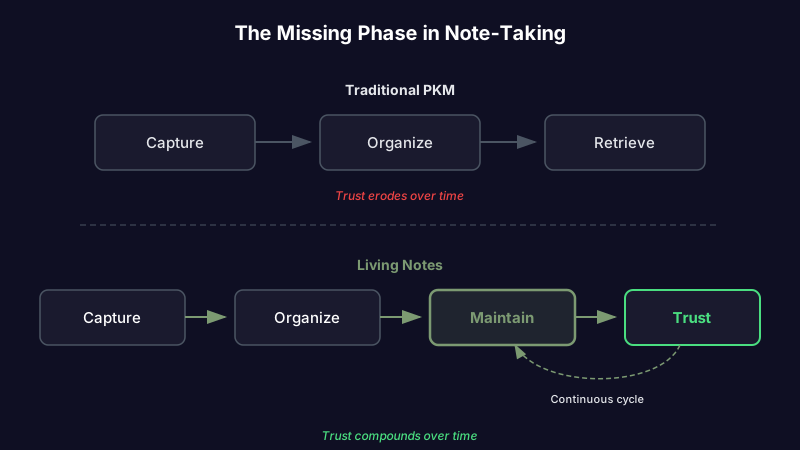
All three share the same blind spot:
Capture → Organize → Retrieve
That lifecycle works when knowledge is stable. It breaks when the world changes faster than you review your notes.
Every one of these methods was designed before AI agents existed as a practical technology. Zettelkasten predates the internet. PARA predates large language models. Even Building a Second Brain, published in 2022, treats AI as a nice-to-have writing assistant, not a maintenance engine for the knowledge it helps you capture.
The phase nobody talks about
Enterprise knowledge management figured this out years ago. Tools like Bloomfire, Guru, and Shelf track content freshness for customer-facing teams. They assign review dates, flag stale articles, and alert maintainers when documentation drifts from reality. Companies invest billions annually in knowledge management, and a significant chunk of that spending goes toward keeping information current, not creating it.
Personal knowledge management has no equivalent.
Claire Carroll described this gap in 2021, calling it "fighting the entropy of knowledge bases". She proposed classifying documents as transient versus reference so teams could focus maintenance where it matters. Good thinking, but scoped to company wikis. Personal notes weren't part of the conversation.
Mem.ai later coined "note rot" for the accumulated knowledge debt in personal notes. They built a cleanup tool around the concept. But refactoring notes after they've rotted is triage, not prevention. The question isn't how to clean up stale notes after the fact. It's how to catch staleness before it costs you.
The clearest evidence that this gap is real comes from the people who've lived it. The blog posts write themselves: "I spent six months building a second brain and then deleted it."
These stories follow the same arc. The system was well-organized. The notes were carefully tagged. But trust eroded because the information decayed while the system looked fine from the outside.
The problem isn't discipline. Maintenance has never been treated as a legitimate phase in the note-taking lifecycle. You wouldn't write software and never update the dependencies. But that is the step every PKM system skips. You capture and organize and then never revisit, and the method blames you when the notes stop being useful.
The gap outlives the methods. The newest pattern in personal knowledge management points an LLM at your sources and has it write the wiki for you, which automates the organizing beautifully and still ships without a maintenance step. Automating the phases a method already had does not add the phase it never had.
The concept of knowledge decay explains why information has a measurable half-life and why your tools should account for it. This article builds on that foundation with a methodology designed to fill the maintenance gap.
Living notes: a note-taking method for the AI era
Living notes starts from different assumptions than traditional PKM.
Most PKM thinking treats notes as permanent artifacts. Andy Matuschak's evergreen notes concept frames them as timeless units of knowledge, meant to be refined and reused indefinitely. That works for philosophical insights and personal reflections, where nothing references external sources that change.
It breaks for API documentation, market research, and citation-heavy analysis. Living notes treats knowledge as perishable. The question isn't whether your notes will go stale. It's when, and whether your system will catch it.
This has a downstream consequence for how you allocate effort. If you spend two hours writing a research brief, that brief's value depreciates every month it goes unreviewed. Maintenance isn't optional extra work that happens when you get around to it. It's the activity that determines whether the original two hours remain an asset or become a trap.
The current conversation about AI and notes misses this entirely. AI writes drafts. AI summarizes meetings. AI transcribes audio. These are all capture-phase tools: faster ways to get information into the system. Living notes assigns AI a different job. It monitors, verifies, connects, and flags. Not generating your notes, but keeping them alive after you write them.
The lifecycle changes:
Capture → Organize → Maintain → Trust
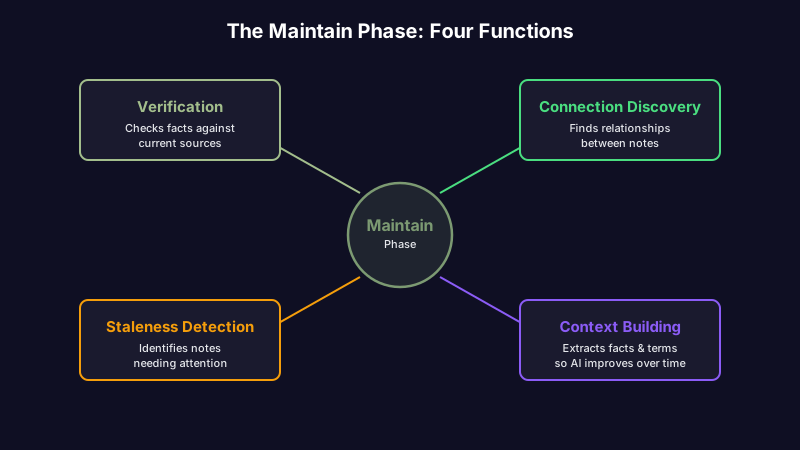
The maintain phase has four functions:
- Verification checks whether the facts in a note still hold against current sources
- Connection discovery finds relationships between notes you haven't explicitly linked
- Staleness detection identifies notes that need attention based on age, topic relevance, and recent activity
- Context building extracts facts, terminology, and relationships from your notes so AI improves over time
None of these require you to do the work manually. That's the point. A methodology built around maintenance only becomes practical when the maintenance itself is automated.
What the maintenance phase looks like day to day
Here's what changes when maintenance is baked into the system.
On a Tuesday morning, you open your notes and find a diff waiting. Background agents ran overnight and found that the Express.js middleware pattern you documented last quarter was deprecated in v5.2. The diff shows the old pattern in red, the current pattern in green, with a link to the Express migration guide.
You review it in 30 seconds, accept the update, and your note is current. Doing the same work yourself would have meant reading release notes you didn't know existed, for a framework update you didn't know had shipped.
That same morning, a daily digest arrives. It surfaces a connection you'd missed: you wrote about a client's rebranding initiative in one note and their Q1 revenue data in another, but never linked them.
The digest flags both notes, explains the relationship, and suggests a wikilink. You tap to accept. Your knowledge graph now reflects a connection your filing system wouldn't have surfaced for months.
In the background, a stale checker noticed something. Your competitive analysis of a SaaS company hasn't been updated in 90 days. Normally that wouldn't trigger anything. But you wrote three new notes mentioning that same competitor last week.
The stale checker flags the analysis for review. Not because it's old (everything gets old), but because it's old and you're actively working in the same space. That's the difference between a calendar reminder and intelligent maintenance.
Later, on your commute, you record a voice memo about an idea for a product feature. The memo gets transcribed and structured by AI into a note with a title, two headings, four action items, and three suggested tags. AI memory already covers your active projects and common terminology, so the transcription handles your jargon accurately. The note is organized before you reach your front door.
Background verification, daily digests, auto-linking, stale detection, and voice-to-structured-note are all part of Scribelet's Pro plan. They're the tools that make the living notes maintenance phase practical at real-world scale.
Over weeks and months, the maintenance layer compounds. Your knowledge base gets more connected, more accurate, and more contextually aware. AI builds a per-desk knowledge graph mapping your people, projects, and terminology.
Conversations carry context through episodic memory, which preserves what you discussed and when. The more you use the system, the better the maintenance becomes.
This is the opposite of the traditional PKM trajectory. In most systems, notes get less trustworthy the longer they sit untouched. With living notes, the system actively fights that decay. Trust compounds instead of eroding.
Why maintenance needs AI (and why the AI should be yours)
You can practice the principles of living notes without AI. Review your important notes quarterly. Check sources manually. Look for connections yourself.
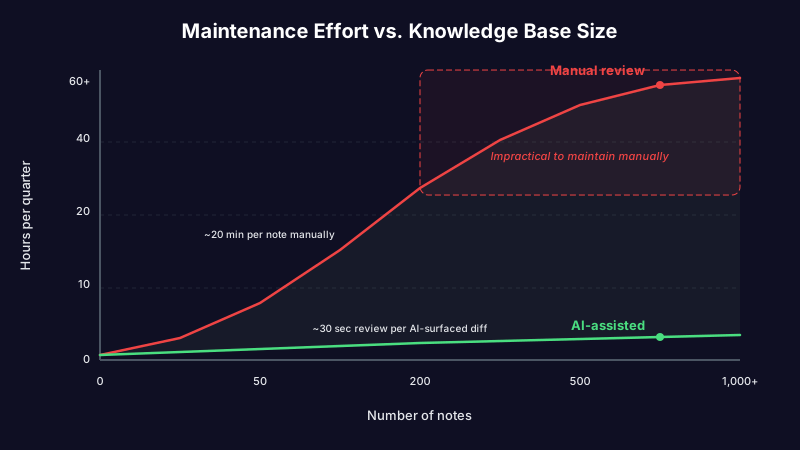
It doesn't scale. Manual verification of a single note, checking cited sources, comparing against current information, reading changelogs, takes 15 to 30 minutes. Multiply that by your top 50 notes and you're looking at a full workday every quarter doing nothing but checking whether what you already wrote is still true.
AI agents make the maintenance phase practical at real-world scale. They run verification checks on hundreds of notes per week and surface connections across a corpus too large for working memory.
They also detect staleness patterns that need multiple signals at once: this note is old, the topic is active in your recent notes, and a key source has changed since you last checked.
But automated maintenance means your notes flow through an AI model. What you wrote, what the agent found, what changed. Scribelet uses fully private AI models, running in our own infrastructure, and will not use your data to train anything. But if you want to control the data flow more closely, that's where BYOK (Bring Your Own Key) matters.
If you decide to go that route, you can choose the provider: OpenAI, Anthropic, or Google Gemini. Your API key, encrypted at rest with AES-256-GCM. Your data goes to the provider you selected, not one a vendor chose for you.
Where living notes changes the math
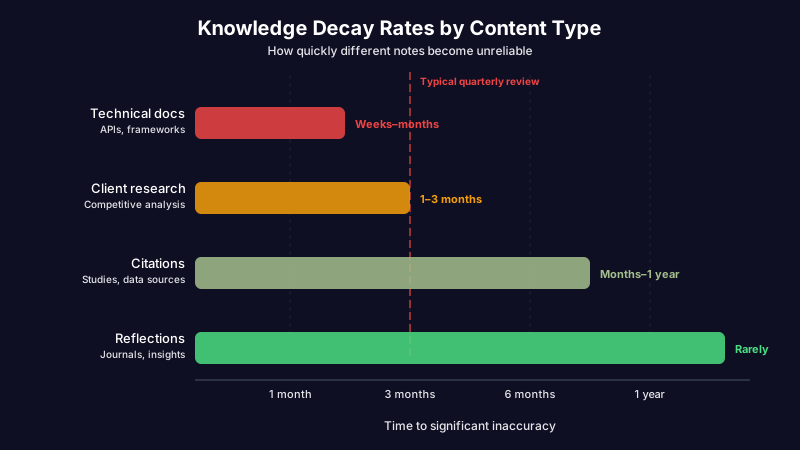
Knowledge decays at different rates depending on what you write about, and the maintenance phase matters most where decay runs fastest.
Technical documentation is the obvious case. You wrote a guide to integrating a payment API. Three months later, the API ships v3 with a new authentication flow. Your guide now teaches a pattern that returns 401 errors.
A teammate follows your guide during onboarding, spends an hour debugging, and discovers the documentation is wrong. With a living notes approach, background verification catches the API change when it ships and gives you a 30-second diff review instead of your teammate's hour of confusion.
Research work decays on a different timeline. A study you cited in a literature review gets retracted for methodological concerns. That risk starts the moment you read a paper and file it away without a way to re-check it. You don't find out until peer review, months later, after you've built analysis on a compromised foundation.
Retraction Watch reports that paper retractions have grown roughly tenfold since 2000. A living notes verification layer monitors cited sources and flags changes, including retractions, before they propagate through your work.
Client-facing research has the highest stakes per note. You pull up last quarter's competitive analysis for a new engagement. Two competitors changed their pricing since you wrote it. One launched a feature that didn't exist three months ago.
You present the analysis with minor updates, confident it's mostly right. "Mostly right" is a professional risk that compounds with every reuse. The maintenance phase catches the drift before you walk into the meeting.
Same methodology, different cadences. The way to keep notes useful long term isn't a single review schedule. It's adapting verification frequency to how fast your specific content decays.
How to keep your notes useful long term
You don't need to rebuild your system. Start with a five-note audit.
Pick five notes you've referenced in the past month. Not the oldest ones, not the most carefully organized. The ones you've actually used.
Now check them against their sources. Are the APIs still working the way you described? Do the links resolve? Has the data been updated since you cited it?
Time how long this takes.
If you're like most knowledge workers, you'll find at least one meaningful inaccuracy and spend 20 to 40 minutes verifying five notes. Multiply that across a knowledge base of hundreds of notes, and the maintenance gap becomes viscerally clear.
Once you've seen the gap, prioritize. Not all notes need the same maintenance cadence. Technical notes with external API references decay fast and need frequent checks. Personal journal entries may never go stale.
Focus maintenance effort where accuracy matters and where facts change.
The final step is automation. You can set calendar reminders and manually audit your top notes quarterly. That's better than nothing. But at the scale where a knowledge base becomes genuinely valuable, hundreds of notes accumulated over years, you need a tool that treats maintenance as a system function rather than a human chore.
Scribelet is built for this. Background verification runs on a schedule you set, surfaces diffs when your notes drift from current sources, and shows you exactly what changed with links to the updated information. Start free, run your first verification, and see your first diff. That five-minute experience will tell you more about living notes than any article can.
Notes that stay alive
The note-taking conversation has been stuck on the wrong phase. Capture tools keep improving. Organization frameworks keep getting refined. Search keeps getting smarter. None of it matters if the information you're organizing and retrieving is no longer true.
If you want to keep notes useful long term, the answer isn't better organization. It's adding the maintenance phase that every other methodology skips, and letting AI agents handle the work. Living notes addresses the actual reason people abandon their knowledge systems. Not bad organization, but eroded trust.
Every note you've written is either appreciating or decaying. The only question is whether your system knows the difference.
Start writing with background verification. Try Scribelet free.
Share this article