The commonplace book was never meant to sit still
Table of contents
Somewhere in your notes app is a passage you copied out two years ago because it felt important. A line from a book, a definition you wanted to remember, an argument you meant to use. You have not reopened it since. That is a commonplace book, and that is exactly how most of them end: full, and never read back.
The method is having a moment. Search interest in the commonplace book is up more than fifty percent year over year, and the guides all promise the same thing, that copying out the best ideas you meet will make them yours. They are half right. The copying is the easy half. What almost nobody explains is what the collection is worth once it stops growing and starts aging, which it does the moment you close the cover.
This is a guide to the method, honestly. What a commonplace book is, what goes in one, how it differs from a journal or a zettelkasten, and the one thing four hundred years of keepers have never had a good answer for: a way to read the thing back.
What is a commonplace book?
A commonplace book is a personal collection of quotes, passages, ideas, and observations gathered from your reading and experience into one place. It is not a diary of your own life. It is a curated store of other people's thinking that struck you as worth keeping, copied out in your own hand so it sticks.
The form is old. Enlightenment scholars kept them as a matter of course. John Locke published a formal indexing method for them in 1706. Marcus Aurelius, Montaigne, Francis Bacon, Thomas Jefferson, and Virginia Woolf all kept some version of one. The modern revival owes a lot to Ryan Holiday, whose essay on how and why to keep a commonplace book put index cards back in circulation, and to the plain fact that the practice predates the printing press and has outlived every note-taking fad since.
The appeal is real. Reading is leaky. You finish a book and keep maybe three ideas from it a month later, which is the whole problem of how to remember what you read. A commonplace book catches the ones you decided were worth catching, and the act of copying them out, slowly, in your own words or verbatim with attribution, does more for memory than a highlight ever will.
What should be in a commonplace book?
Anything you want to be able to find again and think with later. There is no schema. Common entries include:
- Quotes and passages that stopped you mid-page, copied with their author and source.
- Definitions of terms you want to own, in words you understand.
- Arguments and frameworks worth reusing, stripped down to their bones.
- Observations of your own that belong next to what you are reading.
- Questions a book raised that it did not answer.
The famous commonplace book examples are less orderly than you would expect. Bill Gates is known for margin notes and reading logs. Ronald Reagan kept a box of index cards with quotes and jokes. The value was never in the tidiness. It was in having one place where the good stuff accumulated, so that a decade of reading became a resource instead of a fog.
How you organize it matters less than whether you can find things again. Locke's 1706 system indexed entries by the first letter and first vowel of a keyword, an ingenious workaround for a paper book with no search bar. That constraint is gone now, and its disappearance changes the method more than most guides admit. In a digital commonplace book the index is automatic. The effort that keepers used to spend on filing can finally go to the part that was always neglected: going back to what you filed. The same shift, from filing things away to being able to ask them questions, is what lets you catalogue a collection of objects, not just a collection of ideas.
Commonplace book vs journal vs zettelkasten
People searching for the method usually want to know how it differs from the two systems next to it. The short version: a journal holds your life, a commonplace book holds other people's ideas, and the zettelkasten method holds your own ideas, developed and linked. They answer different questions.
| System | What it holds | Written by | The missing step |
|---|---|---|---|
| Journal | Your days, feelings, events | You, about you | Rarely reread |
| Commonplace book | Quotes, passages, ideas you collect | Others, curated by you | Never resurfaced or checked |
| Zettelkasten | Atomic, developed notes, linked | You, thinking | Manual linking gets abandoned |
| Digital garden | Evergreen notes grown in public | You, tending | Everyone plants, nobody weeds |
The pattern down that last column is the point. Every one of these methods is excellent at capture and organization, and every one of them stops at the same place. None of them has a built-in answer for what happens to an entry after you file it. That gap is the step every PKM system skips, and the commonplace book skips it hardest, because collection is the entire premise.
The problem nobody mentions: it is a collect-and-forget archive
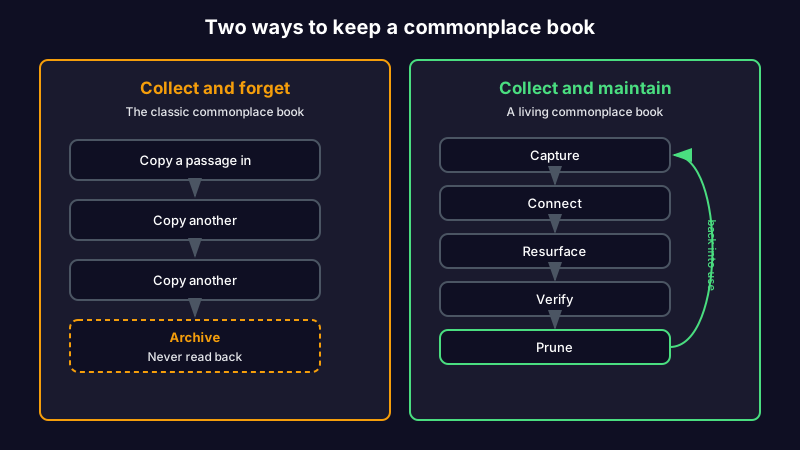
Here is the uncomfortable part the guides leave out. A commonplace book is a one-way street. Ideas go in. Almost nothing ever comes back out. You add the passage, you feel the small satisfaction of having caught it, and then it sits, unread, while you fill the next page.
Worse, the entries do not just sit still. They rot. A quote you copied is only as reliable as its source, and sources move, get corrected, get retracted, or vanish. Link rot is measurable and severe: writing in The Atlantic, Jonathan Zittrain reported that a quarter of deep links in New York Times articles were already dead, and half the links in U.S. Supreme Court opinions pointed to nothing. The passage you trusted enough to copy is aging on the page, and a paper archive gives you no way to know.
This is knowledge decay in its oldest form. The commonplace book was built to fight forgetting, and it half-succeeds: it remembers the words, but not whether the words are still true, still sourced, still connected to the thing you were thinking when you wrote them down. Adding to a collection is not the same as maintaining it, the same way adding to a garden is not the same as tending one.
The digital commonplace book makes collecting easier and forgetting worse
The obvious fix is to go digital, and most people have. A digital commonplace book, whether it lives in a plain text file, Notion, Obsidian, or a folder of Markdown, removes every bit of friction from capture. You can clip a passage in two seconds from your phone. That is genuinely better than hunting for a pen.
But friction was doing quiet work. When copying a quote cost you a minute of handwriting, you copied only what mattered. When it costs two seconds, you collect everything, and the pile grows faster than any human will ever reread it. The modern commonplace book solves the capture problem so thoroughly that it makes the real problem, resurfacing and upkeep, dramatically worse. A digital archive also hides its own staleness better than paper does. A worn notebook at least looks old. A search result looks identical whether you saved it yesterday or five years ago.
What the method has always been missing: a way to read it back
The commonplace book has needed one thing since Locke, and it is not a better way to write things down. It is a way for the collection to work while you are not looking at it. Three things, specifically.
Resurfacing. An entry you never see again might as well not exist. A living commonplace book brings old passages back into view when they are relevant to what you are reading or writing now, instead of waiting for you to remember they are there.
Connection. A quote gains meaning next to related quotes. In Scribelet, notes connect with wikilinks, and background agents propose links between entries automatically, so a passage about attention from a neuroscience book finds the one you saved from a Stoic three years earlier. The collection becomes a graph instead of a stack.
Verification. This is the part no notebook can do. Background agents search the web on a schedule you set, compare what they find against what you saved, and surface the difference as a diff, green for new information, red for what is outdated, with a source link on every change. That is how background verification works. The retracted study you quoted, the statistic that has since doubled, the framework the author later walked back: they show up as a flagged change before you build on them again.
None of this asks you to abandon the habit that made the commonplace book worth keeping. You still read, you still copy out the lines that matter, you still decide what earns a place. The difference is only in what happens next. Instead of a collection that quietly ages the moment you look away, you get one that keeps working, connecting new entries to old ones and checking that what you saved is still worth having saved.
You keep control of the AI, too. Scribelet's AI works out of the box, and you can optionally bring your own key and route through OpenAI, Anthropic, or Gemini, encrypted at rest, so your notes go to the provider you trust rather than one we picked for you.
Your best passages deserve better than a drawer. Start free, point verification at the quotes you most want to still be true, and see what a diff catches. The Pro plan is $8/mo or $79/yr when you want the full set.
How to keep a commonplace book that stays alive
The method still works. It just needs one habit the classic version never included: reading it back. A commonplace book that stays useful runs on a short loop.
- Capture the passage, quote, or idea the moment it lands, without overthinking the filing.
- Attribute it. Author, source, and a link if there is one, so the entry can be checked later.
- Connect it to what it relates to, so it lives in a web, not a list.
- Resurface it on a schedule. Let old entries come back into view rather than waiting to stumble on them.
- Verify the ones that make factual claims, so a quote whose source has changed does not sit there looking authoritative.
- Prune what no longer earns its place. A smaller collection you trust beats a huge one you do not.
Steps four through six are the ones every guide skips, and the only ones that keep the collection from becoming an archive. If you want the manual version, our thirty-minute weekly review system walks through doing it by hand.
Did Marcus Aurelius keep a commonplace book?
Not exactly, but close enough that he is always in the conversation. Meditations reads like a private notebook of borrowed and refined ideas, what the Greeks called hypomnemata, personal notes-to-self drawn from his reading and reflection. It is the spirit of the commonplace book: collecting the best of what others thought, in order to live and think better with it. The irony is that his notebook survived because it was read back, endlessly, by everyone but him.
Collect like it matters, because it does
The commonplace book is the oldest good idea in note-taking, and it has always been half an idea. Gathering the passages worth keeping is worth doing. But a collection that only ever grows is a collection that slowly stops being true, one dead link and one forgotten page at a time.
Keep the practice. Add the missing half. Let the ideas you collected come back to you, connect to each other, and get checked while you are busy reading the next thing. Start a commonplace book that reads itself back.
Share this article