Best Note-Taking App for Android (2026): 10 Rated
Table of contents
The best note-taking app for Android is a trickier question than it looks, because your phone already shipped with an answer. A Pixel hands you Google Keep. A Galaxy pushes Samsung Notes and an S Pen. Both are good enough that most people never go looking, which is exactly why the roundups full of twenty apps feel beside the point.
Two things make Android different from a Mac or a Windows list. The first is the pen. Android is where a mid-priced tablet plus a stylus quietly becomes a notebook, so handwriting apps carry more weight here than almost anywhere else. The second is the exit. Most Android note apps are built phone-first, which is lovely until the day you want the same notes open on a laptop and discover the app never really planned for that trip.
This guide takes 10 apps that hold up on Android and arranges them by the task you reach for most on a phone or tablet. If you want the one-line version, Scribelet's Free plan opens in any Android browser and keeps the same notes on everything else you own.
What actually matters in an Android note app
Any of these can catch a thought on a phone. That is the floor. Four questions decide whether you are still using the app a year from now.
Is it free, or free until the Play Store catches you? Most Android users assume the answer costs nothing, and a few apps keep that promise outright. Plenty of others wear a free label over a meter: a page ceiling on handwriting here, a sync subscription there. Check what the free tier actually includes before a growing library runs into the wall.
Does it handle a stylus? This is Android's home advantage. On a Galaxy Tab with an S Pen, or any tablet with a cheap active pen, strong handwriting support turns the slab into paper that never runs out. These apps span the range from pen-first design to a stylus treated as decoration. If you only ever type, ignore this column entirely. If you write or sketch, it is the one measure worth weighting above the rest.
Do your notes get off Android? Keep lives in your Google account, Samsung Notes in Samsung's, and both feel effortless right up to the moment you pick up a work laptop or switch phone brands. Ask the blunt version: move to an iPhone or sit down at a Windows PC next month, and do your notes follow, or are they marooned on the old handset?
Will the notes still be true later? Whatever you record stays accurate only for as long as the world holds still, which is not long. A how-to you saved in spring points at a menu that moved by autumn, a figure you copied has already changed, a link quietly dies. One app in this lineup takes that decay as its own problem rather than leaving it to you, and the Scribelet section explains how.
Quick picks for Android (2026)
Short on time? Match yourself to one of the lines below and skip straight to that app.
- Best free default: Google Keep, for fast capture if you already live in a Google account.
- Best for Samsung and the S Pen: Samsung Notes, deeply wired into Galaxy phones and tablets.
- Best handwriting-to-text: Nebo, for turning neat script into editable text.
- Best for PDFs and ink: Goodnotes, now on Android, for marking up documents by hand.
- Best free cross-platform all-rounder: Microsoft OneNote, strong and free on every device.
- Best workspace that does more than notes: Notion, for pulling tasks and databases in beside them.
- Best for notes you own outright: Obsidian or Joplin, keeping plain Markdown on the device itself.
- Best for notes that travel and stay trustworthy: Scribelet, a web app that opens in any Android browser, native on iPhone, that catches notes which have drifted into being wrong.
Every pick below comes with its argument, judged on the two measures most Android lists abandon once an app clears the does-it-run bar: whether your notes can leave the phone with you, and whether they stay correct as the months pass.
The 10 best note-taking apps for Android at a glance
| App | Platforms | Stylus | Offline | Price | Best for |
|---|---|---|---|---|---|
| Google Keep | Android, iOS, Web | Basic | Partial | Free | Fast free capture |
| Samsung Notes | Galaxy, Windows | Excellent | Yes | Free | Galaxy and S Pen users |
| Nebo | Android, iOS, Windows | Excellent | Yes | Free; paid upgrade | Handwriting to text |
| Goodnotes | Android, iOS, Mac, Win, Web | Excellent | Yes | Free tier; paid | PDFs and ink |
| OneNote | Android, iOS, Win, Mac, Web | Good | Yes | Free | Free cross-platform notebook |
| Notion | Android, iOS, Win, Mac, Web | None | Partial | Free personal; paid teams | All-in-one workspace |
| Obsidian | Android, iOS, Win, Mac, Linux | Thin | Yes | Free; Sync paid add-on | Local Markdown you own |
| Joplin | Android, iOS, Win, Mac, Linux | None | Yes | Free, open source | Local, auditable notes |
| Simplenote | Android, iOS, Win, Mac, Linux, Web | None | Yes | Free | Plain-text capture |
| Scribelet | Android (web), iPhone, Web | Typing | Yes | Free plan; paid upgrades | Cross-platform, accurate notes |
Prices move. Several of these apps changed theirs in 2026, so treat the figures as a starting point and confirm the current rate before you commit.
Fast, free capture
Google Keep
If your day already runs through a Google account, nothing pins a passing thought faster than Google Keep. It is free, opens instantly, and arranges notes as colored cards that follow you across Android, iOS, and the web, with voice capture, reminders you can hang on a time or a location, and labels for a bit of sorting. For the ten-second job on a phone it is genuinely hard to beat.
Where it runs out of room is organization. Keep gives you no nested folders, little formatting beyond lists and checkboxes, and only a clumsy path for pulling everything out at once, so a library you mean to keep and arrange quickly outpaces it. That ceiling is what sends people looking for a Google Keep alternative with somewhere for a serious pile of notes to actually live.
Simplenote
Simplenote does one thing and does it without friction: plain text that syncs everywhere, free, with no account games. It is lightweight, fast, supports Markdown preview, and runs on Android, iOS, and every desktop, so a note you start on the bus is on your laptop by the time you sit down. For capture and quick lists it is close to ideal.
What you trade is everything past plain text. No attachments, no handwriting, no rich formatting, and only the barest organization. If your notes are words and you want them portable and uncluttered, that restraint is the appeal. If they are anything more, you will feel the walls.
Handwriting and the S Pen
Samsung Notes
If you carry a Galaxy phone or tablet, Samsung Notes is already there and it is better than the default label suggests. The S Pen handwriting is smooth, it converts script to text well, it imports and annotates PDFs, records audio alongside your notes, and even folds in Samsung's own math solver. For a Galaxy owner who writes by hand, it is the app to beat.
The catch is the same gravity that makes OneNote sticky, pointed at Samsung instead. Your notes live in the Samsung account and sync cleanly across Galaxy devices, but step outside that ecosystem and the story thins quickly. The day you switch to a non-Samsung phone is the day Samsung Notes stops being the obvious choice and starts being a reason to export.
Nebo
Nebo, built on MyScript's handwriting engine, is the app to reach for when the whole point is writing by hand and getting clean text out. Its ink-to-text is among the sharpest on any platform, palm rejection is solid, and it runs on Android, iOS, and Windows, so the Galaxy Tab in your bag and the laptop on your desk can read the same notebook. There is a free version, with a paid unlock for the full set of features, so check the current terms before you lean on it.
Where it stops is breadth. Nebo is a specialist, strongest as a handwriting tool rather than a place to run your whole note life, and typing-first users will find it narrower than a general app. If your tablet and your pen are the reason you are here, that focus is exactly what you want.
Goodnotes
Goodnotes spent years as the iPad handwriting favorite, and it is now a real Android app, which changes the Android picture. It pairs natural handwriting with strong PDF annotation and document organization, so marking up a lecture slide deck or a contract by hand feels first-class rather than bolted on. It runs across Android, iOS, Mac, Windows, and the web.
The pricing is where to read the fine print. Goodnotes offers a free tier with limits and charges for the full experience, and the exact shape of that has shifted, so confirm what the free version covers before you depend on it. For stylus-first note-takers who live in PDFs, it is one of the few apps that treats Android handwriting as seriously as the pen deserves.
Cross-platform typing and workspaces
OneNote
Microsoft OneNote is the quiet workhorse of cross-platform Android notes. It costs nothing to download, puts no ceiling on how many notes you keep, takes a pen competently, sorts everything into notebooks and sections, and syncs through a Microsoft account across Android, iOS, Windows, Mac, and the web. For one free app that behaves the same on your phone and on every other machine you touch, it is the strongest choice on this list.
The price is paid in ownership. Those notebooks live in a proprietary format locked inside your Microsoft account and OneDrive, with no tidy way to carry your notes out as plain files. That lock-in is usually what prompts people to start weighing a OneNote alternative once they would rather own their notes than rent the account that holds them.
Notion
Notion is less a note app than a workspace that happens to take notes, folding documents, tasks, and databases into one structured place. On Android it holds up for reading and light editing, and for people who want a single home for a project rather than a pile of loose notes, the structure earns its keep.
Two things temper it on a phone. It leans on the cloud, and its offline mode, while it has improved, still trails local-first apps, so a flaky signal is felt, and the depth that makes it powerful also makes it heavy for a two-line grocery list. Its AI features are bundled into the paid plans. When the structure starts to feel like overhead rather than help, that is the moment people start comparing a Notion alternative built for faster capture.
Notes you own as files
Obsidian
Obsidian keeps your notes as plain Markdown files in a vault on the device, which is the whole pitch: your writing is yours, in a format that will still open in a decade. The Android app is capable, the linking and plugin ecosystem is deep, and nothing lives in someone else's cloud unless you choose to put it there.
The legwork is real, though. Syncing a vault between your phone and a laptop means either paying for the Obsidian Sync add-on or stitching together your own cloud folder, and the pen support is slight, so handwriting devotees should keep moving. The upside is permanence: a vault is nothing but Markdown, so your writing stays portable whatever happens to the app, which is the same reason Obsidian tops our roundup of Markdown note-taking apps.
Joplin
Joplin is the open-source answer for people who want local notes and want to see the code behind them. It stores Markdown on the device, runs on Android and every desktop, and offers optional sync through your own choice of cloud, so you can keep everything auditable and off anyone else's servers. For a privacy-minded note-taker it is a clean, free foundation.
The trade is polish and convenience. The interface is functional rather than beautiful, there is no serious handwriting, and the self-directed sync asks a little setup. If you value transparency and control over a frictionless first run, Joplin repays the effort.
The note app that keeps your notes honest
Scribelet
Scribelet takes the bet that no single phone brand should own your notes. Rather than ship a native Android app, it loads in any Android browser as a full web app, with offline support, search, and a proper sidebar, and it is native on iPhone, with the identical notebook waiting in a browser on Windows and Mac. Switch handsets, borrow a laptop, swap ecosystems entirely, and nothing moves except the screen. What you are trading away is a dedicated Android binary and real pen support; what you get back is a note that is never tied to the device it was born on.
The reason it belongs on an Android list has nothing to do with ink. Scribelet runs AI agents in the background that compare what you wrote against the live web and raise a hand over any note that has quietly gone stale or wrong, handing you a fixed version to accept with one tap. The whole vault sits behind AES-256-GCM envelope encryption, and there is a genuine free plan. If the worry keeping you up is not which app draws the prettiest handwriting but whether the note you trusted last January is still accurate, that is the exact hole it fills.
The question the AI overview skips
Type "best note-taking app for Android" into Google and a neat shortlist appears above the results, bucketed into handwriting, quick capture, and Samsung. All of those apps, and all ten above, answer one question: where does the text go? Not one of the Android-native ones answers the harder follow-up: once it is saved, how do I know it is still correct?
A note is a photograph of what was true the moment you took it, and moments pass. The setup you captured in March runs into a redesigned screen by October. The pricing on this very page was the first thing we had to soften, because several of these apps have quietly changed theirs this year. Repeat that across a couple hundred entries and a tidy board of Keep cards slowly fills with claims that are stated with confidence and simply no longer true, and no app on this list so much as blinks.
That steady erosion is what we mean by knowledge decay, and it is the reason Scribelet treats accuracy as a first-class feature rather than your weekend chore. For anyone picking a note app to keep for years rather than weeks, "will it tell me when a note goes wrong" earns a spot on the checklist alongside price and pen support.
How to choose your Android note app
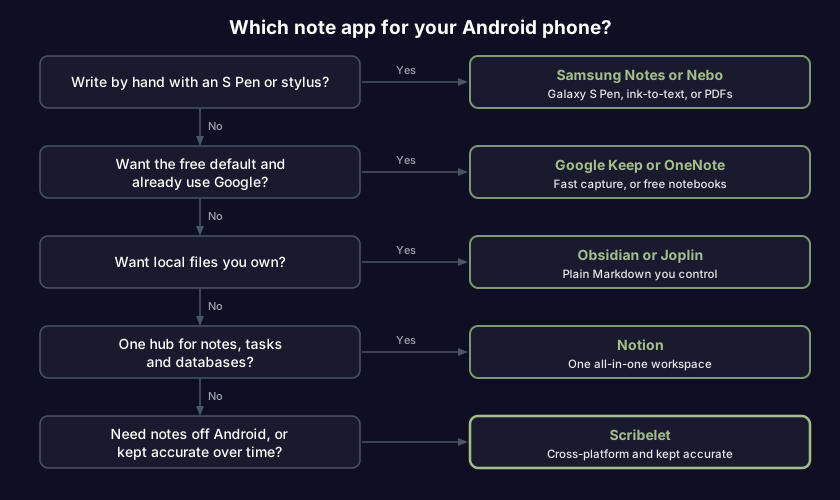
Work down the list and stop at the first yes:
- Is a stylus the whole point? Reach for Samsung Notes on a Galaxy, Nebo when you want script turned into clean text, or Goodnotes when most of your writing lands on top of a PDF.
- Do you want the free default and already use Google? Keep covers quick capture; step up to OneNote when you want real notebooks and pen support without paying.
- Do you want your notes as plain files on your own device? Obsidian or Joplin, accepting that sync and first setup take a bit of fiddling.
- Do notes, tasks, and a database need to sit under one roof? Notion, provided you can tolerate its cloud dependence and thin offline mode.
- Do your notes have to leave Android, or stay reliably correct? Scribelet, opened in the browser on your phone, native on your iPhone, watching for notes that have gone out of date.
Jumping between more than one gadget? Our broader guide to cross-platform note-taking apps weighs the same field on sync and offline behavior for people who move between a phone, a tablet, and a laptop. If your other main machine is a PC, the desktop companion is our best note-taking app for Windows roundup, and if it is a Chromebook, our best note-taking app for Chromebook roundup rates the same field on how each one reaches Chrome OS.
Frequently asked questions
What is the best free note-taking app for Android? For quick capture, Google Keep; for a structured, cross-platform notebook with no cap on how much you store, OneNote. Obsidian and Joplin are also free if you want plain files you control, and Simplenote is free for bare plain-text. In practice the best free app is whichever one you actually leave running.
What is the best Android note app with a stylus? On a Galaxy with an S Pen, Samsung Notes is the natural home. For converting handwriting into editable text, Nebo is the sharpest, and Goodnotes is the one to pick when your writing mostly happens on top of PDFs. All three were built around the pen, where a typing-first tool like Notion treats it as an afterthought.
Does Android have a built-in notes app? That depends on who made the phone. Galaxy devices come with Samsung Notes preinstalled, while a lot of other Android phones fall back on Google Keep through the Google account already signed in. Either is fine for catching a thought; the jump to an app above usually happens when you need serious organization or your notes on something that is not that phone.
Which Android note app is best if I might switch to an iPhone later? Anything that is not chained to one phone maker: OneNote, Notion, Obsidian and Joplin (the files come with you), Simplenote, or Scribelet, which is native on iPhone and a browser app everywhere else. The ones that hurt to leave are tied to a single vendor account, so if a future switch is even possible, cross those off early.
Almost every app here is good at the thing it set out to do. The real decision is which tradeoff you are willing to accept: Keep's instant free capture, a Galaxy and its pen, files that stay on your own device, or notes that reach every screen and quietly correct themselves when the facts move. If that last one is the problem you keep hitting, try Scribelet free and keep your Android notes honest wherever you open them.
Share this article