What is Scribelet?
Updated 2026-03-30
Table of contents
Most note-taking apps treat AI as a bolt-on: a chatbot sitting in a sidebar, disconnected from everything else. Scribelet is different. AI runs through every feature: verifying your facts, discovering connections between notes, learning your vocabulary, and building a memory of your work that improves over time.
The result is a notebook that doesn't just store your thinking; it actively maintains and extends it.
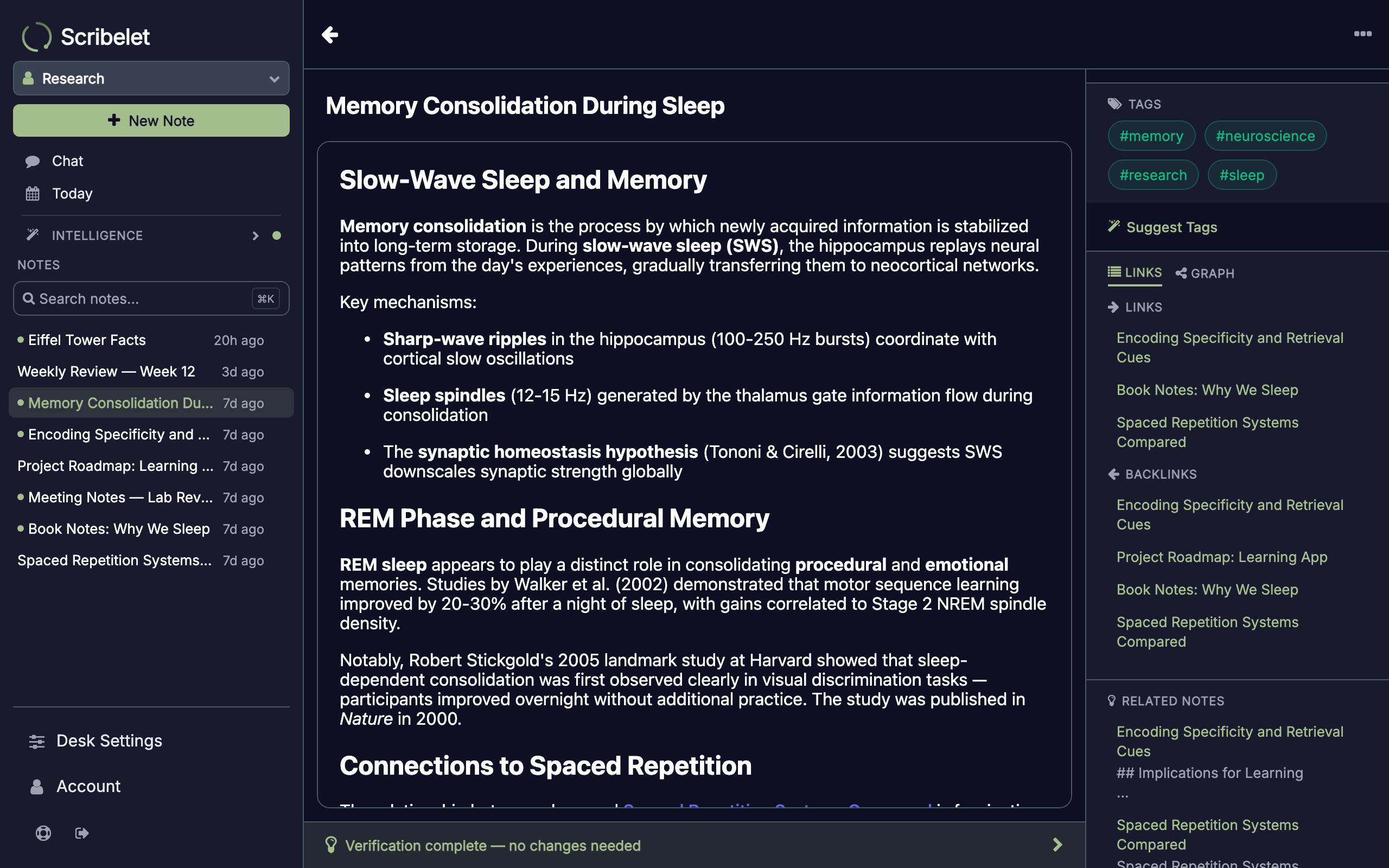
Verify your facts with AI
Write a note with claims, statistics, or technical details, and Scribelet's background checks will search the web for evidence supporting or contradicting what you wrote. Each claim gets a verdict (supported, contradicted, or unverifiable) with source links so you can check for yourself.
When a fact needs updating, you get a diff view showing exactly what changed and why. You can accept corrections with one tap or dismiss them if you disagree. Schedule checks to run automatically, or trigger them on demand. Notice the "Suggested updates available" banner at the bottom of the screenshot above; that's verification at work.
This isn't a grammar checker or a plagiarism detector. It's a research assistant that monitors your notes against current sources and flags when knowledge decay has made what you wrote outdated.
Ask your notes anything
Scribelet's AI chat doesn't just generate text. It searches your notes, reads the relevant ones, and gives you cited answers grounded in your own knowledge base. Ask "what did I write about competitor pricing?" and you'll get a summary with links to the specific notes it drew from.
The chat has memory. It learns the facts, terminology, and relationships from your notes and conversations, so responses get more contextual over time. It remembers what you discussed last week and can pick up where you left off. You can bring your own API keys for OpenAI, Anthropic, or Google Gemini: your keys, your models, your data.
Discover connections you'd never find
Most note-taking apps only surface connections you explicitly create. Scribelet finds the ones you missed.
The auto-linker scans your notes for semantic relationships and suggests wikilinks between them. The stale checker identifies notes that need attention: not just because they're old, but because you're actively working in the same space. Weekly insights emails summarize what changed, what connected, and what needs review.
Every morning, a daily digest surfaces the most interesting connections and updates from across your workspace. It's like having a research assistant who reads all your notes overnight and gives you a briefing.
Speak and get a structured note
Record a voice memo and Scribelet transcribes it with Deepgram Nova, then structures the result into a proper note: title, headings, tags, and action items. Because AI memory already knows your projects and terminology, transcription handles your jargon accurately.
Voice recordings are processed in memory and never written to disk. The structured note appears in your workspace ready to edit, link, and verify like any other note.
Your eyes only
Every note is encrypted at rest with AES-256-GCM using per-desk keys. Even if someone accessed the database directly, your notes would be unreadable without your encryption key.
Authentication supports passkeys and two-factor authentication. If you use your own API keys for AI features, those are encrypted with the same envelope encryption scheme. Scribelet never sees them in plaintext.
This isn't "we encrypt the database" security theater. It's per-desk envelope encryption where each desk gets its own data encryption key, wrapped by a master key you control.
Available everywhere
Scribelet runs on the web and iOS, with Android in development. Your notes sync across devices in real time through event sourcing. Every edit is an event, so nothing gets lost and you can always see the full history of a note.
Already have notes elsewhere? Import from Obsidian vaults or Evernote exports. Want to leave? Export everything to Markdown any time. No lock-in.
For developers and power users, Scribelet offers an MCP server that lets AI tools like Claude Code and Cursor read and search your notes directly.
Free to start
Scribelet has a genuinely generous free tier. AI isn't locked behind a paywall; the free plan includes it with daily limits, and Pro is for higher limits and the always-on automation:
- Free: Unlimited notes, AI chat, AI tag suggestions, note processing, semantic search, on-demand fact verification (all with daily limits), full encryption, and BYOK with your own API key for unlimited AI
- Pro ($8/mo or $79/yr): Higher and unlimited AI limits, the stronger chat model, voice notes, automatic background verification, and always-on intelligence (auto-linker, daily digest, weekly insights, memory consolidation)
- Team: Everything in Pro, plus shared desks and collaboration
See pricing for full plan details.
Next steps
Ready to get started? Sign up free and create your first desk, it takes under a minute! To understand how desks, wikilinks, tags, and memory fit together, read Core Concepts. For a deeper look at how knowledge decay works and why it matters, read why your notes are silently going stale.